A coloring page can be more than a quiet-time activity—it can open a thoughtful, age-appropriate conversation about history, freedom, and community. Use the Cultures in the Classroom course  Buy Now $24.00 to build practical knowledge for honoring diversity and fostering acceptance, then adapt the strategies below to your group. For another way to strengthen culturally responsive curriculum planning, explore From Play to Planning: Building Culturally Competent, Child-Centered Curriculum Buy Now $55.00.
Why can a coloring page be a useful starting point for Juneteenth learning?
Young children often begin with what they can see and describe. A coloring page offers a concrete image to notice together, while an educator’s careful prompts can connect that image to ideas such as freedom, fairness, family, and community. The page is not the history lesson by itself; it is an invitation to talk, wonder, and learn.
Juneteenth commemorates June 19, 1865, when enslaved people in Galveston, Texas, learned of their freedom, more than two years after the Emancipation Proclamation was issued. This history carries great significance, so providers should avoid reducing the day to a decorative theme or presenting it as a generic celebration. For young children, educators can offer a brief, truthful explanation and center dignity, resilience, and the importance of fairness. The National Park Service overview of Juneteenth provides historical context for staff planning.
Using art as a starting point also supports children who communicate in different ways. Some may ask questions, some may share a story, and others may prefer to listen or draw. These varied responses are all valid ways to participate. A thoughtfully chosen #coloring activity can support language, fine-motor practice, and a welcoming classroom #community while making room for children’s curiosity.
How should educators prepare the coloring page and conversation?
Begin by reviewing the page before sharing it. Consider what its images communicate, whether they are respectful and clear, and what children might reasonably infer. If a symbol could be misunderstood or carries a meaning you cannot explain accurately, choose a different page or provide suitable context. The ChildCareEd Juneteenth Count and Color resource Buy Now $0.25 is one example of a printable that combines coloring with simple counting, but any printable should be used as one part of a broader learning experience.
Set a small learning intention: children will hear that Juneteenth is a day many people celebrate freedom and remember an important part of history. Keep the explanation clear and brief. For example: “Juneteenth is a day when many people celebrate freedom. It remembers when Black people who had been enslaved in Texas learned they were free. We can also think about fairness and how we care for one another.”
- Gather crayons or other accessible art materials, plus a picture book or image for context.
- Plan two or three open-ended prompts, rather than a long set of facts.
- Offer children a choice to color, draw, talk, listen, or take a break.
- Check that images show people with dignity and avoid stereotypes or caricature.
- Prepare a brief response for questions that may need a family follow-up.
It can help to coordinate staff language in advance. When adults use consistent, accurate phrasing, children receive a steadier message and educators feel more prepared to respond with care.
What questions can turn coloring into an age-appropriate history conversation?
Start with observation before interpretation. Ask what children notice in the picture: “What do you see?” “What might be happening?” or “What colors or details stand out to you?” Children’s answers show what they are attending to and give educators a natural bridge to the topic. Avoid quizzing children for a “right” answer or assuming they understand a symbol in the same way adults do.
Then connect the image to a simple historical idea. If the picture shows people together, an educator might say, “Juneteenth is connected to a time when Black people in Texas learned they were free. Many people remember this day and celebrate freedom and community.” Explain that freedom means being able to live without being enslaved and having important choices and rights. Keep descriptions truthful, but do not introduce graphic details that are unnecessary for the age group.
Useful prompts include:
- “What do you think the people might be feeling?”
- “What does it mean for people to be treated fairly?”
- “What helps our classroom feel welcoming to everyone?”
- “What would you like to draw or tell about community or celebration?”
Make room for silence and different perspectives. A child may ask why people were enslaved or why freedom came later in Texas. Respond simply and honestly: “Long ago, Black people were forced to live and work without freedom. That was wrong. Juneteenth remembers an important moment when people in Texas learned they were free.” If you do not know an answer, say so and follow up with a reliable source or family partnership rather than guessing. Conversations grounded in respect help children approach #history with curiosity and care.
How can providers adapt the activity for different ages and abilities?
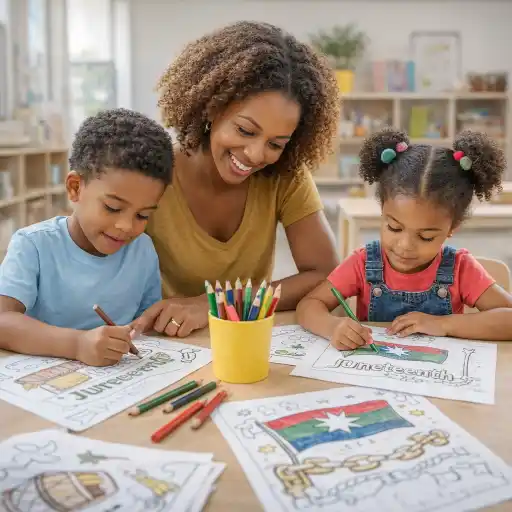
Adapt the experience to children’s developmental stages, attention, communication styles, and motor abilities. For infants and young toddlers, the page may be a visual prompt for shared attention rather than a task to complete. An educator can name a few visible details, use a gentle tone, and offer large crayons or a sensory-safe alternative while closely supervising materials.
Older toddlers may benefit from a short introduction followed by a choice of coloring or free drawing. Preschoolers can engage with a brief read-aloud, a simple historical explanation, and a few minutes of conversation before creating. Keep group discussion manageable; children can return to the topic later through books, dramatic play, music, or collaborative art.
- Use larger printouts, thick crayons, adaptive grips, or a slanted surface when helpful.
- Let children dictate a caption if writing is not yet accessible.
- Provide a non-coloring option, such as choosing a picture, describing it, or listening.
- Allow movement and breaks; participation should not depend on sitting still or finishing a page.
- Focus on process and children’s words rather than matching an adult’s example.
Observe what children say and do: their questions, interpretations, emotional cues, and preferred ways to participate can guide what comes next. A finished page is not a measure of historical understanding. For broader strategies to nurture inclusive, open-ended art, educators may explore Art from the Heart for Preschoolers Buy Now $35.00.
How can coloring connect to books, families, and fuller learning?
Follow the page with materials that give the conversation depth and context. A carefully selected picture book can introduce the history through age-appropriate language, while songs, oral storytelling, and community art can show that Juneteenth is remembered through many forms of cultural expression. Historical context matters: Juneteenth grew from the experiences and commemorations of Black communities, and it should not be treated as an invented classroom theme or reduced to color choices and decorations.
Invite family participation with an optional, respectful message. Ask whether families would like to share a book, song, story, or perspective; do not expect any child or family to represent an entire culture or take responsibility for teaching the group. Offer different ways to contribute, including a note, a recorded greeting, or simply sharing a resource recommendation.
To extend the activity, children can dictate captions about what they noticed, make a collaborative mural about community, or compare how different people in a story respond to an important event. Keep children’s words attached to their artwork so their thinking—not only the finished product—is visible. The ChildCareEd guidance on honoring Juneteenth in age-appropriate ways offers further ideas for short, respectful activities and family partnership.
As you plan, reflect on whose stories are present in your classroom throughout the year, not only in June. If an activity involves visitors, food, or a family event, follow program policies and remember: state requirements vary - check your state licensing agency. Respectful #families partnerships and sustained representation make a single printable part of a larger commitment to belonging. For context on other observances that may be meaningful to families, see this overview of Shavuot, Eid al-Adha, and Juneteenth in early childhood education.
What common pitfalls should educators avoid?
Good intentions are a strong beginning, but a few common approaches can unintentionally flatten history or make children uncomfortable. The goal is not to avoid hard history altogether; it is to offer truthful, developmentally appropriate context without overwhelming young learners. Staff can support one another by reviewing materials and agreeing on language before the activity.
- Using coloring as the whole lesson: Pair it with context, conversation, and another meaningful resource such as a book or story.
- Focusing only on celebration: Acknowledge that Juneteenth remembers emancipation and Black communities’ continued work, resilience, and traditions.
- Overloading children with historical detail: Share a concise explanation and answer follow-up questions honestly at the child’s level.
- Assigning fixed meanings to pictures: Ask children what they notice before explaining what an image may represent.
- Expecting a child or family to speak for a whole community: Invite contributions without pressure and use reliable resources to support staff learning.
- Judging learning by the finished artwork: Listen to children’s ideas, questions, and choices instead.
Afterward, use a short staff reflection: Did our words accurately honor the history? Did all children have meaningful ways to participate? What questions came up, and what should we learn or prepare before the next conversation? Professional learning can help teams build confidence in these decisions. In addition to the course linked above, consider Strength in Differences: Cultural Diversity Buy Now $24.00, Equity-Centered Communication in ECE Buy Now $55.00, and Diversity, Equity, and Inclusion in Education Buy Now $16.00. Together, these courses offer professional learning related to cultural responsiveness, inclusive practice, and communication with families.
Conclusion: How can a coloring page open a meaningful Juneteenth conversation?
A Juneteenth coloring page can open a door to historical learning when educators use it intentionally: provide a short, truthful introduction; invite children to notice and wonder; adapt participation to different ages and abilities; and connect the art to stories, community, and family voices. The page is a prompt—not a substitute for historical context or respectful teaching.
Keep the emphasis on freedom, fairness, dignity, and community while honoring Juneteenth’s specific history and significance to Black communities. Listen to children, respond honestly within their developmental needs, and reflect as a team about how to improve. With preparation and care, a simple art activity can help children build language, curiosity, and a sense that every person belongs. For deeper support in bringing culture and diversity into everyday practice, explore ChildCareEd’s Cultures in the Classroom Buy Now $24.00 course.
- Many Colors, One Canvas: MD ECE Conference
- From Play to Planning: Building Culturally Competent, Child-Centered Curriculum
- Power of Art: Bldg Self-Esteem & Positive Behavior for ALL Abilities
- Children at the Wheel: Emergent Curriculum
- Setting the Stage: Story Time
- Texas Director Credential
- Montessori Cultural Activities: Exploring the World Through Play and Learning
- A Guide to Effective Communication
- Moving About the Classroom: Effective Transitions for Everyday
- Juneteenth History and Activities
- Celebrate Juneteenth in Baltimore
- CDA Certification en Español: Recursos y Consejos para Educadores Bilingües
- 👶😴¿Es Normal que los Niños Griten o Lloren al Despertarse?
- 10 Ejemplos de Cómo la Cultura Influye en el Desarrollo Infantil
- Proporciones de Cuidado Infantil y Tamaños de Grupo por Edad en Virginia (Guía Rápida para Centros y Hogares)
- Retraso del Habla en la Guardería: Cómo Pueden Ayudar los Proveedores
- Cómo Trabajar en el Cuidado Infantil en Carolina del Norte: Requisitos y Pasos
- Teaching Kids About Juneteenth Through Activities and Crafts
- Celebrando la amistad en el cuidado infantil durante el Día de los Mejores Amigos
- Canciones, juegos y preguntas de círculo para niños
- Cómo simplificar la capacitación para sus empleados de daycare
- How can child care programs honor Juneteenth in age-appropriate, respectful ways?
- How Can Early Childhood Programs Introduce Juneteenth in Developmentally Appropriate Ways?
- How Can Child Care Programs Celebrate Juneteenth Through Respectful, Child-Centered Art?
- How Can Coloring Pages Spark Meaningful Historical Conversations About Juneteenth?
- How Can Juneteenth Symbols Build Visual Memory in Young Children?
- How Can Meaningful Juneteenth Vocabulary Support Early Writers?
- How Can Drawing and Dictation Help Children Respond to Juneteenth?
- ¿Todos los niños deben participar en el tiempo de círculo?
