When children draw what freedom, fairness, or community means to them, their ideas can open the door to thoughtful Juneteenth learning. The Juneteenth Writing & Drawing Buy Now $0.25 resource offers a simple way for children to complete sentence prompts and illustrate their thinking, while Cultures in the Classroom  Buy Now $24.00 can help educators deepen their approach to cultural understanding and acceptance.
Juneteenth offers child care providers an opportunity to acknowledge Black history and explore ideas of freedom, fairness, resilience, and community with young children. Drawing and dictation make space for children to respond in ways that fit their developmental and language abilities: one child may draw a family celebrating, another may dictate a sentence, and another may prefer to listen and observe. The aim is not to produce matching artwork or expect children to master complex history in one lesson. It is to offer accurate context, meaningful expression, and attentive listening.
Why do drawing and dictation matter for Juneteenth learning?
Young children often communicate ideas before they can write them independently. Drawing allows them to represent people, feelings, events, and hopes visually; dictation lets an educator record the child’s own words alongside the image. Together, these modes support fine-motor practice, vocabulary, narrative development, and a sense that a child’s perspective matters. The adult’s role is to document rather than interpret or correct every detail.
This practice also makes room for variation. Children may bring different prior knowledge, home languages, family traditions, and comfort levels to a Juneteenth conversation. A child who does not want to speak can participate through a picture or by listening. A child who uses another language can dictate in that language, with family or staff support when available. This flexibility can strengthen belonging and reinforce that learning communities value many forms of expression.
Juneteenth commemorates June 19, 1865, when news of emancipation reached enslaved people in Galveston, Texas, more than two years after the Emancipation Proclamation was issued. For a preschool audience, offer concise, truthful context and center the humanity of the people whose freedom was delayed. The National Museum of African American History and Culture’s children’s Juneteenth guide offers support for age-appropriate conversations about slavery and freedom.
How can educators explain Juneteenth before children create?
Begin with a brief explanation, then invite children to respond. Language can be simple without making history inaccurate or suggesting that everyone’s experience was the same. For example: “Juneteenth is a day when we remember that enslaved Black people in Texas learned they were free on June 19, 1865. We honor their freedom and remember that fairness and freedom matter.” Adjust the wording to children’s ages and the context of your program, and be ready to answer questions honestly in developmentally appropriate terms.
Keep the introduction short and leave time for children’s own questions. Avoid asking children—especially Black children—to speak for a whole community or share personal experiences. Rather than rushing to reassure or changing the subject, acknowledge feelings and provide a clear, calm response. If you do not know an answer, tell children you will learn more and follow up.
- Read a thoughtfully selected picture book by or about Black people and discuss what children notice.
- Introduce a few accessible ideas, such as freedom, family, fairness, community, and celebration.
- Invite children to speak, draw, gesture, dictate, or simply listen.
- Connect the discussion to a broader classroom commitment to respecting one another, not only to a single holiday.
Thoughtful representation throughout the year matters, too. A culturally responsive approach to teaching encourages educators to consider whose experiences, stories, and contributions appear in daily classroom materials and conversations.
How can you guide a drawing-and-dictation activity?
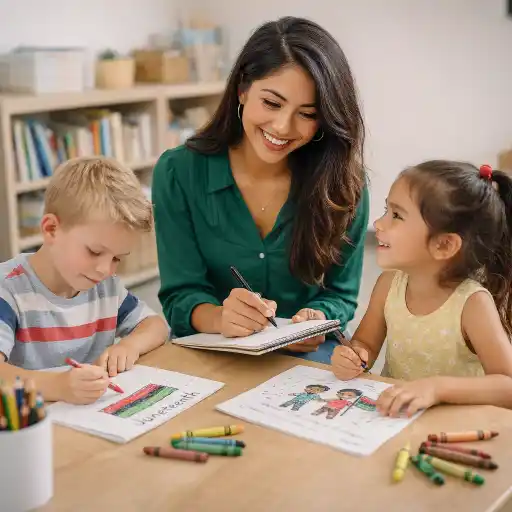
Prepare a calm, welcoming space with paper, crayons or markers, and a few optional visual prompts, such as pictures of families, community gatherings, music, or people helping one another. Introduce the activity as an invitation—not a test of what children know. The ChildCareEd Juneteenth Writing & Drawing Buy Now $0.25 resource uses simple sentence completions about freedom and kindness followed by drawing. Use its prompts as a starting point, adapting them to your group and the conversation you have already had.
- Offer an open invitation: “Would you like to draw something that helps people feel free, cared for, or connected?”
- Give children time to make choices about colors, materials, and subject matter. Avoid providing a model that everyone is expected to copy.
- Ask open-ended questions, such as “Tell me about your picture” or “What would you like me to write?”
- Write the child’s words as spoken, then read the caption back and ask whether it reflects what they meant.
- Offer participation alternatives, including dictating without drawing, drawing without dictation, or observing.
Use the finished work to notice children’s communication and interests, not to judge whether an image is historically precise or artistically polished. One child may draw a heart and say “kindness”; another may draw friends holding hands. Record their meanings in their own words. This honors children’s perspectives without imposing a single interpretation on their art.
How can dictation strengthen language and emergent literacy?
Dictation makes the connection between spoken language and print visible. As you write a child’s sentence, you can say the words slowly, point to the text, and read it aloud afterward. This models that writing carries meaning, that words can be revisited, and that a child’s ideas deserve to be preserved. The interaction can also expand vocabulary and narrative: “You said the family is celebrating. What do you want readers to know about the celebration?”
Keep the exchange conversational and responsive. Avoid turning the moment into a quiz or correcting grammar, pronunciation, or word choice unless a child asks for help. Preserve the child’s meaning and voice; if clarification is needed, ask rather than assume. For children who communicate through gestures, picture choices, assistive communication, or home languages, use the communication method that works best for them.
- For younger children: Accept a word, sound, gesture, or brief phrase and record it with the drawing.
- For children ready for longer stories: Invite a beginning, a detail, or a feeling without requiring a set structure.
- For multilingual learners: Welcome home-language dictation and seek family or interpreter support for translation when useful.
- 📚 Gather individual pages into a class book so children can revisit one another’s ideas and hear their words read aloud.
Review the documentation respectfully before displaying it. Ask children for permission when appropriate, and follow program expectations for sharing children’s work and names. A caption should illuminate a child’s meaning, not speak for the child.
How can educators keep the activity respectful and inclusive?
Respectful Juneteenth learning is more than a themed art project. Provide a brief historical foundation, use reliable resources, and avoid reducing the holiday to decorations, food, or a generic message about being nice. Include Black voices and stories in classroom materials throughout the year, and make space for Black joy, family, creativity, resilience, and community—not only accounts of suffering. The goal is honest, child-centered learning that recognizes Juneteenth’s history and significance. For ideas on connecting Juneteenth with other cultural observances, see this overview of Shavuot, Eid al-Adha, and Juneteenth in early childhood education.
Common pitfalls often arise when adults feel pressure to make a complex history easy. Do not imply that slavery ended everywhere at one instant in 1865 or that all families observe Juneteenth in the same way. Avoid assigning children to represent a culture, asking them to disclose family histories, or treating a worksheet as a substitute for context and conversation. Invite families to contribute a book, song, or perspective only if they wish; participation should be optional and should not place the teaching burden on them.
- Choose accurate, age-appropriate materials and review them before presenting them.
- Let children decide whether to share their work publicly; offer private or small-group options.
- Notice whose stories are absent from the curriculum and make intentional changes over time.
- When planning food, visitors, or special events, state requirements vary - check your state licensing agency and follow program policies.
For professional learning, Strength in Differences: Cultural Diversity Buy Now $24.00, Diversity, Equity, and Inclusion in Education Buy Now $16.00, and From Play to Planning: Building Culturally Competent, Child-Centered Curriculum Buy Now $55.00 offer related perspectives for strengthening inclusive classroom practice. Confirm with your state licensing agency or professional registry whether a course meets a particular training requirement.
Conclusion: What should providers take away?
Drawing and dictation offer children a meaningful way to express what they are thinking and feeling about Juneteenth. When educators provide accurate, age-appropriate context, invite rather than demand participation, and document children’s own words, the activity can support early literacy, creativity, and belonging. The artwork is not the whole lesson; relationships, historical truth, and thoughtful representation give it meaning.
Use open-ended prompts, welcome different forms of communication, and listen carefully before labeling or displaying children’s work. Keep Juneteenth in a wider commitment to inclusive, culturally responsive learning throughout the year. With intentional preparation and respect for children’s voices, providers can help young learners engage with the holiday in a way that is both joyful and grounded in its history.
- CDA Home Visitor Subject Area 3 Part 3 Birth to 5
- Birth to Five CDA Credential with Portfolio Review
- CDA Bridge Bundle: Family Child Care without Portfolio Review
- CDA Bridge Bundle: Infant/Toddler without Portfolio Review
- CDA Bridge Bundle: Preschool without Portfolio Review
- Every Moment Matters: Schedules and Transitions
- CDA Certification en Español: Recursos y Consejos para Educadores Bilingües
- 🔍 ¿Qué ves cuando observas a un niño aprender?
- 💛🧩 ¿Cómo puedo hacer que mi enseñanza sea inclusiva para los niños con autismo?
- Proporciones de Cuidado Infantil y Tamaños de Grupo por Edad en Nueva Jersey (Guía Rápida para Centros y Hogares)
- Proporciones de Cuidado Infantil y Tamaños de Grupo por Edad en Virginia (Guía Rápida para Centros y Hogares)
- Lista para Guardería en Casa en Illinois: Cómo Iniciar una Guardería en el Hogar
- Apoyo en Preescolar para Retrasos del Habla: Estrategias Simples que Ayudan
- Retraso del Habla en la Guardería: Cómo Pueden Ayudar los Proveedores
- Cómo Trabajar en el Cuidado Infantil en Carolina del Norte: Requisitos y Pasos
- Teaching Kids About Juneteenth Through Activities and Crafts
- Celebrando la amistad en el cuidado infantil durante el Día de los Mejores Amigos
- Canciones, juegos y preguntas de círculo para niños
- Cómo simplificar la capacitación para sus empleados de daycare
- How can child care programs honor Juneteenth in age-appropriate, respectful ways?
- How Can Early Childhood Programs Introduce Juneteenth in Developmentally Appropriate Ways?
- How Can Child Care Programs Celebrate Juneteenth Through Respectful, Child-Centered Art?
- How Can Coloring Pages Spark Meaningful Historical Conversations About Juneteenth?
- How Can Juneteenth Symbols Build Visual Memory in Young Children?
- How Can Meaningful Juneteenth Vocabulary Support Early Writers?
- How Can Drawing and Dictation Help Children Respond to Juneteenth?
