Teaching self-regulation is not limited to one lesson—it develops through the predictable rhythm of a child’s day. This article gives child care providers and directors practical, evidence-informed strategies for weaving emotional coaching, calming practices, movement, waiting, turn-taking, and problem-solving into arrival, meals, cleanup, transitions, play, rest, and departure. It also explains how consistent timing, visual cues, simple language, and coordinated staff responses help children gradually manage attention, impulses, emotions, and behavior. To strengthen staff practice, explore ChildCareEd’s self-paced online course Self-Regulation & Change: Helping Children Cope  Buy Now $16.00, which focuses on consistent routines, responsive care, transitions, prosocial behavior, and strategies for fostering self-regulation. Programs can also benefit from Every Moment Matters: Schedules and Transitions Buy Now $55.00, which helps educators design predictable schedules and smoother transitions that support children’s emotional security and successful participation. By embedding short coaching moments and repeated practice into familiar routines, teams can help children build self-regulation skills they can use across settings. Remember that state requirements vary, so always check with your state licensing agency.
Why it matters
1) Children with consistent routines show better attention and fewer disruptive moments; predictable patterns reduce stress and free adults to teach, not manage. See the research- and practice-focused guidance at the Center on the Social and Emotional Foundations for Early Learning (Helping Children Understand Routines and Classroom Schedules) and ChildCareEd’s practical summaries (How Do I Create Healthy Routines).
2) Small, repeated micro-practices (1–5 minutes) produce measurable gains in attention, impulse control, and emotional coping—especially when staff and families use the same words and visuals (ChildCareEd: Which activities and routines best help...).
1) How do daily routines actually teach self-regulation?
Answer: Routines reduce cognitive load and create repeated practice windows where adults can scaffold attention, inhibit impulses, and rehearse calming strategies.
- 🧭 Predictability: Visual schedules and a consistent order of activities let children anticipate what comes next, lowering anxiety and enabling better impulse control. See ChildCareEd’s schedule guidance (How to Create a Classroom Schedule).
- 🧠 Distributed practice: Short, daily moments (e.g., a 60‑second breath before snack) turn skills into habits—this is backed by classroom intervention studies on mindful breathing and emotion exploration (emotion exploration study).
- 🤝 Co-regulation: Adults model calm (name feelings, slow voice, breathe together). Repeated co-regulation supports children’s internal control systems described in ChildCareEd’s primer (How to Promote Self-Regulation Skills).
Practical tip: Teach steps when children are calm (not during meltdowns). Use short scripts and the same cue across staff—this builds shared language for #preschoolers and reduces confusion.
2) What simple routines and micro-activities work best each day?
Answer: Combine 1) transition cues, 2) brief games to practice stopping and waiting, and 3) short calming rituals—each repeated and predictable.
- 😊 Morning check-in (1–3 minutes): feelings cards or a quick “face check” at circle—builds emotional vocabulary and empathy (ChildCareEd routines & empathy).
- 🎵 Transition rehearsals (30–90 seconds): countdowns, a consistent song, or a visual timer before moving—use CSEFEL tips for transitions (Helping Children Make Transitions).
- 😮💨 Micro-breath or movement breaks: 30–90 seconds of bubble breaths, 5-finger breathing, or a quick heavy-work task (carrying books) to reset energy—see ChildCareEd on sensory breaks and heavy work (What Are Sensory Breaks and Heavy Work Activities Buy Now $0.00).
- 🧩 Short play games (2–5 minutes): Red Light/Green Light, Freeze Dance, Simon Says to practice inhibition and attention.
- 📚 Story pauses: ask “How might she feel?”—a low-pressure way to train perspective-taking.
Implementation checklist (3 steps): 1) Pick 2 micro-tools to pilot this week; 2) build them into the schedule at reliable moments (arrival, before lunch, transitions); 3) use the same script and visual each day.
3) How do we teach calming skills inside routines so children really learn them?
Answer: Use brief, scaffolded practice, model co-regulation, and build repair conversations after calm.
- 🔁 Practice when calm: Rehearse balloon breaths, turtle technique, and breathing buddies during circle time
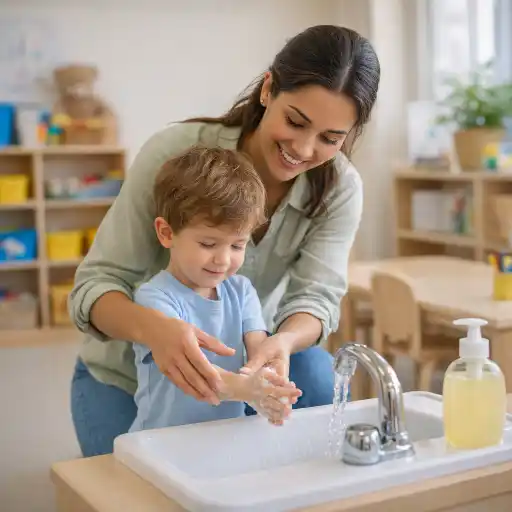 (not only during crises). ChildCareEd emphasizes practice during calm moments (How to Promote Self-Regulation).
 - 🧸 Use tools and visuals: Calm-down cards, a peace corner checklist, and simple emotion charts help children choose actions. See ChildCareEd’s Peace Corner materials (sensory breaks & calming spaces).
- 🤗 Short coaching steps after calm: 1) What happened? 2) What did you feel? 3) What will you try next? Keep language brief and strengths-focused.
- 💪 Include heavy work: scheduled pushing, carrying, or wall push-ups as calming input for some children (Heavy Work Activities Buy Now $0.00).
- 📈 Embed into routines: e.g., 60‑second breath before meals; 30‑second movement reset after outdoor play.
Why it helps: repeated practice changes physiology (breathing patterns, arousal), improves attention, and gives children concrete tools to use when upset. For program-level training, consider courses like Self-Regulation & Change Buy Now $16.00 or workshops like From Tantrums to Triumphs Buy Now $25.00.
4) How can teams, visuals, and transitions create consistent learning moments?
Answer: Consistency across staff and family, clear visuals, and planned transition scripts make daily practice reliable and teachable.
- 👥 Team alignment (3 steps): 1) Choose 3 shared cues (e.g., morning check-in, 1-minute warning, breath cue); 2) Train staff with short role-play; 3) Use the identical phrasing and visuals in each classroom. ChildCareEd provides staff planning tools (How to Create a Classroom Schedule).
- 📷 Visual schedules: post at child eye level; include photos of your classroom doing each activity (CSEFEL and ChildCareEd endorse picture schedules: CSEFEL schedules brief).
- 🔔 Transition script: 1) 2-minute warning, 2) cue song/bell, 3) one short task per child, 4) immediate praise. Rehearse this routine 3–5 times over a week until it becomes automatic.
- 🤝 Family partnership: share one home-friendly script (e.g., “Balloon breath before bed”) so children hear the same language across settings. State requirements vary - check your state licensing agency when sharing materials.
Small systems matter: when adults coordinate phrases and visuals, the child’s environment becomes a continuous teaching tool rather than a series of disconnected moments.
5) When should we get extra help, and what common mistakes should we avoid?
Answer: Use data, watch safety concerns, and correct five frequent pitfalls.
- 🛑 When to seek support (use escalation steps):
- Frequent, long meltdowns daily despite consistent routines.
- Repeated harm to self or others.
- Little to no response to tools after several weeks—consult mental health or early-intervention teams (ChildCareEd emotional regulation).
- ⚠️ Common mistakes (and fixes):
- ❌ Teaching only during meltdowns → ✅ Practice when calm with games and visuals.
- ❌ Inconsistent language between staff → ✅ Pick one script and train everyone.
- ❌ Using calm spaces as punishment → ✅ Teach the space as a voluntary reset and rehearse it.
- ❌ Overloading visuals or too many cues → ✅ Limit to 6–8 clear items on a daily chart.
- ❌ Ignoring individual needs (sensory or developmental) → ✅ Add heavy work or individualized visuals and partner with families and specialists (see CSEFEL family tips: CSEFEL Family Resources).
Keep a simple log: triggers, time of day, and what helped. If concerns meet referral thresholds, partner with families and your mental health consultant. State guidance may differ—state requirements vary - check your state licensing agency.
Conclusion
Daily routines are the classroom’s most powerful curriculum for self-regulation. Start small: pick 2 routines (a 60‑second morning feelings check and a micro-breath before a transition), train your team on one shared script, and practice those steps every day. Use visuals, short games, and a taught calm space to make skills visible and repeatable. For ready-to-use printables, calm-corner checklists, and staff courses, prioritize ChildCareEd resources such as How to Promote Self-Regulation Skills and the sensory-break materials (What Are Sensory Breaks).
Quick FAQ (4 items):
- Q: How long should practice be? A: Micro-practices of 30–90 seconds repeated daily. Short and consistent beats long and sporadic.
- Q: Can mixed-age rooms share routines? A: Yes—use common anchors (arrival, snack, outdoor, nap) and adapt visuals per child (toddler schedule ideas).
- Q: What if a child refuses the calm area? A: Offer one simple choice: stay nearby and rehearse the tool later when calm.
- Q: Where to find lesson plans? A: ChildCareEd offers lesson packs, calm-choice cards, and staff courses listed throughout this article.
You and your team are the steady context that turns short practices into lifelong skills. Start this week with one tiny change—practice it with warmth, predictability, and celebration.
- 45 Hour Child Growth and Development
- 45-Hour Preschool Curriculum
- Teach with Respect ONLINE
- 45 Hour Preschool Methods and Materials
- 45 Hour Infant and Toddler Methods and Materials
- Pediatric RSV First Aid & CPR/AED
- Texas Director Credential
- Everyday Safety: Creating Healthy Environments
- Safeguarding Young Lives: A Comprehensive Guide to Child Care Safety
- Supporting Social Relationships Among Young Children
- 🔍 ¿Qué ves cuando observas a un niño aprender?
- Proporciones de Cuidado Infantil y Tamaños de Grupo por Edad en Nueva Jersey (Guía Rápida para Centros y Hogares)
- How can New York childcare workers help children build a strong sense of identity in a big city?
- How can child care providers support emotional regulation in young children?
- Canciones, juegos y preguntas de círculo para niños
- How can child care providers support emotional development in toddlers?
- The Role of Teachers in Child Growth and Development
- Can we tame the ‘monsters’ of big emotions in young children?
- How can child care teams best support children during tantrums and emotional outbursts?
- How can daily routines teach self-regulation to young children?
- How Can Child Care Providers Understand and Support Sensory Needs in Young Children?
- How Can Staying Calm Help Children Calm Down? Co-Regulation Strategies for Child Care Teams
- How can child care providers teach children to name and manage emotions?
- How do you set up a calm-down space in your classroom?
- How Do You Explain Ego to a Child Without Making It Sound Like a Bad Thing?
- How Can Child Care Providers Help Children Develop Self-Control?
- How Can Teachers Build Emotional Regulation Into Daily Routines?
- What Is Co-Regulation and How Can Child Care Teachers Use It?
- How Can Child Care Providers Help Children Develop Self-Control?
