A large empty box may lift with ease, while a smaller object can feel surprisingly weighty—an everyday puzzle that invites preschoolers to think like mathematicians and scientists. Use the Light or Heavy Sorting Mat Buy Now $1.49 to introduce weight vocabulary through picture sorting, then extend the conversation by comparing safe classroom objects of different sizes and weights. ChildCareEd Buy Now $1.49 The Early Mathematics Through Play Buy Now $24.00 course offers practical strategies for building measurement, comparison, and reasoning into classroom routines, helping you turn children’s curiosity into purposeful learning. Read on for simple ways to help children test their predictions and discover why size alone cannot tell them how heavy something is.
Why does exploring weight matter in preschool?
Weight comparisons give children a concrete way to investigate an idea they cannot always judge by looking. When a child lifts two objects, feels the difference, and checks a balance scale, they are observing, predicting, testing, and revising an idea. These are early mathematical and scientific practices, not just vocabulary drills.
Measurement also gives children useful language for explaining what they notice. Terms such as heavier, lighter, and equal in weight help them distinguish weight from other attributes, including height, length, and volume. As Stanford’s DREME resource notes, children develop measurement ideas through everyday comparisons and conversations; educators can extend their thinking by asking questions such as, “How do you know?” and “What could we use to compare them?”
Weight investigations can fit naturally into block play, outdoor exploration, dramatic play, and cleanup. A child might wonder why a small basket of stones is harder to carry than a large bag of paper streamers. Instead of supplying the answer, invite children to compare the objects and describe what they discover. This supports #curiosity, mathematical #reasoning, and confident participation.
How can teachers help children distinguish size from weight?
Begin with a clear, surprising comparison: a large empty container and a smaller object made of a denser material. Invite children to look first, predict which will feel heavier, and then handle or weigh the items. The point is not to catch children making a “wrong” guess; it is to give them evidence that appearance and weight are different attributes.
Use language that names the specific feature being explored. If a child says, “That one is bigger,” you might respond, “It is taller. Which one feels heavier?” This validates the child’s observation while sharpening the comparison. Everyday examples—an empty cardboard box beside a small book, a long feather beside a short stone, or a large empty cup beside a small filled cup—help make the distinction memorable.
- Offer pairs with contrasting size and weight, not only objects where the larger item is also heavier.
- Ask children to predict before they test: “Which do you think will pull the scale down?”
- Welcome explanations through words, gestures, pointing, drawings, or demonstrations.
- Use the comparison words “heavier,” “lighter,” and “about the same weight.”
- 🌟 Treat an unexpected result as a discovery to investigate together.
Repeated, hands-on comparisons help children build a more precise #vocabulary and understand that size, volume, and weight are related in some situations but are not interchangeable.
What simple activities make weight visible and hands-on?
A balance scale helps children see a comparison: the side that dips lower holds the heavier load. A classroom scale is useful, but a sturdy, adult-prepared hanger balance can also work when it is stable and closely supervised. Begin with a few familiar, age-appropriate items, such as a block, a sponge, a large plastic toy, or a sealed container with a safe filler. Let children explore how the scale responds before asking them to sort or order objects.
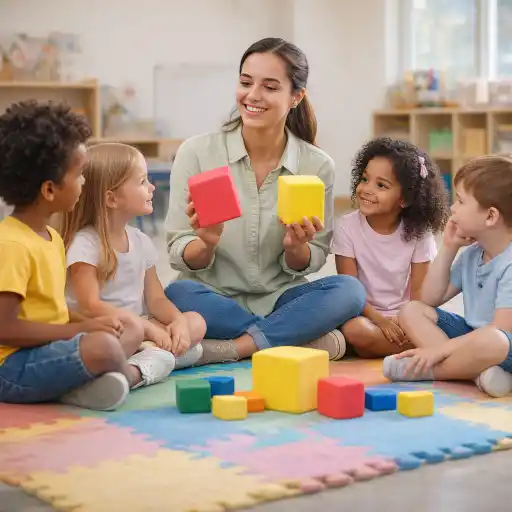
Try a “weight detective” investigation. Give children one comparison object, such as a large block, and invite them to find classroom items that seem lighter or heavier. Children can make a prediction, test it with hands or a scale, and place a picture or drawing in a “lighter” or “heavier” column. This reflects the sequence of observation, prediction, testing, and sharing described in Early Science Matters’ weight scavenger hunt activity.
- Compare and sort: Hold two objects, describe the sensation, then check the comparison on a balance.
- Balance challenge: Add large counters or blocks one at a time to see what balances a classroom object.
- Outdoor search: Compare a leaf, a smooth stone, and a pinecone using one chosen object as the reference.
- Change-it test: Compare an empty container with the same container after an adult adds a safe amount of water.
Keep the activity open-ended. Children may need several attempts to interpret what the scale shows; their discussion and experimentation are meaningful learning in themselves.
How can educators scaffold learning for every child?
Start by watching what children already do. A child who repeatedly fills, carries, or tips containers may be investigating weight and capacity without naming those ideas. Join the play with a concise prompt—“What changed when you added more?”—and allow time for the child to respond. A supportive adult does not need to lead every step; thoughtful questions and accessible materials can be enough to deepen the exploration.
Make participation flexible. Some children may prefer to handle objects, while others may watch the scale, point to a picture choice, use a scoop, dictate a prediction, or draw the result. Adapt object size, handle type, seating, and the quantity of materials to support children’s motor, sensory, communication, and attention needs. A child who does not want to lift a heavy item can still compare it on a scale or document what peers observe.
Safety and inclusion work together. Choose manageable objects, actively supervise lifting and water play, and inspect materials for sharp edges, breakage, splinters, and choking hazards. Avoid small loose items for children who may mouth them, and follow your program’s health and safety procedures. If you are planning activities for a mixed-age group, offer large, stable materials and clear boundaries for where objects are carried and used. State requirements vary - check your state licensing agency.
What common pitfalls should providers avoid?
One frequent pitfall is treating “heavy” and “light” as labels children should memorize. Without handling, comparing, and testing, children may repeat the words without understanding what evidence supports them. Make room for predictions and let children revise their ideas after seeing what happens.
Another pitfall is assuming that the largest object must weigh the most. Include deliberate contrasts so children can discover that an object’s appearance alone does not settle the comparison. Similarly, avoid turning every investigation into a worksheet or rushing to standard units such as grams and pounds. For many preschoolers, comparing two objects directly or using a balance scale is a more meaningful first step.
- Do not correct a prediction before children have a chance to test it.
- Do not use objects that are too heavy or awkward for children to manage safely.
- Do not overload the activity with many new terms at once; revisit a few words in different routines.
- Do not treat a tipping scale as the only acceptable way to show understanding; accept different communication methods.
When the result differs from a child’s expectation, respond with interest: “The small one pulled the scale down. What do you notice?” This keeps the focus on evidence and supports a classroom culture where #learning includes curiosity, revision, and trying again.
How can weight exploration become part of everyday practice?
Weight learning does not need a separate unit or expensive equipment. Add a short comparison to routines children already know: Which basket is easier to carry? Does the container feel different after we add water? Which block should go at the bottom of our tower? These practical questions give children a reason to measure and make the language relevant.
Keep a small collection of safe objects and a simple balance in a supervised discovery area. Rotate a few items, invite children to make a prediction, and record their thinking with quick drawings, marks, photos, or educator notes. Revisit the collection later and ask whether children would sort the objects differently now. Their changing explanations can help teachers plan the next challenge without expecting every child to move at the same pace.
Connect weight with other measurable attributes while keeping the comparison clear. A long feather may be lighter than a short stone; an empty cup may weigh less than a full cup. Ask, “Are we comparing length, how much it holds, or how heavy it is?” These conversations support broader early #measurement skills and help preschoolers notice that objects can be described in more than one way.
Conclusion: Big does not always mean heavy, and preschoolers can discover why through safe, playful comparison. Offer contrasting objects, invite predictions, use a balance or hands to test ideas, and welcome children’s explanations in many forms. When providers weave weight exploration into everyday play and routines, they build a foundation for measurement, scientific inquiry, and meaningful classroom conversation.
Explore five relevant ChildCareEd courses:

- CDA Preschool Credential
- CDA Preschool Credential with Portfolio Review
- CDA Bridge Bundle: Preschool
- CDA Bridge Bundle: Family Child Care without Portfolio Review
- CDA Bridge Bundle: Infant/Toddler without Portfolio Review
- CDA Bridge Bundle: Preschool without Portfolio Review
- Texas Director Credential
- Every Moment Matters: Schedules and Transitions
- SIDS Science: What Every Parent Needs to Know About Safe Sleep
- Cómo Abrir Una Quardería En Casa Sin Dinero?
- Actividades de Fiesta para Niños de Preescolar y Primaria
- Normas de Licenciamiento de Cuidado Infantil en Virginia para Centros Diurnos Infantiles y Hogares Diurnos Familiares
- Cómo Ser Maestra de Preescolar en Dakota del Norte
- Cómo Ser Maestra de Preescolar en Illinois
- How can DC early childhood educators meet OSSE requirements without feeling overwhelmed?
- Juneteenth Activities for Kids: Crafts, Books, and Learning Ideas
- How can preschool programs keep kids cool and practice self-control with heat-safe indoor activities in Texas?
- How does the brain develop in early childhood?
- Cómo simplificar la capacitación para sus empleados de daycare
- How can child care teams help children manage big feelings?
- Daycare Temperature Regulations in Nevada: How Hot Is Too Hot?
- How can child care programs balance screen time, educational technology, and active-learning alternatives?
- How Do Light vs. Heavy Activities Build Early Measurement Skills?
- How Can You Create a “Yes Space” Where Infants and Toddlers Explore Safely?
- When Children Can Reach Materials but Cannot Carry Them Safely, What Should Providers Do?
- How Can You Support Safe Transporting Play Without Losing Your Learning Center?
- Why Does Big Not Always Mean Heavy in Preschool?
