Children are already surrounded by patterns—in the beat of a cleanup song, the order of getting ready for lunch, and the colors in a row of blocks. With a few intentional prompts, child care providers can turn these familiar moments into playful opportunities for children to observe, predict, and explain. For practical strategies that connect patterns with broader early math learning, explore Early Mathematics Through Play Buy Now $24.00; the course covers patterns alongside other math ideas and offers ways to weave them into routines, play, and exploration.
Why are everyday patterns worth noticing?
Pattern experiences are more than a way to keep children busy. When children notice what repeats, they begin to anticipate what may come next, compare details, and make sense of order. These habits are part of early mathematical thinking and also appear in music, stories, movement, and familiar routines. Research on preschool pattern knowledge describes a progression that can include copying a pattern, extending it, and eventually recognizing the structure behind it—not simply matching identical objects.
That progression offers a useful reminder for educators: children need time and repeated, low-pressure opportunities to explore. An incorrect guess is not a setback; it gives you information about what the child is noticing and how to offer the next bit of support. NAEYC’s discussion of early math play likewise emphasizes the value of curiosity, hands-on exploration, and intentional math language in daily experiences.
For providers and directors, the practical benefit is that pattern learning does not require a new block on the schedule or specialized equipment. Repeated experiences with familiar materials can strengthen observation, memory, reasoning, and communication while respecting children’s interests and developmental pace. In a warm classroom, the adult’s role is to make the pattern visible and invite children’s thinking—not to turn each moment into a test.
How can educators make patterns visible in daily routines?
Daily sequences are natural entry points. During arrival, children may hang up a bag, place their name card, and join play. At handwashing, they may wet hands, use soap, rinse, and dry. These are sequences of events rather than repeating color patterns, but they still give children practice noticing order and anticipating what happens next. PBS KIDS for Parents also suggests looking for patterns in everyday schedules and routines.
Use short, descriptive comments to draw attention to what children already experience:
- “First we put away the blocks; next we wash our hands; then we sit for snack.”
- “We visit the garden on these days. What do you notice about our week?”
- “You put on your coat, then your hat. What do we usually do before we go outside?”
Visual schedules, picture cards, or a simple classroom calendar can help children revisit the order. During transitions, use a repeated call-and-response or a predictable movement cue, and invite children to notice which part returns. Be sensitive to individual needs: predictability can be reassuring, but routines should remain flexible when children need extra time or care. These everyday exchanges give children a chance to connect words such as first, next, and again with meaningful experiences.
Which low-prep activities help children explore repeating patterns?
Begin with concrete materials and a short pattern children can see, hear, or do. An AB pattern—such as red, blue, red, blue—is a practical starting point for many preschoolers. First model or invite children to copy it. Then pause and ask what they notice or what they think comes next. As children become ready, vary the materials or introduce a longer pattern, always following their engagement rather than a rigid timetable.
- Blocks and loose parts: Arrange two colors, shapes, or sizes in a repeating line and invite children to continue it.
- Movement: Try clap, stomp, clap, stomp; let children echo the sequence or invent a movement for the group.
- Sound: Use a soft drum, shaker, or body percussion to make a rhythm children can repeat.
- Books and songs: Pause before a familiar repeated phrase and give children time to predict or join in.
- Outdoor noticing: Look for stripes, leaf arrangements, fence posts, or other visible repetitions on a supervised walk.
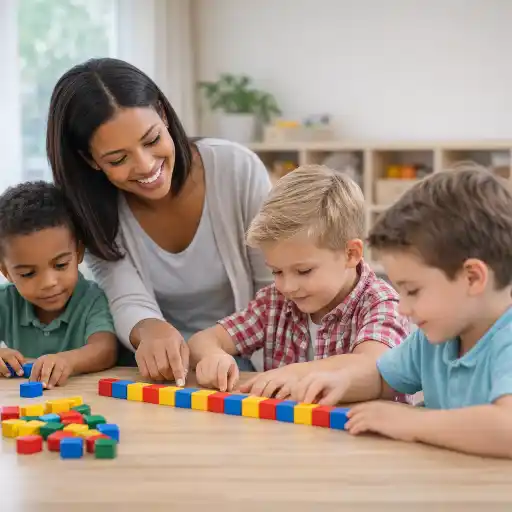
Keep the invitation open-ended: a child may discover a different pattern than the one you intended, and that can be a valuable point of discussion. Use safe, age-appropriate materials; supervise closely with small objects and avoid items that pose choking risks, especially for children who mouth materials. For infants and toddlers, emphasize sensory exploration, repeated sounds, and predictable interactions rather than expecting a formal pattern response.
What questions help children explain what they notice?
Children deepen their thinking when adults make room for observation and explanation. Instead of quickly supplying the answer, describe the materials and pose one clear, open question. For example, “I see red, blue, red, blue. What do you notice?” gives a child a chance to look for the repeating relationship. If the child is unsure, point to the first two or three pieces, say them aloud, or offer two choices. Then give enough wait time for a response, including a gesture, movement, or look.
- “What do you notice?”
- “Which part happens again?”
- “What might come next? How did you decide?”
- “Can you make the same kind of pattern with different materials?”
- “Would you like to make a pattern for me to follow?”
These prompts can support language as well as reasoning. Model words such as same, different, repeat, next, and match, and accept children’s communication in different forms. A child might point, arrange objects, move, speak in a home language, or use an augmentative communication tool. Educators can also connect patterns to sorting: ask which objects are alike and then explore whether the child can arrange those objects in a repeating order. Avoid treating a single correct verbal answer as the only evidence of understanding.
How can providers adapt pattern play and observe progress?
Children develop these ideas at different rates, and the same activity can offer multiple levels of challenge. One child may enjoy noticing two colors; another may copy a short sequence; a third may create a pattern and explain what repeats. Rather than labeling children as ready or not ready based on one attempt, observe how they engage across different materials and contexts. ZERO TO THREE’s Math4Littles resource underscores that young children master skills at different speeds and that activities can be adjusted to a child’s readiness.
Try a simple progression: notice a pattern together, copy it, extend it, then invite the child to create or represent a similar structure in a new way. A brief note can help staff plan the next opportunity:
- Record the context and the child’s action: “During block play, Sam copied red-blue-red-blue.”
- Note the support used: “Continued the sequence after the teacher named the first two colors.”
- Choose a small next step: “Offer two shapes and invite Sam to make a sequence.”
For inclusion, offer options for seeing, hearing, touching, or moving through the pattern. Use high-contrast pieces, larger manipulatives, picture cues, or shorter sequences as helpful. Consider the child’s language, sensory preferences, motor access, and interests. State requirements vary - check your state licensing agency when aligning documentation or training with local expectations. Most importantly, treat observation as a planning tool—not a high-stakes assessment.
What common pitfalls can educators avoid?
Pattern activities are most useful when the pattern itself is the focus and children have space to explore. A common pitfall is moving too quickly to complex sequences before children have had opportunities to notice and copy simpler ones. Another is focusing on a neat finished product—such as a perfectly arranged craft—rather than the child’s choices and reasoning. Keep the task brief, use familiar materials, and make room for experimentation.
- Too many instructions: Give one or two steps at a time, especially for young children.
- Rushing to correct: Ask what the child noticed before modeling another possibility.
- Confusing a sequence with a repeating pattern: A routine has an order; a repeating pattern has a unit or feature that recurs. Both offer useful learning, but they are not identical.
- Expecting all children to respond verbally: Accept pointing, movement, object placement, and other communication modes.
- Using unsafe small parts: Select materials suitable for the age group and supervise actively.
Directors can support staff by keeping a small set of safe, open-ended materials accessible and encouraging brief reflection during team check-ins. The aim is not to add pressure to already full days. It is to help educators notice the learning already present in play and routines, then extend it with a thoughtful prompt. This approach keeps math play-based, inclusive, and connected to children’s lived experiences.
Conclusion: What can you try this week?
To help children notice patterns in everyday activities, start with what is already familiar: a routine, a song, a row of blocks, or a repeated movement. Name what you observe, invite children to predict or create, and adapt the challenge to their interests and current skills. Pattern learning develops over time through meaningful repetition, active exploration, and conversation—not through pressure to get every answer right.
Choose one brief opportunity this week: repeat a clap-and-stomp sequence at transition, invite children to continue a block pattern, or talk through the order of a familiar routine. Notice how each child participates and use that observation to plan a small next step. When providers make room for curiosity, ordinary moments can become welcoming invitations to reason, communicate, and explore the patterns all around us.
To build a broader foundation for integrating early math in play and routines, you can also explore these English-language ChildCareEd courses:

- Moving About the Classroom: Effective Transitions for Everyday
- Early Mathematics Through Play
- Many Colors, One Canvas: MD ECE Conference
- Pediatric RSV First Aid & CPR/AED
- CDA Bridge Bundle: Family Child Care without Portfolio Review
- CDA Bridge Bundle: Infant/Toddler without Portfolio Review
- CDA Bridge Bundle: Preschool without Portfolio Review
- Creating Environments that Nurture Growth and Community
- Moving About the Classroom: Effective Transitions for Everyday
- CDA Certification en Español: Recursos y Consejos para Educadores Bilingües
- 🤯 ¿Por qué este niño está teniendo un comportamiento difícil de repente?
- Actividades de Fiesta para Niños de Preescolar y Primaria
- Regulaciones de Licenciamiento de Cuidado Infantil en California para Centros y Hogares de Cuidado Infantil Familiar
- Lista para Guardería en Casa en Illinois: Cómo Iniciar una Guardería en el Hogar
- Consejos de Supervisión Activa para Salones de Preescolar y el Juego al Aire Libre
- How can child care providers use simple STEM activities with early learners?
- What Toddler Activities Encourage Language and Communication?
- How Can We Celebrate Every Family and Create a Classroom Where Everyone Is Represented?
- How Can Child Care Providers Teach Young Children About Fairness and Equity?
- What Are the Best Ways to Support a Child’s Speech Development?
- How Can Early Math Activities Build Young Children’s Mathematical Thinking?
- How Can Child Care Providers Plan a Balanced Summer Learning Routine for Young Children?
- How Can Child Observations Help You Plan More Meaningful Classroom Activities?
- How Can Family Child Care Providers Carry Individualized Support Into Everyday Activities?
- How Can the Walk Between Activities Become a Learning Moment?
- How Do You Include Children With Different Abilities in Everyday Classroom Activities?
- What Are Simple Ways to Build Early Math Skills During Daily Classroom Routines?
- How Can Toddler Classroom Jobs Build Early Math Beyond Counting?
- What Are Simple Ways to Help Children Notice Patterns in Everyday Activities?
