Young children are already comparing, sorting, counting, building, and noticing patterns long before they encounter formal mathematics. When providers intentionally extend those discoveries through play and routines, they strengthen children’s reasoning while making the classroom more engaging. For practical strategies you can apply immediately, explore Early Mathematics Through Play Buy Now $24.00, which can help you plan developmentally appropriate experiences and support professional learning goals.
Why do early math experiences matter?
Early math is not limited to reciting numbers or completing worksheets. It includes the thinking children use when they decide which container holds more, arrange objects by size, construct a tower, notice a repeating design, or figure out how many plates are needed for snack. These experiences develop #problem-solving, language, persistence, spatial reasoning, and executive function.
Research summarized by the What Works Clearinghouse identifies early mathematics as a foundation for later learning and recommends developmental progressions, daily instruction, progress monitoring, mathematical conversations, and integration across the school day. Similarly, the National Council of Teachers of Mathematics emphasizes that children bring meaningful mathematical knowledge from their homes, cultures, communities, and play. A strengths-based approach therefore begins by asking, “What mathematical ideas is this child already using?” rather than assuming what the child cannot do.
For directors, this perspective also supports program quality. A math-rich classroom does not require expensive equipment or a separate lengthy lesson. It requires consistent adult attention, accessible materials, and intentional language.
Which early math concepts should providers prioritize?
Use a progression that develops from concrete action toward increasingly precise language and representation. Children may revisit the same concept many times while adding complexity. Priority areas include:
- Number and quantity: counting, one-to-one correspondence, cardinality, comparing groups, and combining or separating small sets.
- Patterns and classification: sorting by attributes, creating repeating patterns, and explaining the rule.
- Geometry and spatial reasoning: identifying, composing, transforming, and describing shapes and positions.
- Measurement: comparing length, height, weight, capacity, and time with everyday language and nonstandard units.
- Data and representation: collecting information, organizing it, and discussing simple graphs.
Developmental milestones can inform observation, but they should not become rigid labels. The CDC notes that milestones describe what most children can do by a particular age; they are not substitutes for individualized observation or professional screening. If concerns persist, communicate with families and follow appropriate referral procedures.
Learning trajectories are especially useful because they connect a goal, children’s developing ways of thinking, and teaching strategies that extend understanding. State requirements vary - check your state licensing agency when aligning curriculum, assessment, or training documentation.
How can math be embedded into routines and play?
The most sustainable approach is to add brief math moments to activities that already occur. A useful planning cycle is: observe, name the mathematical idea, ask a purposeful question, and document the child’s strategy.
- At arrival, place name cards on an attendance graph and ask, “How many children are here? How many more might come?”
- At snack, count servings, distribute items fairly, and compare which plate has more or fewer.
- During transitions, count steps, claps, or children in line while practicing one-to-one correspondence.
- At the block center, invite children to describe what is above, beside, behind, or inside a structure.
- At the sensory table, compare full and empty containers, estimate, and measure with cups or scoops.
- During cleanup, sort materials by type, color, size, or location.
Use open-ended prompts such as “How did you figure that out?”, “What could we try next?”, and “Can you show another way?” These questions position children as mathematical thinkers rather than answer-receivers. DREME’s center-time guidance also supports low-preparation activities that children can repeat independently or with peers.
For infants and toddlers, narrate comparisons, sequences, and quantities during caregiving routines. For preschoolers, add symbols, drawings, simple graphs, and story problems when children are ready.
What materials and activities make early math engaging?
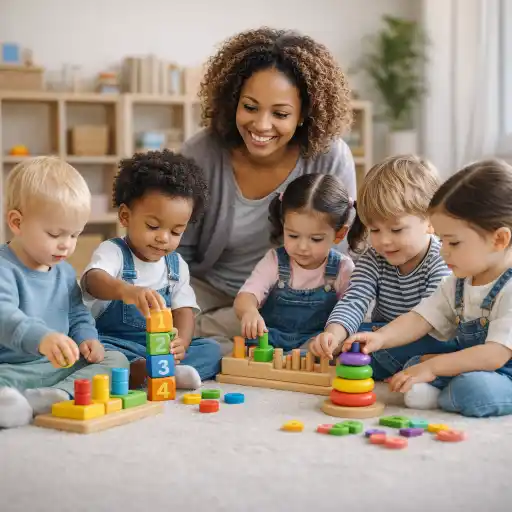
Choose open-ended materials that can represent several ideas. Blocks, linking cubes, large counters, fabric pieces, measuring cups, shape puzzles, dice, natural objects, and recycled containers can support rich exploration. The goal is not novelty; repeated use lets children deepen strategies.
- 🧱 Building challenges: “Can you make a bridge longer than this one?” Invite children to compare, measure, and explain.
- Creature Spots: Roll a die, count paper spots, and attach them to an animal drawing. Extend the activity by comparing sets or adding one more.
- Pattern trays: Offer buttons, shells, or linking cubes and ask children to copy, continue, or invent a pattern.
- Shape investigations: Search for shapes indoors and outdoors, then combine pieces to make new shapes.
- Roll-and-graph games: Record results with stickers or drawings and discuss which column has more.
- Measurement stations: Compare objects using blocks, yarn, footsteps, or cups before introducing standard tools.
Adapt each activity by changing the number of objects, providing visual models, offering larger materials, or adding peer collaboration. Avoid small parts with children who may mouth objects. Include children’s home languages, family routines, and community experiences so mathematics feels relevant and affirming.
How should providers assess progress and avoid common mistakes?
Assessment is most useful when it is brief, authentic, and connected to planning. Watch children during play, listen to their explanations, and record the strategy—not merely whether the answer was correct. A short note might read: “Maya counts six bears, touches each once, and states that there are six; next, offer a comparison task with two groups.”
- Observe: counting, sorting, patterning, spatial language, estimating, and problem-solving.
- Use short probes: match a numeral to a set, sort by two attributes, or recreate a simple structure.
- Save work samples: photographs of constructions, class graphs, drawings, or dictated explanations.
- Plan the next step: provide more support, maintain the challenge, or extend the concept.
Common pitfalls include relying heavily on worksheets, introducing too much vocabulary at once, rushing through developmental progressions, and using one pace for every child. Replace worksheets with manipulatives and conversation; select two or three target words; and use observations to differentiate. The ECRP discussion of teacher professional growth highlights the importance of recognizing children’s demonstrated understanding, using mathematical language, and assessing systematically.
Family partnerships strengthen continuity. Share one manageable idea each week: count stairs, sort laundry, compare grocery items, or describe positions while reading a book. Invite families to contribute games and mathematical practices from home.
How can programs build staff capacity and sustain improvement?
Program-wide change begins with shared expectations and manageable routines. Directors can select one monthly focus, such as comparing quantities or spatial language, and help each classroom identify three daily opportunities to practice it. A small “math shelf” with counters, dice, cards, blocks, and prompt cards reduces preparation time.
Use brief team meetings to examine observations rather than simply reviewing completed activities. Ask: What did children notice? Which strategies did they use? Who needs a different entry point? What should we try next? This creates a reflective culture in which teachers learn from children and from one another.
Professional learning can deepen this work. In addition to Early Mathematics Through Play Buy Now $24.00, consider Math Foundations in Early Childhood  Buy Now $16.00, No Such Thing as Boring Math Buy Now $24.00, and Letter & Number Planning in Child Care Buy Now $24.00. For programs serving younger children, Enhancing STEM Education for Infants and Toddlers Buy Now $16.00 connects early mathematical thinking with exploration. Review course descriptions and confirm whether training meets your local requirements.
Equity must remain central. Provide multiple ways to participate, honor multilingual expression, avoid deficit assumptions, and ensure that children with disabilities have accessible materials and meaningful problem-solving opportunities. High expectations are most effective when paired with responsive scaffolding.
Conclusion: How can providers build strong early math skills every day?
Strong early math develops through frequent, playful, intentional experiences—not isolated drills. Prioritize number, comparison, patterns, geometry, measurement, data, and mathematical language; embed them in routines; use open-ended questions; and observe children’s strategies to plan next steps.
Start with one goal this week. Choose three existing routines where children can practice it, prepare one open-ended material, and record one meaningful observation for each child. Share a simple home connection with families and discuss the evidence with your team. When adults make children’s mathematical thinking visible and valuable, everyday moments become powerful foundations for future learning.
Frequently asked questions
- When should early math begin? From infancy, through counting language, comparisons, patterns, and responsive play.
- Are worksheets ever appropriate? They may be used sparingly, but hands-on materials, conversation, and problem-solving should remain central.
- How often should progress be checked? Use informal observations continuously and brief focused checks when they help guide instruction.
- How can families support early math? Invite them to count, sort, compare, measure, and use spatial language during ordinary routines.
- What should directors do first? Establish a shared goal, stock accessible materials, and schedule short reflection conversations about children’s strategies.
- Early Mathematics Through Play
- CDA Home Visitor Subject Area 2 Part 3 Birth to 5
- Health and Nutrition
- The Best Promotion is Play
- Classroom Setup for Child Care
- Emergent Learning & Development
- Connections That Count: Building Relationships in Child Care
- Texas Director Credential
- Building Vocabulary
- Technology as a Classroom Tool
- Mathematical Skill Development
- CDA Certification en Español: Recursos y Consejos para Educadores Bilingües
- 👶 ¿Cuáles son las proporciones y grupos requeridos en Dakota del Norte? 🏫
- Curso de Comunicación de 9 Horas de Maryland
- How can child care providers use the science of reading to boost early literacy in New York?
- How Do Art Activities Support Cognitive Growth in North Dakota Preschoolers?
- Celebrando la amistad en el cuidado infantil durante el Día de los Mejores Amigos
- National Ice Cream Day: Sweet Activities for Preschoolers
- How Can I Use Fun Math Activities for Preschoolers Every Day?
- What are the most important school readiness skills for preschoolers?
- How can Florida educators build strong foundations for infants, toddlers and K–3 readiness together?
- How can I use simple math activities for preschoolers every day?
- How Does Guided Play Build School-Ready Skills in New York Preschoolers?
- How can preschool classrooms effectively support early math skills?
- How can preschool programs intentionally support early math skills every day?
- How Can Preschool Teachers Effectively Support Early Math Skills in the Classroom?
- How can I teach early math through everyday routines?
- Can Block Play Build Children's Spatial Skills?
- How Can Child Care Providers Build Strong Early Math Skills Every Day?
- How Can Early Math Activities Build Young Children’s Mathematical Thinking?
