A ruler can show a number without showing a child what that number means. Before preschoolers read measurement marks, hands-on objects help them discover equal units, counting, and fair comparisons through playful experiences such as a pumpkin patch path. For practical strategies to weave measurement and other early math concepts into daily routines, explore ChildCareEd’s Early Mathematics Through Play Buy Now $24.00 course, which can strengthen your classroom practice with developmentally appropriate approaches.
Why begin with objects instead of a ruler?
Measuring is more than reading a number. Children need to understand what is being measured, what counts as a unit, and how repeated units cover a length. A ruler compresses those ideas into lines and numerals, which can make the tool seem like a set of mysterious instructions. With blocks, paper strips, or matching tiles, preschoolers can see and touch the process.
Using concrete materials lets children compare familiar things before they must interpret an abstract scale. They can line up two pumpkin paths and notice which is longer, then investigate the difference with units. This experience gives meaning to words such as longer, shorter, equal, start, and end. It also encourages children to explain their thinking: “This path needs more tiles, so it is longer.”
Hands-on activities invite purposeful movement, conversation, and revision. Children may first make an estimate, place their units, count, and then check whether the result fits what they expected. These are early mathematical habits—not merely preparation for a worksheet. The Illinois Early Learning Project recommends incorporating measurement into everyday routines and letting young children explore with informal units such as blocks, string, or shoes.
Starting with objects is not delaying “real” math. It makes the central idea of measurement visible and accessible to a wide range of learners.
What mathematical ideas do equal-sized units teach?
A unit is a consistent amount of length used to measure. When children use paper tiles to measure a pumpkin picture or path, they begin to understand that the total length is the space covered by repeated units. This makes the size of the unit important: a longer unit will cover the same path with fewer pieces, while a shorter unit will require more.
To make a comparison fair, children need to use the same type of unit for both objects. If one pumpkin path is measured with large tiles and another with small tiles, the counts cannot be compared directly. This provides a valuable opportunity to ask, “Did we use the same-sized pieces both times?” rather than simply marking an answer right or wrong.
Accurate measurement also depends on placement. Units should begin at one end, continue in a straight line, and touch without gaps or overlaps. A gap leaves part of the length uncovered; an overlap counts some space twice. The printable Pumpkin Patch Paper-Unit Measurement Activity for Ages 4–5 Buy Now $1.49 includes reusable measuring tiles and a visual demonstration of these techniques, giving educators a ready-made way to model the process.
- Use one consistent unit throughout a comparison.
- Place units end to end, beginning at the marked starting point.
- Check for gaps, overlaps, and curved or uneven placement.
- Count each unit once and name the unit used.
How does measuring support counting and comparison?
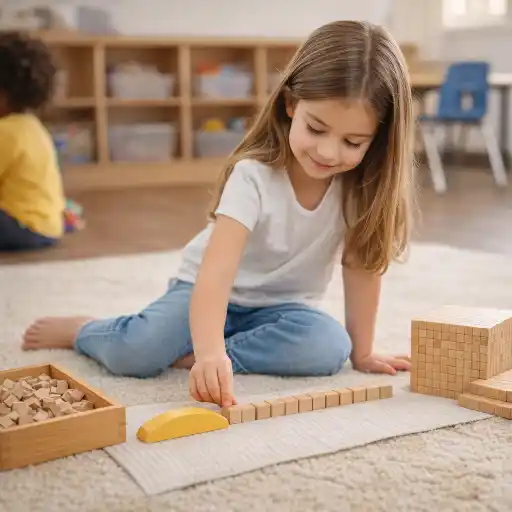
When children place one tile at a time and say one number for each tile, they practice one-to-one correspondence: each object receives one count word. They also encounter cardinality—the idea that the last number counted tells how many units span the path. The count becomes meaningful because children can see the units covering a length.
A pumpkin-themed activity makes comparisons concrete and memorable. Offer two illustrated paths and invite children to predict which one will take more paper tiles. After measuring both with the same-size units, ask them to compare the counts. A child might say, “The vine path is six tiles, and the short path is four, so the vine is longer.” This links number language to an observable attribute.
Keep the emphasis on reasoning, not speed. Some preschoolers will count aloud; others may place each tile carefully and need a prompt to count the total. Both strategies offer useful information about what the child understands. The resource How Do I Introduce Measurement to Young Children? describes how everyday measuring can build comparison language, spatial reasoning, and early number sense.
- Invite a prediction: “Which path do you think is longer?”
- Measure both paths with the same tiles.
- Count together, touching or moving each tile once.
- Ask, “How does the number help us compare?”
How can providers lead a pumpkin patch measurement activity?
Set out the pumpkin-path printable, paper measuring tiles, and a small tray. Begin by exploring the pictures: name the paths, notice their starting and ending points, and invite estimates. Model one path slowly, thinking aloud as you place each tile. Then let children measure another path independently or with a partner. The activity’s visual demonstration and educator guidance help make the technique clear while leaving room for children’s own discoveries.
Use questions that focus attention without taking over the task: “Where should the first tile go?” “Do the tiles touch?” “What might happen if there is a space?” “How can we check the count?” If children disagree about which path is longer, return to the shared unit and measure both in the same way. The goal is to help them use evidence to support a comparison.
- Invite children to choose a path and make a prediction.
- Model alignment from the starting point, with no gaps or overlaps.
- Have children place and count the equal-sized tiles.
- Compare results and invite children to describe their reasoning.
- 📏 Celebrate careful checking and helpful explanations, not just the final count.
For added meaning, connect the activity to dramatic play. Children can pretend to plan rows for a classroom pumpkin patch, compare paper vines, or decide which path needs more “planting space.” The Illinois Early Learning Project also suggests bringing measurement into play and routines, so children can revisit the same concepts with classroom objects and natural materials.
What common pitfalls should educators avoid?
A common mistake is introducing a ruler too soon and focusing on reading the numeral before children understand units. A child may learn to follow a procedure—line up an object and announce a number—without understanding that the number represents equal intervals along a length. Continue using concrete materials until children can demonstrate and talk about what the units are doing.
Another pitfall is allowing inconsistent units or placement. If children mix different-sized pieces, begin at different points, leave gaps, or overlap units, their counts will not provide a fair comparison. Instead of immediately correcting them, ask what they notice and invite them to adjust their arrangement. A purposeful, gentle mistake—such as modeling a small gap—can prompt children to explain why the technique matters.
Finally, avoid treating one answer or one pace as a measure of a child’s ability. Some children benefit from fewer tiles, larger pieces, a visual starting marker, partner support, or the option to point and gesture while explaining. Keep small loose parts out of reach of children who may mouth them, supervise closely, and choose materials appropriate for the age group. State requirements vary - check your state licensing agency.
- Do not mix unit sizes within one comparison.
- Do not count gaps as if they were units.
- Do not rush children from concrete measuring to ruler procedures.
- Observe the child’s strategy before deciding what support to add.
Summary: Why should preschoolers measure with objects first?
Preschoolers benefit from measuring with objects before learning to use a ruler because equal-sized, tangible units make the logic of measurement visible. As children place paper tiles along pumpkin paths, they learn that accurate measurement covers a length from start to finish, with no gaps or overlaps. They count units, connect the final count to the length, and compare objects using a consistent method.
Use the pumpkin activity as a playful invitation: ask children to predict, measure, count, compare, and explain. Observe their strategies and offer support that meets their current needs. When children can show that units repeat evenly and that counts help compare lengths, rulers can become a meaningful extension of familiar work—not a set of unexplained marks.
- Begin with concrete, same-size units children can handle.
- Model starting points and careful placement.
- Use counting and comparison questions to deepen reasoning.
- Connect the activity to play and everyday measurement moments.
For more ways to integrate measurement, counting, and reasoning into preschool routines, consider ChildCareEd’s Math Foundations in Early Childhood  Buy Now $16.00. You may also explore No Such Thing as Boring Math Buy Now $24.00, Basic Science in Early Childhood Buy Now $25.00, and Tracking Progress, Shaping Futures: Observation & Assessment Skills Buy Now $55.00 for related professional learning.
- 45 Hour Child Growth and Development
- CDA Home Visitor Subject Area 3 Part 3 Birth to 5
- 45 Hour Preschool Methods and Materials
- Birth to Five CDA Credential with Portfolio Review
- CDA Bridge Bundle: Family Child Care without Portfolio Review
- CDA Bridge Bundle: Infant/Toddler without Portfolio Review
- CDA Bridge Bundle: Preschool without Portfolio Review
- 45-Hour Preschool Curriculum
- Every Moment Matters: Schedules and Transitions
- 😫🧸 ¿Qué hacer cuando un bebé no quiere dormir la siesta en el aula?
- Cómo Abrir Una Quardería En Casa Sin Dinero?
- ¿Cómo puedo usar escenarios de juego de roles de primeros auxilios en mi aula?
- ¿Cómo pueden los equipos de cuidado infantil practicar habilidades rápidas de primeros auxilios en situaciones reales?
- Actividades de Motricidad Gruesa que Desarrollan el Equilibrio, la Coordinación y la Fuerza
- Proporciones de Cuidado Infantil y Tamaños de Grupo por Edad en Maryland (Guía Rápida para Centros y Hogares)
- Proporciones de Cuidado Infantil y Tamaños de Grupo por Edad en Wisconsin (Guía Rápida para Centros y Hogares)
- Proporciones de Cuidado Infantil y Tamaños de Grupo por Edad en Nueva Jersey (Guía Rápida para Centros y Hogares)
- Proporciones de Cuidado Infantil y Tamaños de Grupo por Edad en Virginia (Guía Rápida para Centros y Hogares)
- Actividades de Otoño Fáciles para Preescolares esta Temporada
- Ejemplos de Crianza Respetuosa vs. Crianza Permisiva
- Retraso del Habla en la Guardería: Cómo Pueden Ayudar los Proveedores
- Capacitación Previa al Servicio para Proveedores de Cuidado Infantil en Illinois
- Celebrando la amistad en el cuidado infantil durante el Día de los Mejores Amigos
- Cómo simplificar la capacitación para sus empleados de daycare
- How can I plant a classroom garden with preschoolers?
- Reglas y regulaciones de guarderías en Minnesota 2026: Requisitos actuales y próximos cambios
- Why Does Measuring Start at Zero, and How Can We Teach Ruler Alignment Through Play?
- Juego Compartido y Autismo: Cómo Fomentar la Participación sin Exigir Contacto Visual
- Why Should Preschoolers Measure With Objects Before Learning to Use a Ruler?
