Friendship skills are teachable, observable, and essential for helping young children cooperate, manage emotions, resolve disagreements, and feel that they belong. Child care providers can support #preschoolers by modeling friendly language, teaching simple ways to enter play, guiding turn-taking, and helping children repair relationships after conflict. This guide offers practical, classroom-ready strategies you can use immediately, including short social scripts, guided-play activities, thoughtfully arranged learning spaces, and predictable routines that allow children to practice friendship skills during real interactions rather than through lengthy lectures.
To strengthen these practices, explore ChildCareEd’s self-paced online course Supporting Social Learning: Creating Classrooms that Care  Buy Now $24.00. The training focuses on building caring classroom communities, prioritizing relationships, strengthening children’s problem-solving abilities, and encouraging open dialogue that supports social success. Providers can also use ChildCareEd’s free “Let’s Be Friends!” Social Skills Lesson Plan Buy Now $0.00, which includes adaptable activities that help children practice empathy, cooperation, kindness, and friendship through interactive play and adult modeling.
Why this matters:
1. Children who form positive peer ties spend more time learning and less time in conflict; social skills support academic and emotional growth (Social skills in action).
2. Small, repeated practices (short scripts, timers, guided-play stations) lead to durable change; see the evidence-based steps in the CSEFEL briefs (CSEFEL What Works Brief).
How can guided play and short scripts help children practice real friendship skills?
Guided play pairs an adult-set goal with child choice so children rehearse social scripts in authentic contexts. Start with 1–2 short phrases and a clear play goal. Refer to the guided-play how-to at ChildCareEd and use CSEFEL strategies to prompt and acknowledge behavior (CSEFEL WWB8).
- 🎯 Choose one skill (joining, turn-taking, or repairing).
- 👩🏫 Model a 3–6 word script with a puppet or adult (e.g., "Can I play?", "Your turn soon").
- 🔁 Provide 3–5 short practice chances during centers or transitions.
- 👏 Prompt briefly and give specific praise: "You asked, 'Can I play?' Great asking!"
- 📋 Track attempts, not perfection—small wins matter.
Citations and sample scripts are available in ChildCareEd’s role-play resources (How can preschool teachers teach friendship skills with activities and role-play?).
What daily routines and classroom design choices encourage belonging, practice, and #inclusion?
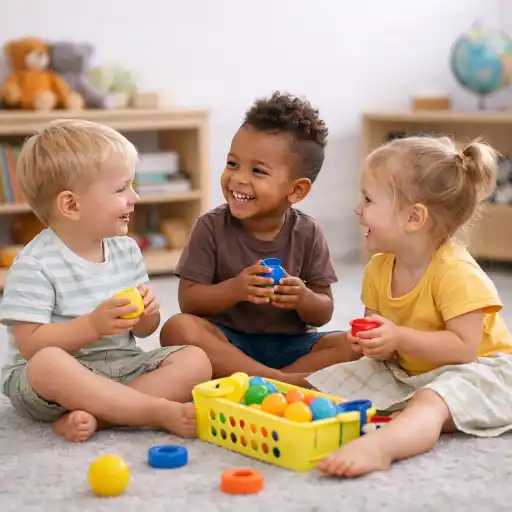
Design and routines set the stage so friendships can form without constant adult intervention. Research and field guides stress arranging space, materials, and schedules to make peer interaction predictable and frequent (design environments that foster friendship).
- 😊 Morning greetings and partner jobs: give each child a short responsibility to increase reciprocal interactions.
- 🧩 Use cooperative materials (big puzzles, shared tracks, dramatic-play stores) that invite teamwork; see ideas in Early Childhood Education Socialization.
- 📚 Story pauses and feeling detective prompts—embed empathy practice in read-alouds (Social skills in action).
- 📐 Arrange centers to reduce crowding and create quiet corners for children who need smaller group sizes (Overton).
- 🧭 Consistent language across staff: post 4–6 friendship phrases where children can see them.
Why it works: planned proximity + cooperative tasks create frequent "teachable moments"—Moments CSEFEL highlights as high-impact opportunities for social teaching (CSEFEL Module 2).
How do I support children who struggle to join in or keep friends?
Many children need scaffolds: priming, peer buddies, visual supports, and smaller practice groups. Practical strategies from ChildCareEd and family-research literature emphasize partnering with families and designing inclusion supports (How Can We Help Children Make Friends?; peer support research).
- 🔎 Prime: give the child a name and a script before free play (e.g., "Ask Maya: 'Can I play with the car?'").
- 🤝 Peer buddy system: assign a friendly peer or "Friendship Foreman" to support joining (ECMH C ideas).
- 🧩 Small-group guided-play sessions: fewer children = more turns and more practice.
- 🖼️ Visuals & timers: sand timers and picture cards reduce ambiguity for children learning language.
- 📣 Family partnership: share one script to practice at home; studies show parent facilitation boosts play success (Yu et al.).
State note: state requirements vary - check your state licensing agency when changing ratios, buddy systems, or when inviting families into classrooms.
How can conflicts be brief teachable moments so children repair and keep friendships?
Conflicts are inevitable and valuable—handled briefly, they become lessons in repair. Use the CSEFEL-recommended pattern: Stop → Name → Offer two choices → Repair (CSEFEL Module 2).
- 🛑 Stop: Ensure safety—"Hands down, safe bodies."
- 🔍 Name the problem: "You look mad because you both want the truck."
- 💬 Offer scripts (model once):
- "Can I have a turn after you?"
- "Letʼs use the timer—your turnis two minutes."
- 🔧 Repair: ask for a small fix—"Can you put the blocks back?" or "Say, 'Iʼm sorry'"—then praise the repair.
Practice these scripts during calm times (puppets, role-play), so they become automatic during real incidents; see ChildCareEd scripts and role-play guidance (role-play article).
What practical activities, lesson plans, and tools can my team use tomorrow?
Use short, repeatable lessons (5–20 minutes) with clear roles and materials. The free ChildCareEd lesson "Let’s Be Friends!" is ready-to-use (Let’s Be Friends! Buy Now $0.00).
- 😊 Cooperative Art (5–10 min): two children share one paper and name roles—builds #sharing and negotiation.
- 🎭 Puppet Problem-Solving (5–10 min): act out a problem and ask children for solutions—practices #empathy and scripts.
- 🧩 Team Build (10–20 min): assign roles for a shared construction; coach helpful language.
- ⏳ Timer Turn-Taking (ongoing): 13-minutee sand timers for popular toys to teach fairness.
- 📚 Read-and-Reflect (5 min): pause a story and ask, "How could a friend help here?"
Assessment tip: track skill attempts (joining, asking, repairing) weekly and celebrate small gains; CSEFEL tools and ChildCareEd printables can help you chart progress (CSEFEL WWB8).
Conclusion: Quick checklist, common mistakes, and FAQ
Quick daily checklist (1-minute scan):
- Model one short script during greetings.
- Plan a 5–15 minute guided-play practice each day.
- Use visual timers or cards for turns.
- Praise specific friendly actions immediately.
- Share one simple script with families weekly.
Common mistakes and how to avoid them:
- 🚫 Forcing sharing — teach offers, trades, and timed turns instead.
- 🚫 Long lectures in the heat of conflict — use one short script and a repair step.
- 🚫 Ignoring small wins — name tiny acts so they grow into habits.
FAQ (short):
- Q: How soon will I see change? A: Small wins in weeks; steady habit change in months with daily practice.
- Q: What if a child is excluded often? A: Prime that child, set up buddy roles, and use planned invitations.
- Q: Can children with delays learn these skills? A: Yes—use repetition, visuals, and peer supports; see inclusion resources (inclusion and ASD research).
- Q: Where can I get lesson plans and scripts? A: ChildCareEd’s lesson plans and CSEFEL briefs are ready to use.
You are already doing the core work: creating safe moments, modeling words, and celebrating small efforts. Use guided #play, short scripts, environmental design, and family partnerships—and watch children grow real #friendship through everyday moments.
- CDA Home Visitor Subject Area 3 Part 3 Birth to 5
- CDA Home Visitor Subject Area 2 Part 3 Birth to 5
- CDA Bridge Bundle: Family Child Care without Portfolio Review
- Art from the Heart for Preschoolers: Open Ended Art Projects that Build Self-Esteem
- Healing Young Hearts: Stress and Grief
- CDA Bridge Bundle: Infant/Toddler without Portfolio Review
- The Best Promotion is Play
- CDA Bridge Bundle: Preschool without Portfolio Review
- Texas Director Credential
- Professional Integrity in Child Care
- Building Social Foundations
- How to Foster Friendship Skills Through Guided Play
- CDA Certification en Español: Recursos y Consejos para Educadores Bilingües
- How can preschoolers learn to share, take turns, and make friends?
- How can preschool teachers teach friendship skills with activities and role-play?
- How can we teach sharing without forcing it?
- How can rainy day indoor activities help preschoolers learn kindness and cooperation in Georgia?
- How can indoor creative play encourage teamwork for preschoolers in California?
- How Can We Help Children Make Friends?
- Best Friends Day: Helping Children Learn Kindness and Friendship
- Celebrating Friendship in Child Care on Best Friends Day
- Celebrando la amistad en el cuidado infantil durante el Día de los Mejores Amigos
- What Can the Golden Gate Bridge Teach Preschoolers About Connection?
- Can a simple friendship bracelet craft strengthen fine motor skills in your daycare?
- How can we teach kindness and friendship in our classroom?
- How can child care providers help children build friendship skills?
- How Can We Teach the Forgotten Skill of Being a Good Friend to Young Children?
- Why Are Coping Skills Important for Preschoolers?
- How Can Child Care Providers Teach Friendship Skills Through Everyday Classroom Activities?
- How Can Child Care Providers Help Children Build Healthy Friendship Skills?
