A simple friendship bracelet craft can be a valuable addition to your daily #daycare routine, offering children an engaging way to strengthen fine motor coordination, hand-eye coordination, concentration, creativity, and early patterning skills. Because the activity is inexpensive, portable, and easy to adapt, educators can use it with mixed-age groups, adjust the materials to match children’s abilities, and rotate it through art or fine-motor learning centers. This article provides practical instructions, developmental adaptations, safety considerations, and documentation ideas so you and your team can lead the activity confidently and connect children’s finished work to meaningful learning goals.
For additional guidance on organizing purposeful classroom activities, explore ChildCareEd’s self-paced online course Spicing Up the Classroom: Learning Centers  Buy Now $16.00. The course helps providers plan instruction and create learning centers that support children’s developmental milestones, growing independence, and physical and intellectual development. State requirements vary, so always check with your state licensing agency.
How does making friendship bracelets build fine motor skills?
- 🧵 Pincer & precision: threading beads or cereal strengthens thumb–index finger control.
- 🔁 Wrist rotation and in-hand manipulation: turning the loom or repositioning threads builds dexterity.
- 🤝 Bilateral coordination: one hand steadies while the other threads or ties.
- ✂️ Scissor prep & sequencing: planning patterns and cutting tail ends reinforce executive function.
ChildCareEd lists similar, classroom-ready fine motor activities and explains how to embed them into daily routines (25 easy fine motor activities).
What materials and set-up make this craft simple and safe for a daycare group?
- Materials (per small group):
- 🎯 Pipe cleaners or cardboard looms (no small parts for infants).
- 🍝 Large-holed beads, cereal loops, or cut straw pieces.
- ✂️ Scissors, tape, and a small tray for each child to contain pieces.
- 📎 Optional: safety clasps or soft ties for finishing the bracelet.
- Set-up (numbered steps):
- 🔹 Prep kits in clear tubs with a picture card showing 3 steps: thread, fill, tie.
- 🔹 Seat children at a table with a staff-to-child ratio appropriate for small parts (vary by age; state requirements vary - check your state licensing agency).
- 🔹 Use a laminated sample bracelet and a 30-second demo to set expectations.
- Safety tips: keep choking-risk items away from under-3s, use larger beads for younger children, and follow toy/jewelry safety guidance (Child Safe Kit, Health Canada toy guidance).
How can I adapt the activity for different ages, abilities, and group sizes?
- By age/skill:
- 👶 Infants/toddlers: pre-threaded pipe cleaners or large-straw beads and adult-guided hand-over-hand support.
- 🧒 Preschool: pipe cleaners + large beads or cereal loops for independent threading.
- 👦 Older preschool/Pre-K: cardboard loom method or pattern sequencing for cognitive challenge.
- By ability:
- ✅ Simplify: use chunky beads, shorter strings, or magnetic closures.
- ✅ Challenge: add color-pattern goals, timed rounds, or letter-bead spelling tasks to combine literacy with motor work.
- Group management:
- 🔁 Rotate 12–20-minute stations so each child gets focused practice (center rotation ideas).
- 🗂️ Use labeled tubs and laminated instruction cards to promote independence.
How do I link this craft to developmental goals and document progress — why does it matter?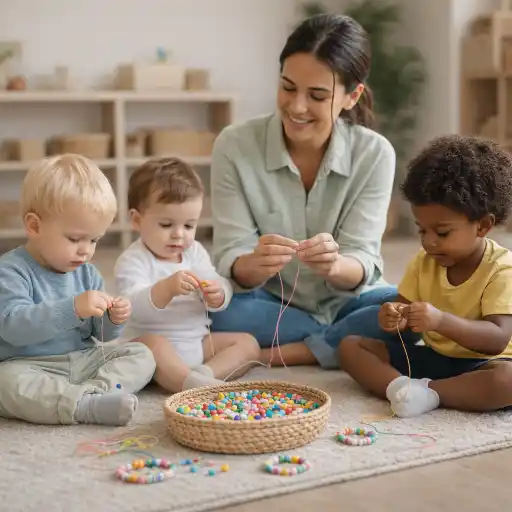
Friendship bracelets are more than craft time: they’re measurable practice toward specific developmental targets. There are clear connections between fine motor skills and academic readiness, self-care, and executive function — so this craft supports learning beyond the hands (importance of fine motor for academics, improving fine motor skills).
- Set measurable goals (examples):
- Thread 5 beads independently (pincer grasp).
- Use both hands—one to hold, one to thread—on 4 out of 5 trials (bilateral coordination).
- Follow a 3-step visual pattern without prompting (visual sequencing).
- Documentation tips:
- 📋 Quick checklist: list target skills and mark attempts during center time.
- 📷 Photo evidence: take a before/after or a child showing their finished bracelet with a one-line caption of the skill practiced.
- 📈 Progress notes: rotate tasks’ difficulty and note when to advance (smaller beads, two-color patterns, letter beads).
- Why it matters:
- Fine motor practice supports handwriting, dressing, and classroom participation.
- Low-stakes, play-based tasks reduce frustration and build confidence, increasing motivation to try more complex tasks later.
What common mistakes should I avoid, and what are quick FAQs to share with staff?
Common pitfalls are avoidable with planning. Below are typical mistakes,s plus practical fixes and a short FAQ for fast staff reference.
- Common mistakes & fixes:
- ❗Too-hard materials: start large and simplify (use cereal loops or straws) rather than force precision.
- ❗Insufficient supervision for small parts: separate under-3 activities and store small pieces securely.
- ❗No clear expectations: show a sample, post a 3-step visual, and do a 30-second model.
- ✅ Lack of documentation: use a one-line checklist to capture the skill practiced and the child's response.
- FAQ (quick answers):
- Q: What materials are safest for toddlers? A: Use large beads, straws, or pre-looped pipe cleaners; avoid anything that fits into a toilet-paper-roll test for choking safety (safety guidance).
- Q: How long should a bracelet station run? A: 12–20-minute rotations fit attention spans and allow repetition.
- Q: How often should children do fine motor practice? A: Daily short sessions (10–20 minutes) plus incidental moments in routines improve outcomes (see activity ideas).
- Q: How do we include diverse learners? A: Offer multiple difficulty levels per tub, tactile variations, and assistive tools (grip aids, larger beads).
For additional ready-made activities and printable curriculum extensions (feelings, matching, infant/toddler adaptations), explore ChildCareEd’s free resources and curriculum pages (Resources, Feelings Color Match Buy Now $0.00).
Conclusion
Friendship bracelets provide a natural, joyful context to strengthen core #finemotor skills while supporting social-emotional learning and classroom readiness. Implement with simple, labeled kits, short rotations, and measurable goals: 1) pick materials, 2) demo, 3) monitor, 4) document. Use inclusive options and supervise small parts carefully — state requirements vary - check your state licensing agency. These small investments yield real gains in independence, confidence, and the fine motor foundation children need for school success. Keep it playful, scaffold deliberately, and celebrate progress: your team is building important skills one bracelet at a time. #friendship #bracelets #finemotor #daycare #craft.
- 45-Hour School Age Curriculum
- CDA Home Visitor Subject Area 2 Part 3 Birth to 5
- Beyond the Classroom: Connecting Families to Essential Services
- Coordinating with Community in Child Care
- 45 Hour Infant and Toddler Methods and Materials
- Pediatric RSV First Aid & CPR/AED
- 45 Hour School Age Methods and Materials
- Art from the Heart for Preschoolers: Open Ended Art Projects that Build Self-Esteem
- Potty Training Made Simple
- Summertime Crafts for All Abilities
- Developing Skills Through Fall Crafts in Childcare
- Crayons, Chopsticks, and Cheerios: Surprising Ways to Boost Fine Motor Skills in Kids
- How to boost fine motor skills: Holiday Edition
- DIY Snow Globes: The Fine Motor Craft That’ll Keep Kids (and Adults) Busy for Hours
- Confetti, Glitter, and Fine Motor Fun: Montessori Craft Ideas
- Increasing Fine Motor Skills in the Early Childhood Education Classroom
- CDA Certification en Español: Recursos y Consejos para Educadores Bilingües
- St. Patrick’s Day Activities for Kids: Fun, Educational, and Easy Ideas for Parents & Teachers
- 🔍 ¿Qué ves cuando observas a un niño aprender?
- What are 25 easy fine motor activities I can use in my preschool?
- Actividades de Motricidad Gruesa que Desarrollan el Equilibrio, la Coordinación y la Fuerza
- 10 Ejemplos de Cómo la Cultura Influye en el Desarrollo Infantil
- Proporciones de Cuidado Infantil y Tamaños de Grupo por Edad en Maryland (Guía Rápida para Centros y Hogares)
- Celebrando la amistad en el cuidado infantil durante el Día de los Mejores Amigos
- Diversión fresca de verano: actividades del Día Nacional del Helado para niños
- Canciones, juegos y preguntas de círculo para niños
- Cómo simplificar la capacitación para sus empleados de daycare
- Can a simple friendship bracelet craft strengthen fine motor skills in your daycare?
- How can I meaningfully involve grandparents in my daycare program?
