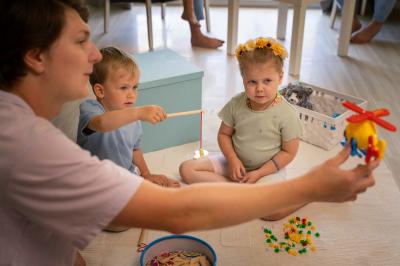
Recognize the needs of individualized learning for infants and toddlers.
Recognize the needs of individualized learning for infants and toddlers in family child care. Our page focuses on early childhood education and child care centers, providing essential information on how to create a tailored learning experience that meets the unique needs of each child.Trainings incorporating this outcome
120 hours courses
 12 CEUs
 online
5/5
12 CEUs online
4.8/5
12 CEUs online
CDA Family Child Care Credential with Portfolio Review  Credencial CDA de Cuidado Infantil Familiar con Revisión del Portafolio
Credencial CDA de Cuidado Infantil Familiar con Revisión del Portafolio 5/5
12 CEUs online
CDA Infant/Toddler Credential with Portfolio Review Credencial CDA para infantes y niños pequeños con revisión de portafolio
Credencial CDA para infantes y niños pequeños con revisión de portafolio 4.8/5
45 hours courses
4.5 CEUs online
4.7/5
30 hours courses
3 CEUs online
4.7/5
3 CEUs online
CDA Bridge Bundle: Family Child Care without Portfolio Review Paquete puente CDA: Cuidado infantil familiar sin revisión de portafolio
Paquete puente CDA: Cuidado infantil familiar sin revisión de portafolio 5/5
3 CEUs online
CDA Bridge Bundle: Infant/Toddler without Portfolio Review CDA Paquete puente: Bebé/niño pequeño sin revisión de portafolio
CDA Paquete puente: Bebé/niño pequeño sin revisión de portafolio 4.8/5
3 CEUs online
4.8/5
3 hours courses
0.3 CEUs online
Engaging Indoor Activities for Inclement Weather Actividades entretenidas en interiores para días de mal tiempo
Actividades entretenidas en interiores para días de mal tiempo 4.3/5
0.3 CEUs online
4.5/5
2 hours courses











Related Outcomes
- Recognize the needs of individualized learning in preschool.
- Recognize the needs of individualized learning in family child care.
- Identify the need to maintain individual feeding schedules for infants.
- Demonstrate an understanding of developmentally appropriate practices for infants and toddlers with developmental, emotional, cognitive, language and/or physical needs
- Demonstrate an understanding of developmentally appropriate practices for infants and toddlers with developmental, emotional, cognitive, language and/or physical needs.
- List resources and the referral process for infants and toddlers with a suspected/diagnosed disability.
- List and review tracking systems to monitor the daily feeding schedule of infants and toddlers
- Identify strategies to ensure appropriate infant and toddler supervision
- Recognize theory and theorist in relation to child development and approaches to learning.
- Recognize informal and formal assessments to plan activities, individualize programs, and improve program quality.
- Describe common myths and facts about safe sleep for infants and young toddlers.
- Demonstrate an understanding of how environment and equipment modifications support individual needs.
- Identify indoor activities to plan for infants and toddlers during inclement weather.
- Demonstrate understanding of observational and assessment techniques to track skill development and individual need
- Define healthy practices to mitigate the spread of germs and decrease the likelihood of SIDS in infants and toddlers.
- List safety risks for infants and toddlers and strategies to diminish these risks.
- Identify strategies to ensure appropriate infant and toddler supervision.
- Demonstrate an understanding of how to implement an Individual Education Plan.
- Identify types of abuse in infants and toddlers.
- List the most common reasons why infants and toddlers bite.
Latest Jobs
Related Articles
- Identifying Developmental Milestones in Children
- Recursos en Español sobre el Sueño Seguro del Bebé
- How Can Child Care Providers Understand Temperament in Infants and Toddlers?
- How Can Child Care Providers Introduce Simple Routines to Infants and Toddlers?
- Online Early Childhood Education Courses: Learn, Grow, and Advance Your Career
- Infant Toddler CDA Practice Test: What Should You Know Before Exam Day?
- Should You Use Corrected Age for an 8-Week-Old Baby Born Prematurely?
- Should Child Care Teachers Wake Toddlers From Naps? What Should You Consider?
- Hello, Fall! Cozy Activities to Help Babies Explore the Season
- What Makes Babies Stressed in Child Care? 7 Nursery Changes That Can Help
- How Can Child Care Providers Support Healthy Brain Development in Young Children?
- How Can Child Care Providers Support Memory Development in Young Children?
- How Can Child Care Providers Support Healthy Toddler Development?
- How Can Child Care Providers Support Infant and Toddler Development?
- What Does a Developmentally Appropriate Daily Schedule Look Like?
- How Can Child Care Providers Build a Developmentally Appropriate Curriculum for Infants?
- ¿Todos los niños deben participar en el tiempo de círculo?
- How Can Caregivers Respond Consistently to an Infant’s Distress?
- How Can You Plan for Two Toddlers the Same Age but with Different Skills?
- How Can You Plan Infant Play When the Best Moment Lasts Only a Few Minutes?
