A simple frame can turn an autumn walk into a lively investigation of geometry, observation, and children’s own ideas. Explore easy ways to use Nature Shape Viewer Frames and Discovery Mats, and build your confidence in playful math instruction with Math Foundations in Early Childhood  Buy Now $16.00—a course that offers practical strategies for making math hands-on and meaningful. For a broader look at learning through play, you can also explore Early Mathematics Through Play Buy Now $24.00 as you continue reading.
Why look beyond the familiar oval leaf?
When a child calls a leaf an oval, that is a useful beginning—not the end of the conversation. Fall nature offers an abundance of irregular outlines, repeated patterns, curved edges, branching veins, and shapes that change with the viewing angle. A leaf may appear nearly round, heart-shaped, long and narrow, or difficult to name. Looking closely helps children notice attributes and explain what they see rather than relying only on memorized shape labels.
This matters because early geometry is more than naming circles and triangles. Children develop spatial reasoning as they compare size, orientation, boundary, position, and parts of objects. Outdoor play also gives mathematical ideas a real context: children can match a frame to a natural feature, compare two leaves, or decide whether a twig arrangement resembles a shape. NAEYC describes outdoor environments as rich settings for math and science exploration, while Stanford’s DREME guidance encourages adults to extend children’s investigations without taking over their play.
For providers and directors, a frame-based activity is adaptable and low-prep. It can support language, fine-motor practice, science observation, and collaboration alongside geometry. The aim is not to make every natural object fit a perfect diagram; it is to help children look carefully, share interpretations, and stay curious.
How do frames and discovery mats invite children to notice shape?
A viewer frame narrows attention to a selected area. Children can hold a cardboard frame over a leaf, tree trunk, flower, or patch of sky, then describe the outline and details inside it. A frame may be a simple rectangle, circle, triangle, or child-designed opening. Discovery mats can provide a place to compare collected objects, arrange them by a chosen attribute, or draw what children observed.
These materials make abstract geometry more concrete without limiting children to worksheet answers. A leaf is three-dimensional and irregular, while a shape card is a simplified representation. Comparing them gives children a reason to discuss likenesses and differences: “This leaf is longer than the oval card,” or “The edge curves, but it has a point at the bottom.” Project Learning Tree’s shape activity similarly invites children to find shapes in both natural and built environments, then reflect on what they found.
- Offer frames with different openings and invite children to choose what they want to examine.
- Use a discovery mat with open spaces for sorting, drawing, or placing objects side by side.
- Model descriptive language: curved, pointed, wide, narrow, smooth, jagged, symmetrical, and irregular.
- Ask children to explain their choices rather than insisting on one exact match.
Keep the materials open-ended: the frame guides attention, but children decide what is interesting.
How can educators plan a fall shape investigation?
Begin with a brief invitation: “What shapes might we notice outside today?” Before the walk, show a few frames and allow children to handle them. Introduce one or two words, such as outline and curve, and demonstrate how to hold a frame steady without pressing it against plants. Then give children time to explore. They might frame a leaf’s edge, the spaces between branches, a pinecone’s repeating scales, or the round opening of a tree knot.
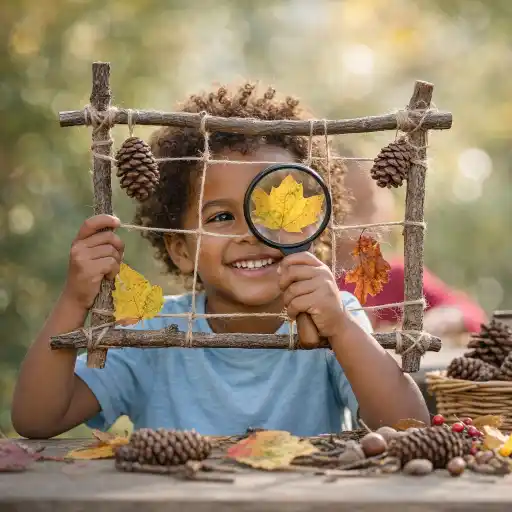
When children return, place safe, collected materials on the discovery mats. Invite them to compare items, sort in more than one way, and represent their observations with drawings or photographs. Nature-based math guidance from DREME recommends noticing children’s interests, offering relevant prompts, and supporting problem-solving without directing every step. A good prompt opens a path: “What do you notice about these two outlines?” or “How could we arrange the twigs to make a corner?”
- 🔎 Start with a short, supervised walk and a small number of frames.
- Invite children to find one similar feature and one difference between two objects.
- Use twigs or large, safe natural pieces to build straight, curved, or closed outlines on a mat.
- Revisit the collection later to see whether children notice new details.
Allow interpretations to vary. A child’s explanation can reveal developing geometric thinking even when the object does not closely resemble the sample shape.
How can shape exploration grow into broader math learning?
Shape investigations naturally connect with other early math concepts. Children can sort leaves by outline, size, or color; compare which is longer or wider; count pointed ends or visible sections; and create repeating arrangements. A group might organize leaves from smallest to largest, then decide whether the ordering changes when they sort by color. These tasks bring classification, measurement, patterning, and data language into a familiar seasonal experience.
Invite children to make and test their own rules. One child may group leaves with pointed tips; another may group by color. Ask, “What was your sorting rule?” and “Can you find another way to organize them?” NAEYC’s discussion of outdoor math emphasizes collections, sorting, patterns, and conversations that build on children’s observations. The focus is the reasoning process, not producing a single correct arrangement.
Frames can also prompt spatial language. Children might describe what is inside, outside, beside, above, or between the frame’s borders. They can rotate a frame to see whether the view changes, or compare how a close-up and a wider view represent the same object. Record a child’s words or photograph their arrangement to make thinking visible and help plan a next step.
- Compare length, width, and size using direct side-by-side placement.
- Build a simple repeating pattern with leaves, twigs, or large natural pieces.
- Make a class picture graph of the outlines children noticed most often.
How can programs keep this activity safe, inclusive, and responsive?
Before exploring outdoors, scan the area and set clear boundaries. Avoid unknown plants, mushrooms, animal waste, sharp objects, and materials that may present choking risks. Use active supervision, especially when children are carrying frames or collecting items. Follow your program’s cleaning and handwashing practices, check family information for relevant allergies, and use safe substitutes—such as large felt leaves or photographs—when needed. State requirements vary - check your state licensing agency.
Make participation flexible. Some children may prefer to observe without touching; offer tongs, a magnifier, or a partner’s help. Children can communicate by speaking, pointing, drawing, using gestures, or sharing words in a home language. Provide seated access to the discovery materials and frames with comfortable grips or larger openings. These adaptations preserve the core experience: noticing, comparing, and communicating.
Avoid turning the walk into a search for perfect examples. If children cannot find a square leaf, that is a chance to consider why natural forms are often irregular. Avoid overloading the activity with vocabulary or correcting children before you understand their reasoning. Use brief observations to guide future planning: what did the child compare, what language did they use, and what question might extend the investigation?
How can providers carry the discoveries forward?
Keep a small collection of children’s drawings, photos, and dictated observations near the math or science area. A child’s comment—“This one is pointy at the top but round on the sides”—can become a prompt for the next day’s comparison. Invite families to notice shapes on a neighborhood walk or share a photo of a leaf, seed, or tree from their surroundings. This helps connect classroom inquiry with children’s everyday environments.
For a simple extension, place frames and mats in an outdoor or indoor center for several days. Add new materials gradually, such as bark, large seed pods, or classroom objects for comparison. Ask children to revisit a previous drawing and see whether they want to add details. That return to an idea supports sustained inquiry and shows that learning can deepen through repeated observation.
Conclusion
How can fall nature frames help preschoolers discover more than leaf shapes? They focus children’s attention, invite rich comparisons, and create authentic opportunities to explore geometry, spatial language, patterns, measurement, and classification. Prepare thoughtfully, keep the activity open-ended, and use responsive questions to extend children’s ideas without taking over. A frame is small; the possibilities for observation and learning are broad.
For continued professional learning, explore these English-language ChildCareEd courses:
- Math Foundations in Early Childhood Buy Now $16.00
- Early Mathematics Through Play Buy Now $24.00
- No Such Thing as Boring Math Buy Now $24.00
- Creating the Natural Outdoor Classroom Buy Now $16.00
- Building Early Science Foundations Buy Now $16.00
Small moments of looking closely can help children see that shapes are not confined to cards or blocks: they are part of the living world they explore every day.
- 45 Hour Child Growth and Development
- CDA Home Visitor Subject Area 3 Part 3 Birth to 5
- Easy Steps to Resume and Interview Success
- Tracking Progress, Shaping Futures: Observation & Assessment Skills
- Pediatric RSV First Aid & CPR/AED
- Art from the Heart for Preschoolers: Open Ended Art Projects that Build Self-Esteem
- Sensitive Periods in Montessori: Guiding Natural Learning
- Texas Director Credential
- 45 hour Growth and Development Birth-age 12 ONLINE
- Nature’s Classroom: Why Fall Is the Best Season for Sensory Learning Outdoors
- Pumpkins, Pinecones, and Leaves: Autumn-themed STEM Projects
- Actividades de Otoño Fáciles para Preescolares esta Temporada
- Cómo Trabajar en el Cuidado Infantil en Carolina del Norte: Requisitos y Pasos
- Pumpkin, Leaves, and Apples: Fall Activities for Preschoolers
- Celebrando la amistad en el cuidado infantil durante el Día de los Mejores Amigos
- How can leaf-themed art and science activities deepen learning in my child care program?
- What’s Happening Outside? Fall Science Adventures for Preschoolers
- Go on a Fall Hunt! Outdoor Learning Challenges for Preschoolers
- Can You Build a Leaf Bridge? Fall STEM Challenges for Pre-K
- How Can Fall Literacy Activities Build Early Language and Communication Skills?
- How Can You Adapt Fall Learning Activities for Children of Different Ages?
- How Can Fall Art Leave Room for Children’s Ideas Beyond Matching Pumpkins?
- How Can You Plan Fall Activities for a Mixed-Age Family Child Care Group?
- How Can a Kite Design Help Children Discover Symmetry?
- How Can Preschoolers Tell Evergreen Trees from Trees That Change Color?
- How Can Fall Sorting Mats Show Children That More Than One Answer Can Be Right?
- How Can Fall Nature Frames Help Preschoolers Discover More Than Leaf Shapes?
- How Can Fall Clubs Engage School-Age Children Who Have Outgrown Preschool Crafts?
- How Can Preschoolers Revisit Fall Through Photos, Predictions, and Discoveries?
