When children describe a circle, compare a triangle with a rectangle, or find a shape in a story illustration, they are doing more than learning geometry—they are building language for thinking and reading. Science of Reading Foundations in the Pre-K Classroom Buy Now $16.00 can help educators connect vocabulary, oral language, print knowledge, and storytelling through practical classroom experiences. For a complementary focus on interactive books, explore Reading Aloud and Storytelling  Buy Now $16.00, which can strengthen read-aloud practice while supporting professional learning.
Why does shape vocabulary matter for early reading?
Shape vocabulary gives children precise words for describing what they see, how objects relate to one another, and why items are alike or different. Words such as circle, triangle, rectangle, edge, corner, curved, and straight expand children’s oral language while supporting classification, comparison, and visual attention.
These abilities overlap with early reading. Literacy and mathematics both require children to notice attributes, recognize patterns, organize information, explain reasoning, and connect symbols with meaning. The ReadWriteThink shape-hunt lesson describes how read-alouds, environmental exploration, spelling, writing, and reflection can be integrated around geometry (Going on a Shape Hunt).
Oral language is especially important because vocabulary supports children’s later comprehension. A systematic review of 72 longitudinal studies found that preschool vocabulary and grammar predicted reading comprehension, word reading, and pseudoword reading (systematic review and meta-analysis). Shape talk is therefore not an isolated math exercise; it is an opportunity to help children understand and communicate meaning.
- Use exact words repeatedly in authentic situations.
- Connect words to objects, gestures, drawings, and photographs.
- Invite children to explain rather than only repeat labels.
- Honor home-language terms and multilingual forms of participation.
How can read-alouds connect shape words with print?
Picture books provide a natural setting for combining geometry, oral language, and emergent reading. During a first reading, prioritize enjoyment, comprehension, and children’s responses. On a later reading, revisit illustrations and deliberately notice shapes, attributes, and positional relationships.
Choose books with illustrations that show recognizable shapes in meaningful contexts: wheels that are circles, windows that are rectangles, roofs that may resemble triangles, or boxes that suggest three-dimensional forms. DREME notes that picture books can develop math and language simultaneously through numbers, shapes, patterns, and measurement (Math in Storybooks).
Use a gradual sequence of questions:
- “What shape do you notice?”
- “What makes you think it is a rectangle?”
- “How is this shape like the one on the previous page?”
- “Where else might we find this shape?”
Write one or two target words on chart paper beside a quick drawing. Point to the word as you say it, invite children to clap its syllables, and reread it in a sentence. Children do not need to memorize every printed label; they need repeated, meaningful encounters with print. Shared reading also creates back-and-forth conversation, a practice NAEYC describes as valuable for language development and early mathematical thinking (Extending the Math in Picture Books).
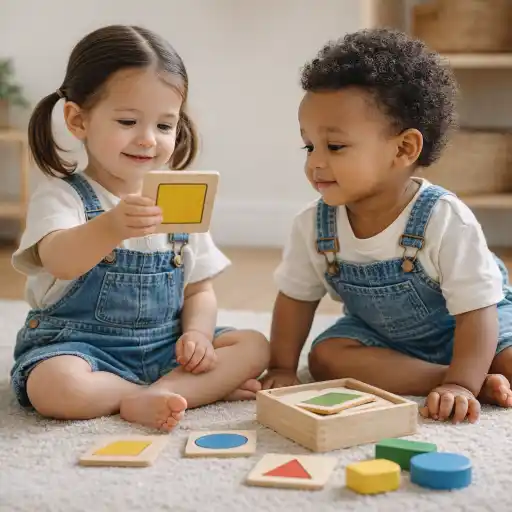
How can educators turn the classroom into a shape-and-reading laboratory?
The classroom itself is an accessible text. Invite children to search for shapes in doors, clocks, shelves, signs, windows, containers, blocks, and outdoor equipment. Begin with a small set of familiar shapes, then gradually add less common forms or three-dimensional vocabulary.
Prepare a “shape detective” basket with paper shapes, clipboards, crayons, picture cards, and labels. Children can work individually, with a partner, or in a small teacher-led group. Ask them to locate an object, sketch it, select or attempt to write its shape name, and describe where they found it.
- 📚 Read a shape-focused book before the hunt and revisit it afterward.
- Post labels such as “circle,” “square,” and “rectangle” near real examples.
- Invite children to photograph or draw shapes found outdoors.
- Create a class chart: “We found circles in the clock, plate, and wheel.”
- Compare examples: “This window is rectangular, but this sign is square.”
Environmental print makes vocabulary functional. When children use the chart, word wall, personal dictionary, or classroom labels to attempt spelling, they learn that print records ideas and helps people communicate. A child’s invented spelling is meaningful evidence of developing sound awareness and print knowledge; respond by valuing the attempt and modeling conventional spelling without turning the activity into correction.
How can shape activities strengthen phonological and phonics practice?
Shape words are useful for playful sound work, especially when teachers keep activities brief and connected to meaning. Invite children to listen for the beginning sound in circle, square, or triangle. Compare words that start alike, clap syllables, and notice repeated sounds.
- Clap the syllables in tri-an-gle and rec-tan-gle.
- Sort picture cards by beginning sound: circle, cube, and square.
- Play “I spy”: “I spy a shape that starts with /r/.”
- Build shape names with magnetic letters after children identify the object.
- Match a printed word to a shape card, photograph, or classroom object.
Keep the instructional target clear. If the goal is phonological awareness, focus on listening and sound play rather than requiring children to decode the whole word. If the goal is print knowledge, point out letters, directionality, and the relationship between a label and its referent. The course Understanding Print Knowledge in Preschool Buy Now $16.00 offers a focused professional-learning option for educators developing print-rich experiences.
For children learning English, provide gestures, photographs, real objects, and opportunities to say the word in a home language and English. Avoid treating pronunciation differences as errors. A child may demonstrate conceptual understanding by pointing, sorting, drawing, signing, or explaining through a familiar language.
How can teachers plan, differentiate, and assess shape vocabulary?
Begin with one observable objective, such as “The child names or communicates three familiar shapes” or “The child uses one attribute word while describing a shape.” Then design experiences that move from noticing to naming, describing, applying, and representing.
- Observe: Watch how children use blocks, puzzles, books, and classroom objects.
- Model: Introduce one or two precise words and demonstrate how to use them.
- Practice: Offer repeated opportunities through play, movement, read-alouds, and hunts.
- Extend: Ask children to compare, combine, transform, or explain shapes.
- Document: Record exact words, gestures, strategies, and needed supports.
Differentiation can be simple. Offer two shapes instead of six, use large tactile pieces, provide picture-word cards, or invite children to respond by pointing or building. For children ready for greater complexity, discuss attributes rather than appearance: a square has four equal sides, while a rectangle has four sides with opposite sides equal, depending on the instructional level and local expectations.
Use brief anecdotal notes, photographs, dictated descriptions, and work samples. A note such as “Jamal found three rectangles, used the word ‘corner,’ and dictated ‘The door is a rectangle’” provides more useful information than a completed worksheet. State requirements vary - check your state licensing agency when documentation or training records are part of program requirements.
What common mistakes should providers avoid?
Shape vocabulary is most effective when it remains connected to meaningful experiences. Several common practices can unintentionally narrow learning.
- Teaching appearance instead of attributes: Do not imply that every triangle must point upward. Rotate shapes and discuss sides and corners.
- Introducing too many terms: Select a few words and use them across the day.
- Relying on worksheets: Begin with objects, movement, conversation, and construction before paper-based practice.
- Correcting without extending: If a child says “round,” respond, “Yes, this is round. We can call this shape a circle.”
- Ignoring language diversity: Invite family vocabulary and use visual supports rather than requiring English-only responses.
- Assessing recognition only: Ask children to describe, locate, compare, draw, build, and use shape words in play.
Directors can support consistency by adding shape vocabulary to read-aloud plans, environmental labels, block-area prompts, and observation forms. The ChildCareEd course Letter & Number Planning in Child Care Buy Now $24.00 can help educators intentionally coordinate early math and literacy goals while considering individual needs. For broader play-based math support, Early Mathematics Through Play Buy Now $24.00 addresses geometry, patterns, measurement, and mathematical reasoning in everyday classroom experiences.
Conclusion: How can shape vocabulary strengthen early reading practice?
Shape vocabulary strengthens early reading when educators treat geometry as language-rich meaning-making rather than isolated labeling. Read shape-filled books, discuss illustrations, search the environment, display meaningful print, play with sounds, and invite children to draw, dictate, build, and explain. These experiences develop vocabulary, visual attention, classification, oral comprehension, and confidence with print.
The most effective approach is intentional but playful: choose a small vocabulary set, repeat it across routines, provide multiple ways to participate, and use observation to plan the next step. When a child finds a rectangle, hears the word, sees it in print, and uses it to describe a real object, mathematics and literacy become connected ways of understanding the world.
Five practical takeaways:
- Pair every new shape word with a real object, image, gesture, and sentence.
- Use read-alouds to notice, compare, and explain shapes.
- Make environmental print functional through labels, charts, and children’s dictation.
- Integrate sound play without confusing phonological awareness with decoding.
- Document children’s language and strategies, not merely correct answers.
Recommended ChildCareEd courses
- Science of Reading Foundations in the Pre-K Classroom
- Language and Literacy Foundations in Pre-K
- Setting the Stage: Story Time
- 24 Hour Texas Pre-Service
- Creating Environments that Nurture Growth and Community
- Texas Director Credential
- Access for All: Inclusion and the ADA
- Classroom Tools for Emergent Literacy
- Supporting Families and Caregivers in Language and Literacy
- Boosting Language Through Play
- 📖 ¿Cómo puedo hacer que la hora del cuento sea la parte más poderosa de mi día?
- 10 Ejemplos de Cómo la Cultura Influye en el Desarrollo Infantil
- Cómo Trabajar en el Cuidado Infantil en Carolina del Norte: Requisitos y Pasos
- Cómo simplificar la capacitación para sus empleados de daycare
- How can New York child care providers use the science of reading to boost early literacy?
- How Does the Brain Develop During the First Five Years?
- Can we build early literacy skills through play in high-quality child care?
- How can child care providers build early literacy skills through play?
- How can child care providers build early literacy skills through play?
- Why Do Bilingual Classroom Activities Matter for Dual Language Learners?
- How Can Child Care Programs Build Meaningful School Readiness?
- How Can Emergent Readers Support Vocabulary Growth?
- What Are the Best Ways to Support a Child’s Speech Development?
- How Can Child Care Providers Understand and Support Speech and Language Development?
- How Can Simple Music and Movement Activities Build Early Literacy Skills?
- How Can Shape Vocabulary Strengthen Early Reading Practice?
- How Can Predictable Text Reinforce Shape Concepts in Preschool?
- How Should Providers Respond to Invented Words in Children’s Stories?
