A toddler who eagerly finds a familiar cup may hesitate when shown its photograph—and that pause can be a meaningful part of learning, not a failure. Explore practical ways to build the bridge from tangible objects to images, and consider Observing & Assessing in Child Care  Buy Now $16.00 to strengthen your skills in documenting development and planning responsive experiences. For a structured, hands-on activity sequence, the Real Object to Photo Matching Progression Pack is a helpful resource to explore alongside this guidance.
What makes a photograph harder to understand than a real object?
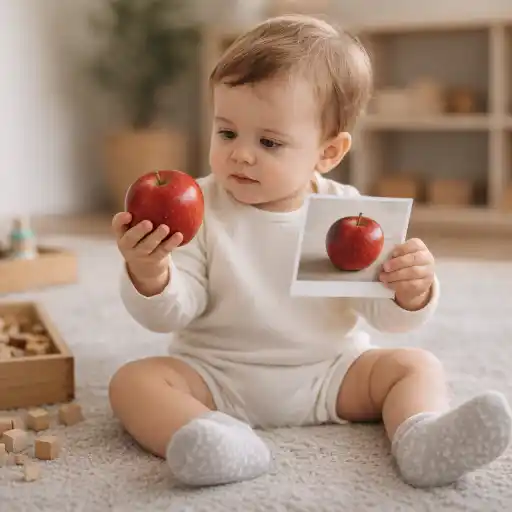
A real object can be touched, turned, smelled, and explored from several angles. A photograph is flat, still, and viewed from one perspective. For a young child, understanding that this two-dimensional image stands for a three-dimensional object requires symbolic representation: the child must connect what is on the page with something in the real world. This is a developing thinking skill, not simply a matter of knowing an object’s name.
Children may also recognize an object in its familiar setting but not identify it when it appears in a different context. A banana in a lunchbox may be easy to recognize; the same banana photographed against a plain background can look unfamiliar. Lighting, angle, image style, and visual complexity all affect how clearly the picture communicates.
Early learning resources describe how children gradually learn that pictures and other symbols represent real things through interactions with adults and their environment. As the ECE Resource Hub’s overview of symbolic representation explains, everyday interactions and pretend play can support this growing understanding.
- Begin with an object that is familiar and interesting to the child.
- Use a clear image showing the object by itself, from a recognizable angle.
- Allow time to look, point, touch, and compare without turning the moment into a quiz.
Does this difference mean the child is behind?
Not by itself. Children develop at different rates, and their ability to show what they know can vary with the setting, materials, language, and mood. Recognizing the actual item but not a photograph may simply indicate that the child is more comfortable with concrete experiences than with symbolic ones. It is useful information about the child’s current learning pathway—not a diagnosis.
Milestones are helpful reference points, not a complete measure of a child’s abilities. The CDC notes that toddlers’ skills change across areas such as play, learning, language, and movement, and recommends encouraging exploration and simple matching games. See the CDC’s guidance for toddlers ages 1–2 and toddlers ages 2–3 for broader developmental context.
Providers can notice whether the child succeeds when the picture is larger, more realistic, paired with a spoken label, or presented with fewer choices. A child may demonstrate understanding by reaching for the real item, vocalizing, looking back and forth, or bringing the photograph to an adult. Communication takes many forms.
If a concern persists across everyday situations or several developmental areas, document specific examples and follow program procedures for discussing observations with the family. Do not diagnose or compare children. Share what you noticed and invite the family’s perspective.
How can providers scaffold from real objects to photographs?
Use a gradual progression, adjusting the challenge based on the child’s engagement. Many children benefit from matching identical real objects first, then linking an object to a photograph, and later matching pictures to pictures. The sequence is a teaching aid, not a rigid timetable; a child may move forward, pause, or need more concrete practice depending on the material and context.
- Start with the real thing. Offer one familiar item, name it naturally, and let the child explore safely.
- Pair object with photo. Place one clear photograph next to the object. Say, “Here is your cup. This picture shows a cup.”
- Invite, don’t test. Ask, “Would you like to find the picture of the cup?” Wait and notice the child’s response.
- Add a small choice. When the child is comfortable, offer two photographs with visibly different subjects.
- Repeat meaningfully. Use photos of classroom materials, familiar foods, pets, or objects the child chooses.
Keep materials manageable and use images that resemble the actual object. A toy cow paired with a photograph of a real cow can be less confusing than an abstract drawing or a busy scene. Activities centered on exploration rather than correctness are consistent with the practical guidance in object-to-picture matching.
What should educators observe and document?
Observe the child across more than one attempt and context. A single mismatch may reflect distraction, fatigue, unfamiliarity with the picture, or simply a preference to play another way. Write down what happened without interpreting the behavior as unwillingness or inability. For example: “During free play, Maya picked up the wooden spoon when asked to find one. When shown a photograph of a spoon among three cards, she looked at each card and then returned to the spoon.”
Notice the conditions that help the child participate. Does matching improve with one photo at a time? Does the child respond to a familiar voice, a gesture, or a spoken label? Are realistic photos easier than illustrations? Does the child point, look, reach, name, or bring items to an adult? These details can help you select a supportive next step.
Observation is most useful when it informs teaching. NAEYC describes ongoing, purposeful observation as a way to understand children’s strengths and interests, adapt strategies, and plan experiences. Read Using Observation to Guide Your Teaching for examples of turning what educators notice into responsive planning.
- Record the date, setting, materials, and exact prompt used.
- Describe what the child did, said, or communicated nonverbally.
- Note supports offered and whether the child engaged or showed interest.
- Use observations over time; no single activity should stand in for a full assessment.
For further professional learning, Assessing through Observation Buy Now $35.00 focuses on observation strategies and methods of assessment. Providers seeking broader developmentally appropriate assessment knowledge can also explore Tracking Progress, Shaping Futures: Observation & Assessment Skills Buy Now $55.00.
What common pitfalls should providers avoid?
Matching can look like a simple game, but an adult’s expectations and setup influence what the child is being asked to do. Avoid increasing difficulty too quickly or treating every attempt as a measure of ability. If the child does not match, that response can guide your next adjustment: reduce choices, use a more familiar object, simplify the image, or return to hands-on exploration.
- Too many cards at once: Begin with one image, then offer two distinct choices as the child is ready.
- Unclear or stylized pictures: Choose well-lit photographs with a simple background and a recognizable view.
- Repeated quizzing: Model the match and describe what you notice instead of asking the child to name every item.
- Correcting immediately: Pause to let the child inspect, try, and revise. Offer a calm hint only if it helps.
- Assuming a mismatch means no understanding: Look for other evidence, including gaze, gesture, exploration, and recognition in routines.
- Unsafe small materials: Supervise closely and choose items appropriate for children’s ages and mouthing behaviors.
Some children may benefit from photographs that reflect their home and community: a familiar cup, a family pet, or a classroom object they use every day. Invite families to share what images or objects are meaningful, while following program policies for privacy and documentation. Respectful, culturally responsive practice makes learning materials more relevant and communication with families more collaborative.
Keep the experience brief and pleasant. A child who walks away may be finished, not incapable. Return to the activity another time or embed object-photo connections into a book, snack routine, or cleanup. The goal is a supportive opportunity to notice and connect, not a performance.
How can providers turn observations into next steps?
Use a simple plan–observe–reflect cycle. First, identify a small learning opportunity: for example, connecting a child’s familiar block to a photograph of that block. Then observe what the child does with an accessible setup. Finally, reflect on whether the materials, prompt, and setting supported participation, and decide what to try next.
If the child engages with the real object but not the photograph, continue offering concrete play while making the image connection visible and low-pressure. If the child begins to look between the photograph and object, point, or bring them together, recognize that as progress. You might say, “You looked at the picture and found the block.” Specific, warm feedback supports confidence without requiring a correct verbal answer.
Share observations with families using objective examples and ask whether similar responses happen at home. The CDC’s resources for early childhood educators highlight educators’ role as trusted partners and offer tools for conversations about development. If there is an ongoing concern, follow your center’s policies and encourage families to consult the child’s health care provider or appropriate early intervention resource. Providers monitor and share observations; they do not diagnose.
Developmentally appropriate practice also means considering the child’s language, culture, interests, and opportunities to show competence in different ways. NAEYC’s guidance on observing, documenting, and assessing children emphasizes ongoing, responsive methods and using assessment information to guide learning.
Conclusion: What should you remember when a child recognizes the object but not the photo?
A child’s difficulty matching an object to its photograph often reflects the additional symbolic and visual demands of images, rather than a lack of familiarity with the object. Start with real, meaningful materials; introduce clear photographs gradually; keep choices limited; and follow the child’s lead. Photograph matching can nurture #thinking, #language, #observation, #learning, and #development when it feels like discovery rather than a test.
Observe carefully, record factual examples, and adapt the next experience to what the child shows you. Celebrate looking, reaching, comparing, and returning to an activity—not only a completed match. When concerns persist, collaborate with families and follow program guidance rather than making assumptions. For structured practice and deeper professional learning, consider the Real Object to Photo Matching Progression Pack and the ChildCareEd courses linked above. State requirements vary—check your state licensing agency for applicable training or documentation expectations.
- CDA Home Visitor Subject Area 3 Part 3 Birth to 5
- 45 Hour Infant and Toddler Methods and Materials
- CDA Bridge Bundle: Preschool
- CDA Bridge Bundle: Family Child Care
- CDA Bridge Bundle: Family Child Care without Portfolio Review
- CDA Bridge Bundle: Infant/Toddler without Portfolio Review
- CDA Bridge Bundle: Preschool without Portfolio Review
- CDA Bridge Bundle: Infant/Toddler
- Texas Director Credential
- CDA Certification en Español: Recursos y Consejos para Educadores Bilingües
- 🌙 ¿Cómo afecta el tiempo frente a las pantallas el sueño y el comportamiento infantil? 😴
- 🤝¿Cómo fomentar respeto e inclusión en el aula infantil? 🌻
- 🚨 Reporte Obligatorio en Nevada
- ¿Cómo incluir a niños con necesidades especiales en cuidado infantil? Guía práctica y sencilla
- ¿Cómo puedo usar escenarios de juego de roles de primeros auxilios en mi aula?
- Cómo simplificar la capacitación para sus empleados de daycare
- How Can Fun Bingo Games Teach Colors, Shapes, and Animals to Preschoolers?
- How Can Emergent Readers Support Vocabulary Growth?
- How Can Visual Schedules Make Early Childhood Classrooms More Predictable and Inclusive?
- How Can Shape Vocabulary Strengthen Early Reading Practice?
- How Can Repetitive Early Readers Help Children Learn Color Words?
- ¿Todos los niños deben participar en el tiempo de círculo?
- How Can a Picture Label Become a Real Conversation with a Preschooler?
- Can Every Toddler Reach and Recognize Their Own Storage Space?
- Why Do Toddlers Keep Asking Where Their Belongings Go?
- When Does a Classroom Picture Mean Something Different to a Child?
- Is the Child Following the Picture or Your Pointing Finger?
- How Can Consistent Tactile Landmarks Help Children Find Classroom Materials?
- Why Might a Child Recognize a Real Object but Not Its Photograph?
