Fallen leaves can turn an ordinary walk into a lively first math investigation—without worksheets or complicated materials. With attentive supervision and a few intentional prompts, providers can help toddlers notice, sort, match, compare, and make simple patterns; Early Mathematics Through Play Buy Now $24.00 offers a deeper foundation for weaving these ideas into everyday experiences. For an additional nature-based perspective, explore Creating the Natural Outdoor Classroom  Buy Now $16.00, which can help you plan inviting outdoor spaces for exploration.
Why are leaves such useful early math materials?
Leaves are varied, familiar, and easy for children to investigate with their senses. One may be broad and yellow; another, narrow and brown. As toddlers look, touch, carry, and arrange them, they encounter mathematical ideas as part of meaningful play—not as abstract directions to memorize. Outdoor math experiences can also build positive dispositions toward problem-solving when adults follow children’s interests and offer gentle support.
Early math includes more than saying number words. Children begin to classify, notice relationships, compare attributes, and recognize repetition. A leaf collection provides a concrete starting point for these ideas. A toddler might discover that two leaves look alike, place all the large ones together, or notice that a small leaf fits on a picture card.
These moments matter because early classification and comparison are foundations for later mathematical thinking. Head Start’s preschool math goals include comparing quantities, understanding simple patterns, measuring attributes, and describing shapes and positions. Toddlers are at an earlier stage, so the emphasis is on exploration, language, and repeated experiences—not mastery of formal concepts.
Keep the interaction relaxed. Follow children’s attention, name what they notice, and make room for their own discoveries. A child’s surprising arrangement may reveal a thoughtful rule worth asking about.
How can providers explore leaves safely?
Good preparation makes outdoor discovery calmer and safer for everyone. Before a walk, inspect the route and collecting area for hazards, including sharp objects, animal waste, unsafe plants, or areas beyond program boundaries. Choose an age-appropriate space, maintain active supervision, and follow your program’s procedures for outdoor play and natural materials. State requirements vary - check your state licensing agency.
When gathering leaves, adults should help children choose dry, intact specimens from safe locations. Avoid leaves that may be moldy, contaminated, or from plants that cannot be confidently identified. Toddlers may mouth objects, so keep the collection small, supervise closely, and remove unsafe pieces promptly. If gathering real leaves is not appropriate, use large laminated leaf pictures or felt shapes instead.
- Set a clear boundary for where children may explore and collect.
- Offer a small basket or tray rather than bags that can become difficult to manage.
- Wash hands after handling outdoor materials and follow your program’s sanitation practices.
- 🍂 Choose a few large, dry leaves and keep them within an adult’s view throughout the activity.
Safety does not need to flatten curiosity. A brief hazard scan, purposeful positioning, and attentive supervision let children explore while adults remain ready to respond.
How do sorting and matching introduce classification?
Begin with a handful of leaves and an open invitation: “What do you notice?” Give toddlers time to look and handle the materials. They may notice color, shape, size, or texture before they are ready to organize anything. Naming those features builds vocabulary and makes mathematical attributes more visible: “This leaf is smooth,” “That one is wide,” or “These two are both yellow.”
Next, invite children to make a simple group. You might place two different-colored mats or large picture cards on the ground and ask, “Where could this leaf go?” Toddlers can place a leaf beside a matching color or pair a real leaf with a photograph that looks similar. Matching can be done by appearance without requiring children to identify a formal category.
For a child who is ready, offer a second way to sort the same leaves. Ask, “Could we group them by size instead?” This shows that one collection can be organized according to different features. Follow the child’s reasoning rather than insisting on one expected answer; ask, “What made you put these together?” if the child is communicating through words, gestures, or pointing.
- Start with one visible attribute, such as color or large/small.
- Use just a few leaves to keep the choice manageable.
- Model words such as same, different, group, and match in short, natural phrases.
- Accept pointing, placing, and gestures as meaningful ways to participate.
These small decisions help children practice attention, comparison, and early logical thinking.
How can leaves make size comparisons concrete?
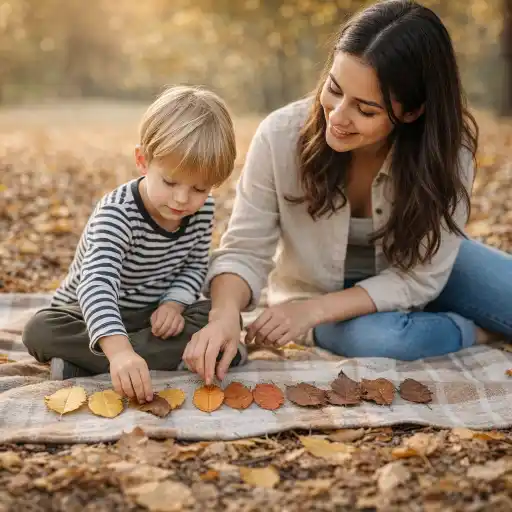
Leaves make size easy to see and touch. Place two leaves side by side and describe the relationship: “This one is bigger. This one is smaller.” Then invite the toddler to choose which is larger or to hand you the smaller leaf. The goal is not to test a child but to make comparative language part of a shared activity.
As children become interested, offer three leaves and arrange them from smallest to largest. Start with clearly different sizes; close comparisons can be confusing for young learners. Use gestures, such as spreading your hands for “big” and bringing them closer for “small.” A toddler may participate by selecting, placing, or watching while you narrate the order.
You can extend the idea with a simple leaf hunt: “Can you find one smaller than this?” or “Let’s find a leaf as long as your hand.” Comparisons with a familiar object or body part give children an intuitive reference. Avoid requiring exact measurement or using a ruler as the main focus; informal comparison is a meaningful first step.
- Offer a contrast pair first, then add another leaf if the child is engaged.
- Use words like bigger, smaller, longer, shorter, and same size consistently.
- Let children move leaves themselves when possible, supporting agency and fine-motor practice.
When children compare real objects, they begin to understand that size is an attribute that can be observed and described. Repeating the experience with leaves, blocks, or toys helps carry the idea into other parts of the day.
How can children explore simple patterns with leaves?
A pattern is a repeated arrangement, and toddlers can begin noticing repetition before they can explain it. Arrange two large leaves in a simple sequence—such as light, dark, light, dark—and pause. Invite the child to place the next leaf or copy the arrangement using two contrasting shapes. Keep the repeated unit short and visually clear.
Patterns do not need to rely on color alone. Use a large leaf and a small leaf, or pair a leaf with a broad, safe classroom object such as a block. Children can also make a movement pattern: touch a leaf, clap, touch a leaf, clap. This variation helps children experience repetition through more than one sensory channel.
Follow children’s interest rather than requiring a correct continuation immediately. If a toddler places a different leaf, respond with curiosity: “You added another one. What should come next?” Demonstrate the repetition again if helpful. For preschoolers or children ready for more, invite them to invent a sequence and describe what repeats.
- Start with two contrasting elements and repeat them several times.
- Point to each item as you name it, giving the child time to observe.
- Invite copying, extending, or making a new pattern—whichever suits the child’s engagement.
Natural materials can lead to richer conversations, too. Children may notice that leaves have different edges or markings, or that colors change across a collection. Those observations connect math with science while honoring children’s questions.
How can providers extend learning and observe progress?
Extend the experience by bringing the collection indoors for a short small-group activity, or by revisiting the same ideas during later walks. A matching game, a two-group sort, and a simple repeating sequence can all use the same few leaves. Repetition with a familiar structure helps toddlers focus on new attributes without facing an entirely new task each time.
Use brief prompts that invite thinking without taking over: “What do you see?” “Which one is smaller?” “Where might this leaf belong?” Then wait. Children need time to inspect, decide, and respond. For dual language learners, pair words with gestures and visuals, welcome home-language descriptions, and avoid making verbal explanations the only way to show understanding.
Observe the process rather than judging a single result. Notice whether a child:
- Looks closely at attributes such as size, color, or shape.
- Matches objects or places similar leaves together.
- Uses gestures, words, or actions to compare two leaves.
- Copies or continues a short repeated arrangement.
- Returns to the activity or changes a strategy after observing what happens.
Write a concise note about the child’s strategy and consider one next invitation. For example: “Matched two leaves by color; next time, offer two sizes to compare.” Keep the activity playful and manageable—too many leaves, too many rules, or rapid correction can make exploration feel like a test.
Conclusion: What can fallen leaves teach toddlers about early math?
Fallen leaves offer toddlers a hands-on introduction to sorting, matching, size comparison, and simple patterns. The learning grows from children’s own observations: noticing what looks alike, deciding where an object belongs, comparing two sizes, or spotting what repeats. Adults make these experiences richer by naming attributes, asking open questions, waiting for children’s ideas, and adapting the challenge to each child.
Plan for safety first, use a manageable number of clean, age-appropriate materials, and treat the process—not a perfect result—as the learning. A short nature walk can become a meaningful math experience when providers remain curious alongside children. The central question has a practical answer: leaves teach early math by giving young children real things to notice, organize, compare, and arrange.
For additional professional learning, review ChildCareEd’s Math Foundations in Early Childhood Buy Now $16.00, Enhancing STEM Education for Infants and Toddlers Buy Now $16.00, and Building Early Science Foundations Buy Now $16.00.
- 45 Hour Child Growth and Development
- What Makes Me Special: An Overview of Autism and ADHD
- Pediatric RSV First Aid & CPR/AED
- Math Foundations in Early Childhood
- CDA Bridge Bundle: Infant/Toddler without Portfolio Review
- Texas Director Credential
- 45 hour Growth and Development Birth-age 12 ONLINE
- 45-Hour Infant and Toddler Curriculum
- CDA Certification en Español: Recursos y Consejos para Educadores Bilingües
- 😤💬 ¿Qué Le Digo a un Niño que Acaba de Morder a Otro?
- 🚨 Reporte Obligatorio en Nevada
- Curso Para Trabajar En Daycare:Qué Necesitas Para Empezar
- Recursos en Español sobre el Sueño Seguro del Bebé
- Actividades de Otoño Fáciles para Preescolares esta Temporada
- Cómo Trabajar en el Cuidado Infantil en Carolina del Norte: Requisitos y Pasos
- Cómo Ser Maestra de Preescolar en Maryland
- Celebrando la amistad en el cuidado infantil durante el Día de los Mejores Amigos
- ¿Cómo puede la retroalimentación visual apoyar la fluidez en la multiplicación?
- How Can Fall Nature STEM Activities Spark Preschoolers’ Scientific Thinking?
- How Can Outdoor Fall Activities Support Children’s Development?
- How Can Fall Activities Build Kindergarten Readiness Skills?
- How Can Preschool Teachers Use Fall Experiences to Support Individual Learning Needs?
- What Happens to Fallen Leaves? Exploring Decomposition With Young Children
- What Can Preschoolers Learn by Watching Trees Change Throughout the Fall?
- Why Can Observing the Same Tree Teach Preschoolers More Than a Nature Walk?
- How Can Preschoolers Tell Evergreen Trees from Trees That Change Color?
- Can Preschoolers Invent a Leaf Carrier That Really Works?
- What Can Fallen Leaves Teach Toddlers About Early Math?
