A toddler who proudly returns one block or carries a cloth is discovering that their contribution matters. Start with the child’s current skills and interests, then use the Toddler Classroom Helper Chart Buy Now $1.99 to introduce a manageable job, such as helping put away toys or books. Offer a simple demonstration, welcome voluntary participation, and adjust your support as the child gains confidence. For practical strategies on matching expectations to children’s development and encouraging autonomy, explore ChildCareEd’s Supporting Children’s Independence  Buy Now $24.00. Read on for ways to choose classroom jobs that help toddlers experience success and belonging.
Why do toddler classroom jobs matter?
For toddlers, a small responsibility can make an abstract idea—“I belong to this group”—visible and concrete. Returning a book to a low shelf, carrying a clean cloth, or placing a toy in a familiar basket allows a child to see how an action affects the shared classroom. Meaningful participation can support emerging confidence, communication, coordination, and a sense of connection.
Jobs also fit naturally into daily routines. NAEYC describes daily routines and classroom transitions as essential elements of supportive environments for young children. When a toddler takes part in a predictable routine, they can practice noticing what comes next, following a simple sequence, and engaging with materials alongside others.
The goal, however, is not to recruit toddlers to complete adult work or to keep them compliant. A job should meet a real, child-appropriate classroom need and offer a supported chance to participate. Success may mean trying one step, communicating a choice, or asking for help—not finishing perfectly.
These distinctions matter to directors and educators. When jobs are safe, accessible, and offered warmly, they can strengthen community without turning everyday helping into a test. That approach honors both the child’s developing abilities and the adult’s responsibility to guide.
What signs suggest a toddler is ready for a job?
Readiness is not a fixed age or a single milestone. It is a practical judgment based on what the child can do in a particular context, with reasonable support. Observe the toddler during familiar routines: Do they show interest in carrying, placing, matching, or putting away objects? Can they engage briefly with a task? Do they respond to a gesture, picture, or simple phrase? A child does not need to perform independently before being invited to try.
Consider the task’s demands alongside the child’s current strengths. A job that requires carrying one lightweight book may be accessible, while a multi-step request such as “clean the whole room” is likely too broad. The National Association for the Education of Young Children’s developmentally appropriate practice guidelines emphasize knowing children as individuals and observing their learning in context. Head Start likewise notes that toddler learning happens within relationships with important adults (infant/toddler teaching practices).
- Notice interests: Does the child gravitate toward books, plants, music, or putting objects into containers?
- Check access: Can the child reach the materials and destination safely?
- Think about communication: Can the child respond through words, gestures, pointing, pictures, or a communication system?
- Allow variation: A child may be ready on one day and need more help on another.
Readiness is about whether the opportunity can be made understandable and safe—not whether the toddler is quiet, fast, or eager to please.
Which classroom jobs are safe and manageable to try?
Begin with brief tasks that have a visible beginning and ending, use familiar objects, and involve one or two simple actions. Demonstrate the task and remain close enough to supervise. As with any classroom practice, state requirements vary - check your state licensing agency, especially for tasks connected to meals, cleaning, doors, or care of living things.
- 🧺 Basket helper: Put one or two large, safe toys in an open, labeled basket.
- Book helper: Carry a sturdy book to a low shelf or reading area.
- Cloth carrier: Bring a clean, lightweight cloth to an educator or a designated spot.
- Napkin helper: Hand a napkin to one or two peers with close adult supervision and in line with meal and allergy procedures.
- Plant helper: Hold a small watering tool while an adult manages the amount of water and supervises the activity.
- Music helper: Choose between two songs or place a simple instrument in its storage spot.
- Visual schedule helper: Carry or point to a transition picture with an educator.
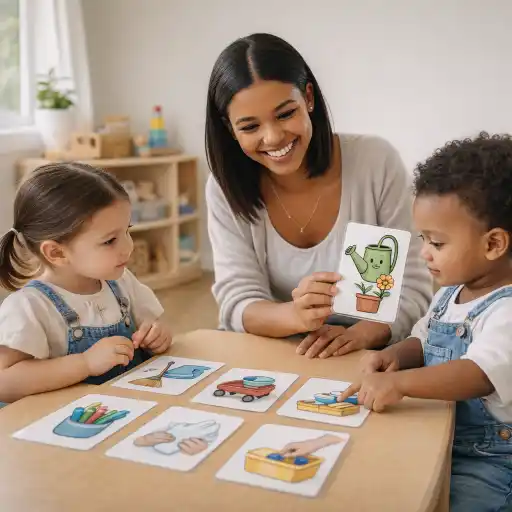
Adapt jobs to the child rather than expecting every child to do them in the same way. A toddler who does not use spoken language may match a photo, point, gesture, or hand over an object. A child who prefers less sensory input might choose a dry cloth task instead of watering. These are meaningful forms of participation, not lesser roles.
Keep toddlers away from cleaning chemicals, sharp or heavy tools, hot liquids, and unsupervised access to doors, food, pets, or other hazards. Child participation never replaces adult sanitation, food-safety, or supervision responsibilities.
How can educators introduce a job and offer the right support?
Introduce a job during a calm, familiar part of the day. Get down to the toddler’s level, say the task in a few clear words, and show the action slowly: “Book helper. Pick up the book. Put it here.” Pair language with a gesture, object, or photograph if that helps the child understand. Then pause. Toddlers often need time to process a prompt and decide how to respond.
Offer the least assistance that makes participation possible. You might bring the basket within reach, point to the picture, model one step, or help steady an object. If the child is struggling, simplify the task instead of immediately taking over: try one block rather than three, or let the child carry an empty cup while you pour.
- Choose one safe, concrete task connected to a real routine.
- Model the task and make the materials easy to find and reach.
- Invite the child to try, then wait attentively before adding another prompt.
- Describe the action and its effect: “You put the book on the shelf.”
- Offer a different role or a later opportunity if the child declines.
Specific acknowledgment helps toddlers connect effort with contribution without turning helping into a prize. Instead of promising a treat or insisting on a perfect result, say, “You carried the cloth to the table,” or “You put the block in the basket; now there is room for another.” Head Start’s guidance on developmentally appropriate practice with infants and toddlers also underscores that expectations should reflect each child’s development, culture, and relationships.
How can jobs include every toddler without pressure?
Equity means every child has a genuine way to participate—not that everyone must do an identical task. A chart can help toddlers anticipate a routine, but it should not become a public ranking, a reward for “good behavior,” or a measure of who is most capable. Make jobs available to children with different mobility, sensory, attention, language, and communication needs.
- Use photos, symbols, gestures, home-language words, or communication tools as helpful cues.
- Offer seated and movement-based versions of responsibilities.
- Let a child work alongside an educator or peer when shared participation makes the task more accessible.
- Rotate opportunities thoughtfully, allowing enough repetition for toddlers to become familiar with a role.
- Notice quiet attempts, choices, persistence, and help-seeking—not only enthusiastic or complete performance.
Relationships remain central. Head Start explains that infants’ and toddlers’ learning takes place in the context of relationships with important adults. Warm invitations, patient pauses, and respectful responses to refusal help keep the job connected to trust. If a child says no or turns away, acknowledge the cue: “You don’t want to carry the book right now. I’ll do it, and you can try another time.”
Families can offer useful insights about children’s interests, familiar routines, language, and ways of helping at home. Ask with curiosity rather than assuming that every family has the same practices. The NAEYC resource on planning for individuality describes observation and family relationships as important ways to understand children’s strengths and contexts.
How can staff tell whether a job is a good fit?
Evaluate the design and support, not the toddler’s worth or willingness. Brief, objective observations help educators determine whether a task is engaging, accessible, and appropriately challenging. Record what happened and what support was useful: “After seeing the photo, Sam carried one book to the low shelf; an adult pointed to the basket for the second step.” This is more informative than labeling a child “not ready.”
Use observations to adjust the job. If a toddler waits for repeated directions, keep a clear visual cue available and pause before prompting. If children crowd around one role, offer two complementary tasks or duplicate safe materials. If the task leads to frustration, reduce the number of steps, change the tool, or try a different job that serves a similar purpose.
Common pitfalls are manageable when staff share a simple plan:
- Assigning multi-step responsibilities before toddlers understand each part.
- Prompting so quickly that children have no time to respond.
- Offering jobs only to verbal, compliant, or fast-moving children.
- Using responsibilities as rewards, punishments, or tests of obedience.
- Allowing children to handle hazardous materials or replacing adult safety duties with child jobs.
Directors can support consistency by agreeing on a small set of jobs, modeling invitations and adaptations during team meetings, and checking that materials are accessible. For added professional learning, explore Early Learning with Infants and Toddlers Buy Now $24.00, Positive Attention: Interactions & Supervision of Infants and Toddlers, Playful Learning: Infant & Toddler Activities Buy Now $25.00, and Environments That Inspire Independence and Exploration Buy Now $55.00. Each offers further learning connected to development, responsive interactions, planning, or inclusive environments.
Conclusion: How do you choose a job a toddler is ready to try?
Choose a job by observing the individual toddler, then matching a real classroom need to a short, safe, understandable task. Look for interest and emerging skills, make materials accessible, model the steps, and offer only as much help as needed. Readiness is flexible: a child may participate with a cue, an adaptation, a partner, or adult support.
Most of all, keep the purpose focused on contribution and belonging—not adult convenience, rewards, or perfect performance. When educators invite rather than pressure, adapt responsibilities equitably, and respond warmly to children’s cues, everyday jobs can become gentle practice in #independence, #confidence, #responsibility, #belonging, and #routines. The guiding question remains: Is this task safe, meaningful, and possible for this toddler with the support available?
- CDA Certification en Español: Recursos y Consejos para Educadores Bilingües
- 💛🧩 ¿Cómo puedo hacer que mi enseñanza sea inclusiva para los niños con autismo?
- Qué capacitación se requiere para ser director de cuidado infantil en Texas?
- Requisitos Para Ser Maestra Principal En Un Daycare: Lo Que Necesitas Para Empezar
- Que es Título 22 en California?
- ¿Cuánto tiempo se tarda en obtener una certificación CDA?
- ¿Cómo empiezo mi certificación CDA en Florida en línea?
- 10 Ejemplos de Cómo la Cultura Influye en el Desarrollo Infantil
- Cómo Iniciar el Proceso de Obtención de la Licencia de Cuidado Infantil
- ¿Cómo solicito la licencia para una guardería en California?
- Regulaciones de Licenciamiento de Cuidado Infantil en California para Centros y Hogares de Cuidado Infantil Familiar
- Proporciones de Cuidado Infantil y Tamaños de Grupo por Edad en Nueva Jersey (Guía Rápida para Centros y Hogares)
- Proporciones de Cuidado Infantil y Tamaños de Grupo por Edad en Virginia (Guía Rápida para Centros y Hogares)
- Cómo Trabajar en el Cuidado Infantil en California: Requisitos y Pasos
- Cómo Ser Maestra de Preescolar en Wisconsin
- Celebrando la amistad en el cuidado infantil durante el Día de los Mejores Amigos
- Cómo simplificar la capacitación para sus empleados de daycare
- How Can Transition Routines Keep Toddlers Engaged Between Activities?
- How Can Toddlers Contribute to Classroom Jobs Without Turning Them into Rewards?
