Food words turn familiar routines into lively opportunities to notice letters, sounds, and meaning. Strengthen your classroom practice with Classroom Tools for Emergent Literacy  Buy Now $16.00, a course that explores practical strategies such as vocabulary activities, interactive read-alouds, and classroom print. Then try the ideas below—and explore the linked Science of Reading Foundations in the Pre-K Classroom Buy Now $16.00 course for a broader learning experience spanning foundational reading skills.
Why are food and kitchen words useful for early literacy?
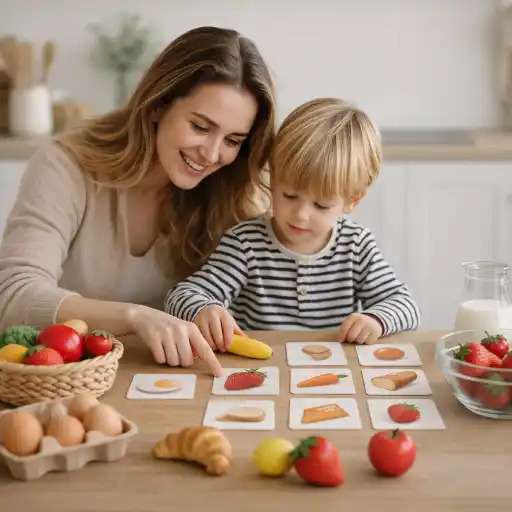
Children encounter food words in meaningful settings: snack, pretend cooking, grocery-store play, family meals, and picture books. These everyday connections give new words a concrete referent and allow children to connect spoken language, images, print, and personal experience. Familiarity can lower the barrier to joining a literacy activity, while new words such as whisk, crust, or ripe offer rich opportunities to stretch vocabulary.
Early reading develops through several related understandings—not simply memorizing words. Children notice that print carries meaning, recognize letters, hear sounds in spoken words, and begin connecting letters with those sounds. A food theme can support each area when adults make the learning visible and playful.
The aim is not to turn every meal into a lesson. Rather, providers can enrich ordinary interactions with brief, responsive conversation and print experiences. A child who points to a picture of an egg or asks for a bun is already communicating; an adult can honor that attempt and gently extend it.
How do picture-supported word activities connect letters and sounds?
Picture-supported activities give children a meaningful clue while they attend to the letters in a word. The Complete the Words - Food & Kitchen Buy Now $1.00 resource invites learners to fill in a missing letter in twelve pictured words: jam, bun, egg, fig, cob, dip, can, pie, sub, yam, pan, and bib. The picture helps children identify the word, and the blank creates a chance to think about which letter or sound completes it.
Use the page as a brief, adult-supported center rather than expecting every young child to complete it independently. Point to the image, say the word naturally, and invite the child to listen: “This is a pan. What sound do you hear at the beginning?” Depending on the child’s stage, focus on the first sound, the missing letter, or simply naming and matching the picture. Keep the exchange encouraging; if a child is unsure, model the answer and let them try again without pressure.
- Say the pictured word, then emphasize the target sound without distorting the word.
- Invite children to point to, name, trace, or choose a letter; writing is only one way to participate.
- After a word is completed, reread it together and connect it to a real object, photo, or pretend-play prop.
- Offer just a few words at a time when a full page feels tiring or overwhelming.
The resource description presents the worksheet as useful for phonics centers, homework packets, or a food-and-nutrition unit. Adjust the format to suit each child’s developmental needs and attention.
How can conversation make food vocabulary stick?
Children need many meaningful encounters with words to understand and use them. Instead of quizzing, model precise language while following their focus: “You’re spreading jam on the bread,” or “The pan is warm; we are stirring the batter.” Pair familiar terms with new ones, and explain unfamiliar words in language children can grasp. For example: “A crust is the outside edge of the bread.”
Try conversational prompts that invite children to notice, compare, and explain:
- “What do you notice about the pear and the apple?”
- “Which ingredient should we add first?”
- “How does the dough feel—smooth, sticky, or crumbly?”
- “What food would you put on your pretend menu?”
When children answer briefly, expand without requiring them to repeat a longer phrase. If a child says “egg,” you might respond, “Yes, a brown egg is in the basket.” These warm exchanges strengthen #vocabulary and keep interaction reciprocal.
How can dramatic play and classroom print extend the learning?
A pretend kitchen or grocery store lets children use food words for real purposes: taking orders, making a shopping list, reading a menu, sorting pretend ingredients, and sharing a meal. Add a few accessible print materials, such as picture-word labels on baskets, a short menu, recipe cards with images, shopping lists, and blank paper for children’s marks. Children may imitate writing before forming conventional letters; their marks are meaningful early communication and deserve a place in the play.
Build on children’s interests rather than overloading the center. Begin with a small collection of safe, age-appropriate props. Add labels that show a picture alongside a word, and invite children to help place labels where they belong. A family recipe book can honor children’s lived experiences and languages. NAEYC’s example of recipe-based play shows how books, ingredients, and adult scaffolding can bring together pretend reading, oral language, and emergent writing.
- Ask children to “read” a menu and choose an item; accept pointing or pretend reading.
- Make a shared class list of ingredients, using pictures and words where helpful.
- Set up a word basket with food labels or picture cards for matching and conversation.
- Link play to a read-aloud about food, then invite children to retell or act out a moment.
ChildCareEd’s article on cooking in the classroom also describes how recipe reading and conversation can support literacy within hands-on experiences. Actual food preparation requires program-appropriate allergy, sanitation, and supervision planning.
How can providers make food-word literacy inclusive and developmentally responsive?
Children differ in language, experience, motor skills, sensory preferences, and familiarity with foods. Start with what each child knows and avoid treating one food tradition as universal. Invite families to share food names, recipes, or images if they wish, and include home-language labels when possible. For multilingual learners, a familiar food word in a home language can be a meaningful bridge to a new word in English—not a detour from literacy.
Offer multiple ways to engage. A child may point to a picture, select a letter card, use a communication device, dictate a shopping list, or listen while an adult models the word. Children who are not ready to write can still explore sounds by listening, matching, or sorting. Choose materials appropriate for children’s ages and abilities; supervise closely, particularly when real food, small pieces, or utensils are present. Follow your program’s allergy and food-safety procedures. State requirements vary - check your state licensing agency.
Use brief observation rather than a high-pressure test to guide next steps. Notice whether a child names a picture, recognizes an initial letter, listens for a sound, joins a conversation, or uses print during play. Record a specific example and plan a modest next challenge. For example, if a child confidently names “jam,” invite them to compare the first sounds in “jam” and “juice.” This responsive approach helps providers build on each child’s strengths and support #inclusion.
How can educators avoid common pitfalls and assess progress?
A themed worksheet can be engaging, but it should be one part of a literacy-rich experience—not a stand-in for conversation, books, play, or responsive teaching. Avoid asking children to perform beyond their developmental readiness, correcting every attempt, or requiring everyone to use the same language or response method. Also avoid assuming that a child’s unfamiliarity with a food indicates limited ability; it may simply reflect different family experiences.
Keep assessment practical and observational. Choose one or two goals for a short activity, such as hearing the initial sound, connecting a picture to a spoken word, or using food print during pretend play. Note what the child does independently and what support helps. Revisit a word in a different context later, such as moving from the worksheet image of a pan to a labeled pretend pan in dramatic play. Repetition across contexts supports meaningful learning without drill.
- ✅ Keep the activity brief, welcoming, and connected to children’s interests.
- Use accurate pronunciation and a clear model of the sound-letter connection.
- Accept speech, gesture, pointing, home-language responses, and AAC as participation.
- Extend a child’s contribution with one useful word or idea instead of turning play into a quiz.
- Observe and document a small example of growth to inform the next activity.
For additional professional learning, explore ChildCareEd’s Reading Aloud and Storytelling Buy Now $16.00, Building Vocabulary Buy Now $16.00, and Language and Literacy Foundations in Pre-K Buy Now $16.00 courses. Together, these English-language courses offer further perspectives on interactive reading, vocabulary, and foundational literacy practice.
Conclusion: What are the key takeaways?
Food and kitchen words can make early reading ideas concrete, engaging, and relevant to children’s daily lives. Picture-supported activities such as Complete the Words - Food & Kitchen Buy Now $1.00 provide a focused opportunity to connect images, spoken words, letters, and sounds. Their value grows when providers extend the experience through responsive conversation, meaningful classroom print, pretend play, and books.
Keep activities brief, adaptable, and inclusive. Honor children’s languages and experiences, offer more than one way to participate, observe what each child can do, and build the next step from those strengths. To develop your own practice further, consider Classroom Tools for Emergent Literacy Buy Now $16.00 for practical classroom strategies, alongside the additional literacy courses linked above. The goal is not to rush children into conventional reading; it is to surround them with joyful, purposeful opportunities to explore how words work.
- Science of Reading Foundations in the Pre-K Classroom
- Reading Aloud and Storytelling
- Language and Literacy Foundations in Pre-K
- Setting the Stage: Story Time
- Texas Director Credential
- Classroom Tools for Emergent Literacy
- Wellness in Action: Teaching Healthy Habits to Children
- Classroom Tools for Emergent Literacy
- Every Moment Matters: Schedules and Transitions
- Supporting Families and Caregivers in Language and Literacy
- STEAM Playground: How to Turn Your Kitchen into a Science Lab
- How to Include Kids in the Kitchen
- CDA Certification en Español: Recursos y Consejos para Educadores Bilingües
- Boosting Language Through Play
- 📖 ¿Cómo puedo hacer que la hora del cuento sea la parte más poderosa de mi día?
- 👶 ¿Cuáles son las proporciones y grupos requeridos en Dakota del Norte? 🏫
- Cómo Abrir Una Quardería En Casa Sin Dinero?
- Lista para Guardería en Casa en Texas: Cómo Iniciar una Guardería en el Hogar
- Cómo Trabajar en el Cuidado Infantil en Carolina del Norte: Requisitos y Pasos
- Celebrando la amistad en el cuidado infantil durante el Día de los Mejores Amigos
- Canciones, juegos y preguntas de círculo para niños
- Cómo simplificar la capacitación para sus empleados de daycare
- How can food safety training protect children in my child care program?
- Can simple kitchen activities teach valuable skills to young children in child care settings?
- Why Do Bilingual Classroom Activities Matter for Dual Language Learners?
- How Can Food and Kitchen Words Build Early Reading Skills?
- How Should Providers Respond to Invented Words in Children’s Stories?
