Memory games turn practicing focus and recall into something young children want to do: play. Try the Role of Play in Learning  Buy Now $16.00 course to deepen your understanding of how play supports child development, and use the The Best Promotion is Play Buy Now $24.00 course to explore practical ways to foster playful learning in your classroom. Then discover how a short matching game can become a meaningful, developmentally responsive learning experience.
Why do memory games matter for attention and working memory?
When children play a memory game, they must notice details, hold information in mind, and use it to decide what to do next. In a matching game, for example, a child remembers where a picture appeared and compares it with the card just turned over. This calls on visual attention and working memory—the ability to temporarily hold and use information.
These skills show up throughout a child’s day: listening to a story, remembering a cleanup step, following a simple direction, or waiting for a turn. Games give children a joyful, low-pressure way to practice those processes repeatedly. Harvard’s Center on the Developing Child describes play as an opportunity to practice focus, working memory, and self-control through engaging interaction.
Playful practice is not a promise that a particular game will automatically improve every classroom behavior. Instead, it offers meaningful opportunities to exercise developing skills. As NAEYC explains in its discussion of playful learning, active, engaging experiences can connect children’s curiosity and agency with intentional learning goals.
- Children practice noticing and remembering information.
- They learn to pause, take turns, and follow a shared rule.
- They experience challenge, success, and trying again in a supportive setting.
Small games can make big classroom moments more manageable when adults keep the experience warm, brief, and responsive.
How do memory games exercise attention and working memory?
Attention helps a child focus on relevant information; working memory helps keep that information available long enough to act on it. In a matching game, children look carefully at cards, remember what they have seen, and compare possible pairs. In “What’s Missing?”, they study several objects, keep a mental record, and identify what has changed. These activities bring attention and memory together in a concrete, understandable way.
Memory games can also encourage children to think strategically. A child may begin to remember card locations, group images by theme, or explain a choice aloud. These strategies emerge through practice and conversation—not through pressure to perform perfectly. A useful prompt might be, “What do you remember seeing in that spot?” rather than “You should know where it is.”
The ChildCareEd article How Can Child Care Providers Help Children Develop Memory and Attention Skills? emphasizes practical supports such as predictable cues, brief directions, movement, and scaffolding. The aim is to give children enough structure to participate while leaving them room to think and make decisions.
- Attention: Notice a card’s picture, position, color, or shape.
- Working memory: Hold that detail in mind while another card is revealed.
- Flexible thinking: Revise a guess when the cards do not match.
- Self-regulation: Wait for a turn and follow the game’s agreed rules.
Because development varies, one child may show these skills through speech, another through pointing, and another through careful observation before joining in.
How can providers use a summer memory game in the classroom?
A seasonal theme can make a familiar matching activity feel fresh and inviting. ChildCareEd’s Summer Time Memory Game Buy Now $0.50 is a downloadable resource designed for matching and visual-memory play. Introduce it as a shared game, not a test: model how to turn over two cards, look closely, and return them face down if they do not match.
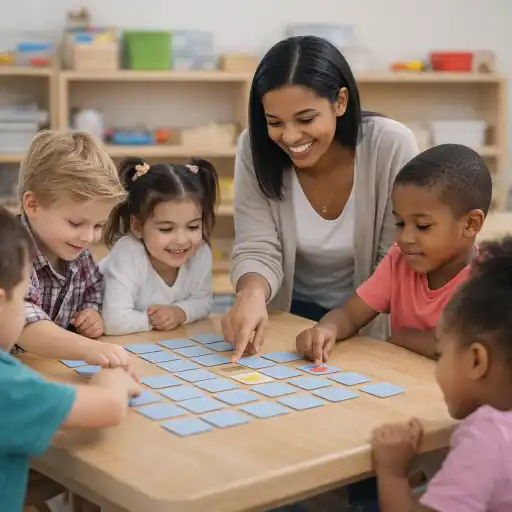
Start with a small number of pairs so children can learn the routine and experience success. Invite them to describe what they notice—“I saw the sun near the blue picture”—and let them choose whether to say, point, or gesture. As children become familiar with the game, add pairs or ask them to remember a detail such as color or position.
- 🧩 Begin with a few pairs and demonstrate one round slowly.
- Use a consistent turn-taking cue, such as passing a small object to the next player.
- Let children take turns being the card-shuffler or game helper.
- Pause or simplify if children lose interest or become frustrated.
Connect play to children’s experiences by talking about summer places, activities, or objects that are familiar to them. Avoid assuming that every child has the same summer experiences; invite their ideas and welcome different ways of participating. The game can be a short small-group activity or a center choice, with adult supervision appropriate to children’s ages and the materials used.
How should you adapt games for different ages and abilities?
An effective memory game is challenging enough to invite thinking but not so difficult that children feel defeated. Adjust the number of cards, the length of a turn, and the amount of adult support. For younger children, begin with two or three pairs, name the pictures together, and let them match cards face up before trying a face-down version. Older preschoolers may enjoy more pairs, a brief look at the cards before play, or opportunities to explain their strategy.
Offer more than one way to access and respond to the activity. Use large, clear images; reduce background distractions; provide extra processing time; and allow a child to point, use words, or communicate with an assistive method. For multilingual children, name images in the child’s home language when possible and invite families to share familiar vocabulary. A child who watches before joining may be learning the game’s structure and can be invited without pressure.
The ChildCareEd resource How Can Child Care Providers Support Memory Development in Young Children? recommends responsive, individualized support rather than treating age ranges as rigid expectations. Observe what children do with and without prompts, and adapt based on their engagement and comfort.
- Make it easier: use fewer pairs, reveal cards, or provide picture cues.
- Make it more challenging: add pairs gradually or invite children to recall a location after a short pause.
- Support inclusion: adapt card size, seating, communication options, and turn length.
Celebrate effort and strategy—“You looked carefully and remembered where you saw that picture”—rather than speed or winning.
How can staff make memory-game practice purposeful and sustainable?
Short, repeated experiences fit naturally into a busy child care day. A few minutes during a small-group choice period may be more useful than a long session that leaves children tired. Staff can rotate memory games with movement patterns, story sequencing, “What’s Missing?”, or simple visual matching so children encounter the same underlying skills in varied forms.
Notice and document participation without turning play into formal testing. Record a specific observation, such as whether a child remembered a matching location, waited for a turn with a cue, or needed a smaller set of cards. These notes can help staff plan next steps and share meaningful examples with families. Keep conclusions modest: one game session is a snapshot, not a measure of a child’s overall ability.
Common pitfalls are easy to avoid. Too many cards, overly complicated rules, or correcting every unsuccessful guess can shift the focus from playful practice to performance. Instead, model the rules, reduce difficulty when needed, and let children try again. Memory games are one part of a broader learning environment that includes conversation, routines, movement, storytelling, and child-directed play.
For professional learning that connects play to child development, explore Role of Play in Learning Buy Now $16.00, a course in CDA Subject Area 8, and Play, Learn, Grow Online Version Buy Now $16.00, which focuses on developmentally appropriate practice and learning through play. Staff can also consider The Best Promotion is Play Buy Now $24.00 for ideas about creating an engaging play environment. State requirements vary - check your state licensing agency.
Conclusion: What should providers remember about memory games?
Memory games support attention and working memory by inviting children to focus, hold details in mind, compare information, and act on what they remember. Their value comes not from drilling children or expecting identical performance, but from offering repeated, enjoyable practice in a supportive relationship.
For practical classroom use, start with a simple activity such as the Summer Time Memory Game Buy Now $0.50. Keep turns brief, scale the challenge to each child, include different ways to participate, and praise persistence and strategies. Then notice how skills practiced in play—looking carefully, remembering a cue, and waiting—appear in routines and other learning experiences. The guiding question is not whether every child wins; it is whether each child has an accessible opportunity to engage, think, and grow.
- Building Equity: Inclusionary Practices in Preschool
- Administering Basic Health and Safety ONLINE
- Bienvenido! Welcoming All Families
- Setting the Stage: Story Time
- The Best Promotion is Play
- Classroom Setup for Child Care
- Play, Learn, Grow
- Role of Play in Learning
- Texas Director Credential
- Montessori Cultural Activities: Exploring the World Through Play and Learning
- CDA Certification en Español: Recursos y Consejos para Educadores Bilingües
- Apoyo en Español para Capacitaciones Grupales Presenciales y por Zoom en Cursos Selectos
- Cómo simplificar la capacitación para sus empleados de daycare
- How Can Child Care Providers Help Children Develop Memory and Attention Skills?
- How Can Child Care Programs Effectively Support Executive Function Skills in Young Children?
- How can child care programs build focus and self-control in young children?
- What Is Executive Function and Which Simple Classroom Activities Build Memory, Self-Control, and Flexible Thinking?
- How do singing, rhythm, movement and musical play support language, memory and social development in young children?
- How can child care programs effectively support executive function skills in young children?
- How Can Music and Movement Activities Boost Learning and Inclusion for Young Children?
- Self-Control Activities for Preschoolers: 10 Games That Teach Stop, Wait, and Try Again
- Proporciones para guarderías en casa bajo el Título 22: Cómo la mezcla de edades cambia su capacidad en California
- How Can Child Care Programs Strengthen Executive Function in Young Children?
- How Can Child Care Providers Support Memory Development in Young Children?
- How Can Child Care Providers Help Children Develop Self-Control?
- Why May Emotional Self-Regulation Matter More Than Academic Skills Before Kindergarten?
- How Do Children Learn Through Play?
- How Do Memory and Matching Games Support Visual Discrimination?
- Why Do Memory Games Support Attention and Working Memory?
- What Does a Memory Game Reveal About How Children Approach a Challenge?
