What if your toddler curriculum could support meaningful learning without turning the day into a series of adult-directed lessons? A responsive, play-based plan helps providers connect routines, relationships, exploration, and developmental goals; Playing with a Purpose: Infant/Toddler Lesson Planning  Buy Now $24.00 can help you strengthen those planning skills and earn relevant professional development hours. For a broader foundation in infant and toddler curriculum, explore ChildCareEd’s 45-Hour Infant and Toddler Curriculum Buy Now
 $399.00$275.00 course, while confirming requirements with your state licensing agency.
Why does a purposeful toddler curriculum matter?
Toddlers learn through movement, relationships, repetition, sensory exploration, communication, and problem-solving. A strong curriculum recognizes that learning does not occur only during a scheduled activity. Diapering, meals, outdoor play, transitions, and spontaneous discoveries all provide opportunities to build language, self-regulation, motor coordination, social competence, and early thinking.
Developmentally appropriate practice, or DAP, calls providers to make decisions based on knowledge of child development, each child’s individuality, and the child’s family and cultural context. NAEYC describes DAP as a framework grounded in research on development and educational effectiveness. Head Start similarly emphasizes that responsive relationships are the foundation of appropriate practice with infants and toddlers.
For directors, curriculum also provides coherence. It gives staff a shared language for planning, observing, documenting, and adjusting experiences while leaving room for professional judgment. A curriculum should guide practice rather than restrict children’s curiosity.
- Prioritize relationships and emotional security.
- Connect goals to children’s observed interests and strengths.
- Use play and routines as the primary context for learning.
- Offer repetition with small variations.
- Plan for individual, cultural, linguistic, and developmental differences.
What should a toddler curriculum include?
An effective curriculum addresses the whole child rather than isolating academic skills. Purdue’s ELM infant-toddler resources organize experiences around communication and language, cognition, self-regulation, social-emotional development, and physical health. HighScope’s infant-toddler framework similarly includes social-emotional development, physical development and health, communication and literacy, cognitive development, creative arts, and approaches to learning.
These domains overlap in daily practice. A child filling a cup at the sensory table may develop fine-motor control, use new vocabulary, practice concentration, and solve a problem when the cup tips. A song with gestures supports language, memory, imitation, social connection, and body awareness.
Directors can use the following curriculum audit:
- Relationships: Are children greeted warmly and supported by consistent caregivers?
- Communication: Do adults narrate actions, respond to gestures, and invite back-and-forth exchanges?
- Physical development: Are children able to crawl, climb, carry, grasp, pour, and manipulate safe materials?
- Cognition: Can children explore cause and effect, object permanence, matching, sorting, and simple problem-solving?
- Self-regulation: Are routines predictable and adults available to co-regulate emotions?
- Creativity: Are open-ended music, movement, art, and pretend-play opportunities available?
A balanced curriculum also includes health, safety, nutrition, inclusion, family partnership, and observation. These are not separate from learning; they make learning possible.
How can providers plan experiences that remain developmentally appropriate?
Begin with observation rather than an activity calendar. Notice what each child is attempting, repeating, communicating, avoiding, or beginning to understand. Then identify a modest goal and design an experience that offers several ways to participate.
For example, if toddlers are interested in transporting objects, a provider might offer baskets, soft blocks, cardboard tubes, and push toys. One child may carry objects, another may fill and empty a basket, and another may describe sizes or colors. The adult extends learning with language and gentle challenges without requiring every child to complete the same task.
A practical planning cycle is:
- Observe: Record a brief, objective note about a child’s action, communication, or strategy.
- Interpret: Consider what the behavior may suggest about interests, skills, or support needs.
- Plan: Select one goal and a flexible experience connected to the child’s current learning.
- Interact: Follow the child’s lead, model language, wait, and offer scaffolding.
- Reflect: Document what happened and decide whether to repeat, simplify, or extend the experience.
Keep focused experiences brief, often about 10–15 minutes, while allowing children to return to materials during free play. Avoid confusing a short attention span with a lack of learning. Toddlers may learn through several brief encounters across the day.
Use simple lesson-plan components: one goal, a short materials list, two to four steps, safety considerations, and an observation prompt. State requirements vary - check your state licensing agency.
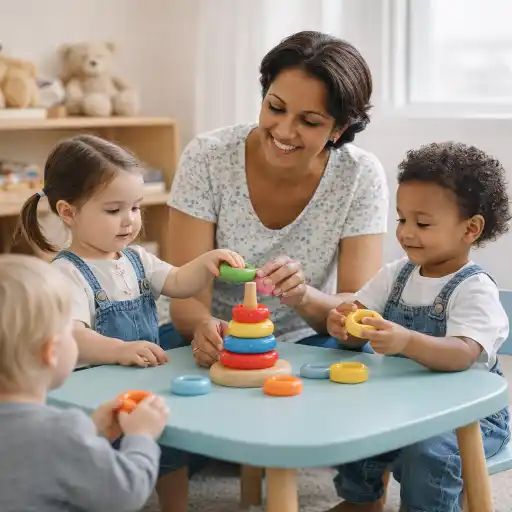
How do relationships, routines, and the environment function as curriculum?
For toddlers, the environment communicates expectations before an adult says a word. Low shelves, clearly defined play areas, accessible materials, and uncluttered pathways invite independence. Materials should be safe, durable, open-ended, and connected to children’s home experiences.
HighScope identifies adult-child interaction, the learning environment, schedules and routines, and observation as central elements of curriculum delivery. This perspective is useful because it places curriculum inside the entire day. A carefully planned block activity cannot compensate for rushed transitions, inconsistent caregiving, or an environment that prevents active exploration.
Predictable routines support #selfregulation. Use visual cues, songs, and consistent language for arrival, cleanup, meals, rest, and departures. Predictability does not mean rigidity: children need flexible responses when they are tired, hungry, distressed, or deeply engaged.
Relationships are equally central. Primary caregiving and continuity of care help children develop trust and allow adults to know individual cues. During routines, slow down enough to invite participation: ask a child to lift an arm while dressing, choose between two cups, or place a spoon in the dish bin. These moments support autonomy, language, cooperation, and connection.
Consider the environment through a toddler’s perspective:
- Can children see and reach a limited selection of materials?
- Are quiet and active areas separated when possible?
- Do photographs, books, labels, music, and materials reflect children’s families, languages, and cultures?
- Can children participate safely without constant adult correction?
- Are materials rotated while familiar favorites remain available?
Thoughtful design reduces unnecessary behavior challenges and increases opportunities for purposeful #play.
How can curriculum support inclusion and family partnerships?
Inclusive curriculum begins with the assumption that every child belongs and can participate meaningfully. Providers can adapt the pathway without lowering the learning goal. Offer thicker crayons, larger handles, stable seating, visual directions, sensory alternatives, extra wait time, gestures, sign language, or peer-supported roles as appropriate.
For dual language learners, welcome the home language as an asset. Learn familiar words from families, use gestures and real objects, display multilingual labels, and pair spoken language with photographs. A toddler may demonstrate understanding through movement or a home-language response before using the classroom language. That communication is valuable evidence of learning.
Cultural responsiveness requires more than occasional celebrations. Select books, songs, family photographs, dramatic-play materials, and routines that reflect children’s everyday lives without stereotyping. Invite families to share preferences, comforting routines, words, songs, and goals in ways that are voluntary and respectful. NAEYC’s family-engagement resources and Head Start’s culturally responsive curriculum guidance both emphasize relationships built through respect and collaboration.
Useful partnership practices include:
- Ask, “What helps your child feel secure and engaged?”
- Share one specific observation rather than a general judgment.
- Invite families to contribute photos, words, songs, or objects with consent.
- Use interpreters or translated communication when needed.
- Coordinate classroom and home routines when practical.
Curriculum becomes more relevant when families are treated as knowledgeable partners. It also becomes more equitable when planning reflects children’s identities, strengths, communication styles, and abilities.
How should directors and teachers assess whether the curriculum is working?
Assessment in toddler settings should be ongoing, authentic, and connected to children’s natural play and routines. It is not a demand for formal testing. Objective observation helps teachers understand what children can do, what they are practicing, and what support might be useful next.
Write what you see and hear: “Maya placed three cups inside one another, paused when the stack fell, and tried again.” Avoid conclusions such as “Maya was frustrated” unless observable behavior supports that interpretation. Collect multiple observations across settings, times, and adults to reduce bias.
Use documentation to improve curriculum:
- Child level: Identify strengths, emerging skills, and possible next steps.
- Experience level: Determine whether materials were accessible, engaging, and appropriately challenging.
- Classroom level: Examine transitions, adult interactions, schedules, and environmental access.
- Program level: Review whether staff have planning time, training, materials, and coaching.
Common mistakes include planning too many goals, expecting all toddlers to produce the same outcome, relying on worksheets, overusing adult-directed group time, and documenting only problems. Replace these habits with one clear intention, flexible participation, open-ended materials, and strengths-based notes.
Directors can schedule brief curriculum-reflection meetings. Ask: Which children are participating? Who may be overlooked? What interests are emerging? Are routines taking too long? Do materials reflect families? What adaptations are needed? This cycle strengthens #observation and turns curriculum into a living process.
Conclusion: What makes a toddler curriculum effective?
An effective toddler curriculum is relationship-based, play-oriented, culturally responsive, inclusive, and grounded in observation. It connects developmental goals to real experiences rather than separating learning from care. The central question is not, “Did every child complete the activity?” but, “How did this experience help each child explore, communicate, connect, move, think, and gain confidence?”
Start with a manageable system:
- Observe one meaningful behavior.
- Choose one developmental goal.
- Offer one flexible, play-based experience.
- Extend learning through warm interaction and routines.
- Document one strength and one possible next step.
- Reflect with families and colleagues.
Your curriculum does not need to be elaborate to be powerful. When adults provide responsive relationships, purposeful environments, and thoughtful opportunities for #toddlers to lead their learning, ordinary moments become extraordinary foundations for development.
- 45 Hour Child Growth and Development
- 45 Hour Preschool Methods and Materials
- From Play to Planning: Building Culturally Competent, Child-Centered Curriculum
- 45 Hour Infant and Toddler Methods and Materials
- Pediatric RSV First Aid & CPR/AED
- 45 Hour School Age Methods and Materials
- CDA Bridge Bundle: Infant/Toddler without Portfolio Review
- Texas Director Credential
- 45-Hour Infant and Toddler Curriculum
- Supporting Child Development Through Individualized learning.
- Childcare Training
- CDA Certification en Español: Recursos y Consejos para Educadores Bilingües
- Curso de Comunicación de 9 Horas de Maryland
- ¿Cuáles son los pasos, requisitos y opciones en línea para la certificación de 90 horas en cuidado de Infantes/Toddlers en Maryland?
- Proporciones de Cuidado Infantil y Tamaños de Grupo por Edad en Maryland (Guía Rápida para Centros y Hogares)
- Proporciones de Cuidado Infantil y Tamaños de Grupo por Edad en Virginia (Guía Rápida para Centros y Hogares)
- Cómo simplificar la capacitación para sus empleados de daycare
- Daycare Lesson Plans for Toddlers: Easy Activities for Every Day
- Daycare Teacher Discounts: Deals and Benefits You May Be Missing
- What Makes a Great Home Daycare? 10 Things Parents Notice First
- Dump It, Stack It, Build It! Open-Ended Activities for Curious Toddlers
- No Playground Today! Rainy Day Activities for Kids All Ages.
- How Can Child Care Providers Understand and Support Infant Milestones?
- What Toddler Activities Encourage Language and Communication?
- How Can Child Care Providers Create Low-Cost STEM Activities With Items They Already Have?
- How Can Sensory Bin Ideas Promote Early Language Skills?
- How Can Providers Bring Nature-Based Learning Into Any Program?
- How Can Child Care Providers Build a Developmentally Appropriate Curriculum for Infants?
- How Can Child Care Providers Build an Effective Curriculum for Toddlers?
