Cleanup can become a warm, meaningful part of the day when toddlers are invited to contribute without being judged by adult standards of neatness. Pair simple routines with the Creating Environments that Nurture Growth and Community  Buy Now $55.00 course to strengthen your understanding of accessible spaces, inclusive materials, and classroom community; the training can help you earn relevant professional learning while translating these ideas into daily practice.
For a more focused look at predictable transitions, Every Moment Matters: Schedules and Transitions Buy Now $55.00 offers additional strategies for creating calmer routines and more purposeful transitions.
Why does toddler cleanup matter beyond having a tidy room?
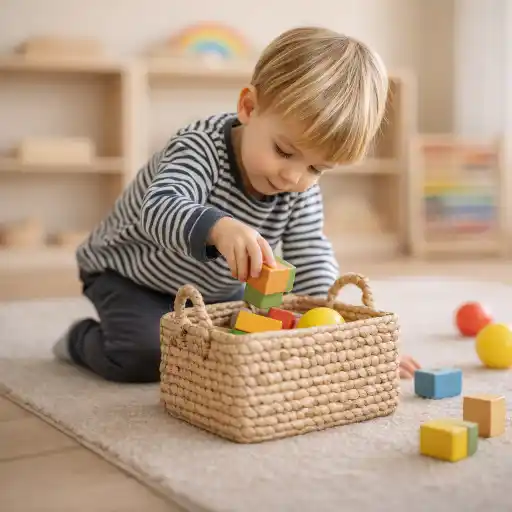
For toddlers, cleanup is not a test of obedience or a demand for adult-level organization. It is a repeated opportunity to practice #independence, communication, movement, memory, and belonging. A toddler who carries one block to a basket is learning that actions have purpose. A child who watches a peer return a book is beginning to understand shared responsibility. These small contributions matter even when the room remains imperfect.
NAEYC’s developmentally appropriate practice framework emphasizes responsiveness to children’s individual development, interests, and context. Cleanup fits this approach when adults teach the routine, offer support, and value participation rather than demanding a flawless result. Head Start similarly describes routines as contexts for learning, relationships, and emotional security.
The process may include:
- Practicing stopping, shifting attention, and beginning a new task.
- Building vocabulary such as “in,” “out,” “more,” “same,” and “belongs.”
- Strengthening balance, carrying, grasping, reaching, and placing.
- Learning that classrooms are shared spaces cared for by a community.
Why it matters: when providers treat cleanup as instruction instead of correction, toddlers experience themselves as capable contributors. That sense of agency is more valuable than a perfectly arranged shelf.
What cleanup expectations are realistic for toddlers?
Toddlers vary considerably in language, motor development, temperament, sensory preferences, and prior experiences. One child may place several large toys in a basket, while another may participate by handing one item to an adult or pointing toward its storage location. Both can be meaningful forms of engagement.
Begin with one-step directions connected to visible actions: “Put the ball in,” “Bring the cup,” or “Books on the shelf.” Use a calm voice, gestures, and demonstrations. Allow extra processing time before repeating the direction. Too many words can make a manageable task feel confusing.
- Offer large, lightweight objects that are easy to grasp.
- Use open baskets rather than tight lids or complicated containers.
- Invite children to clean alongside an adult or peer.
- Give one task at a time and celebrate attempts.
- Stop before frustration becomes overwhelming.
A toddler may not understand the full cause-and-effect relationship between making a mess and restoring the room. The goal is not to make the child responsible for the entire environment. The goal is to let the child rehearse participation in a predictable, emotionally safe way.
Respect cultural and family differences as well. Ask caregivers what responsibilities the child enjoys at home and which words or gestures are familiar. Cleanup should build continuity, not imply that one family’s routines are the only acceptable model.
How can song cards and picture labels make cleanup easier?
Visual and auditory cues reduce reliance on lengthy verbal instructions. Head Start’s guidance on visual supports explains that pictures can clarify what will happen, what is expected, and how children can participate. For toddlers, photographs of actual classroom materials are often especially meaningful.
Place a picture-and-word label on a low shelf or basket. Show the label while naming the material: “Cars. Cars go here.” Then model matching one car to the photograph. Keep labels simple, durable, and uncluttered. If a basket contains too many unrelated materials, the image may not communicate a clear “home.”
- Use photos of the actual blocks, books, or animals in the room.
- Position labels at toddler eye level.
- Pair spoken words with pointing, gestures, and objects.
- Include home-language words when families can provide them.
- Review labels when materials or classroom interests change.
A short cleanup song card can show three simple images: play, put away, and next activity. Sing the same brief song consistently for several days. Children may join through clapping, rocking, gestures, vocalizations, or simply watching. The song should signal a transition, not pressure children to hurry.
🎵 Invite toddlers to choose a motion for the song—such as tapping knees or carrying one item—so the cue becomes participatory rather than adult-controlled.
How can providers make cleanup playful without turning it into a race?
Playfulness helps toddlers shift away from an absorbing activity, but competition can create stress and unsafe movement. Instead of saying, “Who can clean up fastest?” try playful invitations that emphasize discovery and cooperation: “Can you find one soft animal?” or “Let’s help the cars find their garage.”
Use the cleanup song cards and picture labels as props for brief games:
- “Find one”: Each child returns one clearly identified item.
- “Where does it live?” Children match an object to its picture.
- “Helper walk”: A child carries a lightweight basket with adult support.
- “Same and different”: The provider names a simple feature, such as color or type.
Keep the language descriptive and encouraging. Say, “You put the animal in the basket,” rather than “Good job.” Specific feedback tells toddlers what they did and helps them repeat the action. If a child drops an object or places it in the wrong container, respond neutrally: “The block is here. Let’s look at the block picture.”
Some children may not want to sing or touch certain materials. Offer alternatives: pointing to the label, holding a card, watching a peer, carrying a cloth, or placing one object beside the basket. Participation does not require identical behavior from every child.
When cleanup is approached as shared play, toddlers can experience cooperation without losing the joy and agency that make early learning effective.
How can directors and educators keep cleanup inclusive and safe?
Inclusion means adapting the task without removing the child’s opportunity to contribute. A toddler with limited mobility may place materials in a nearby container. A child who benefits from visual information may use a single picture card. A child who is sensitive to sound may receive a quiet visual cue instead of a song. A child who uses AAC, gestures, or a home language is participating when the environment recognizes those communication methods.
Design the space to support success:
- Keep frequently used materials within safe reach.
- Use lightweight baskets with stable bases.
- Maintain clear pathways and adult sight lines.
- Reduce available materials when clutter makes cleanup impossible.
- Provide quiet roles for children who are overwhelmed by group activity.
Separate child-friendly tidying from adult sanitation. Children may return toys, place books on a shelf, or wipe a low surface with a dry or water-dampened cloth when permitted by program policy. Adults must handle bleach, disinfectants, bodily fluids, broken glass, hazardous waste, and regulated cleaning procedures. Hand hygiene should follow the program’s health policies.
State requirements vary - check your state licensing agency before changing sanitation practices, supervision procedures, products, or documentation. Directors can clarify expectations in writing so staff do not ask toddlers to perform unsafe work or attempt deep cleaning during active supervision.
Common mistakes include expecting every child to participate in the same way, giving directions from across the room, redoing children’s work in front of them, and using cleanup as a consequence. A more supportive approach is to model, simplify, wait, and document progress. Notice effort: “You carried one basket,” “You looked at the picture,” or “You helped your friend.”
How can you build a realistic toddler cleanup routine this week?
Start with one high-use area rather than redesigning the entire classroom. Select two or three materials, create clear picture labels, and choose one short song or visual signal. Teach the routine when toddlers are calm, not only when the room is already busy.
- Give a gentle warning: “Two more minutes, then cars go home.”
- Show the song card or picture sequence.
- Model one action: “Car in the car basket.”
- Invite each child to attempt one manageable contribution.
- Acknowledge effort and transition without requiring perfection.
Observe what helps. Does a child participate more readily with photographs, a quieter cue, or a peer model? Does the basket need to be closer? Are there too many choices? Use these observations to adjust the environment rather than labeling a child as uncooperative.
Directors can support consistency by sharing a brief script with all staff and reviewing examples during team meetings. Resources such as the cleanup learning guidance can help teams connect routines with executive function, language, cooperation, and early mathematics.
Conclusion: How can toddlers participate in cleanup without being expected to be perfect?
Toddlers participate best when cleanup is brief, predictable, playful, accessible, and taught through relationships. The central goal is not a spotless room; it is growing #confidence, coordination, communication, cooperation, and care for a shared environment.
- Match expectations to each toddler’s abilities and communication style.
- Use picture labels and song cards to make the routine understandable.
- Teach one step at a time and allow processing time.
- Value attempts, partial participation, and alternative forms of contribution.
- Keep children away from chemicals and adult-only sanitation tasks.
With thoughtful materials and patient coaching, cleanup becomes more than tidying. It becomes a daily invitation for toddlers to say, through action, “I belong here, and I can help.”
Related ChildCareEd courses:
- Creating Environments that Nurture Growth and Community Buy Now $55.00
- Every Moment Matters: Schedules and Transitions Buy Now $55.00
- Supporting Children’s Independence Buy Now $24.00
- Creating Engaging and Meaningful Learning Experiences Buy Now $55.00
- Positive Attention: Interactions & Supervision for Infants & Toddlers Buy Now $35.00
- 45 Hour Child Growth and Development
- Birth to Five CDA Credential with Portfolio Review
- 45 Hour Infant and Toddler Methods and Materials
- Pediatric RSV First Aid & CPR/AED
- 45 Hour School Age Methods and Materials
- CDA Bridge Bundle: Infant/Toddler without Portfolio Review
- CDA Bridge Bundle: Infant/Toddler
- Texas Director Credential
- Every Moment Matters: Schedules and Transitions
- CDA Certification en Español: Recursos y Consejos para Educadores Bilingües
- Recursos en Español sobre el Sueño Seguro del Bebé
- Que es Título 22 en California?
- ¿Cuáles son los pasos, requisitos y opciones en línea para la certificación de 90 horas en cuidado de Infantes/Toddlers en Maryland?
- 10 Ejemplos de Cómo la Cultura Influye en el Desarrollo Infantil
- ¿Cómo solicito la licencia para una guardería en California?
- Regulaciones de Cuidado Infantil en Maryland para Centros y Hogares de Cuidado Infantil Familiar
- Proporciones de Cuidado Infantil y Tamaños de Grupo por Edad en Virginia (Guía Rápida para Centros y Hogares)
- ¿Cuál es la Diferencia Entre la Crianza Respetuosa y la Crianza Permisiva?
- Cómo Trabajar en el Cuidado Infantil en Carolina del Norte: Requisitos y Pasos
- Cómo Trabajar en el Cuidado Infantil en California: Requisitos y Pasos
- Cómo Ser Maestra de Preescolar en Maryland
- Celebrando la amistad en el cuidado infantil durante el Día de los Mejores Amigos
- Canciones, juegos y preguntas de círculo para niños
- Cómo simplificar la capacitación para sus empleados de daycare
- Why Do Classroom Management Strategies Fail With 3-Year-Olds—and What Works Instead?
- How Can Child Care Providers Support Language Development in Young Children?
- What Are Age-Appropriate Ways to Teach Gratitude Before Thanksgiving?
- How Can Toddlers Participate in Cleanup Without Being Expected to Clean Perfectly?
- How Can Toddlers Contribute to Classroom Jobs Without Turning Them into Rewards?
