Two-year-olds often experience powerful emotions before they have enough words to explain them. With brief, playful routines and responsive adult support, you can help children name feelings, communicate needs, and practice early regulation; Brighter Futures: Social Emotional Development  Buy Now $16.00 offers deeper professional learning that can strengthen classroom practice and support CDA Subject Area 3 training goals.
For providers seeking a broader foundation, Opportunity for Growth: Emotional Development Buy Now $16.00 explores stages of emotional development and the social-emotional skills children need to build empathy and relationships.
Why do social-emotional activities matter so much at age two?
At age two, children are becoming more independent while still relying heavily on adults for co-regulation. They may know what they want, but not yet have the language, impulse control, or perspective-taking skills to communicate it safely. A child who screams when a tower falls may be expressing frustration, disappointment, fatigue, or a need for help—not deliberately trying to disrupt the classroom.
Social-emotional activities give children repeated opportunities to connect feelings with words, body cues, relationships, and next steps. Emotional literacy is not simply vocabulary instruction; it supports communication, problem solving, empathy, and participation in group routines. The CSEFEL guidance on emotional literacy emphasizes that children learn to identify feelings through responsive relationships, adult modeling, stories, songs, and play.
- Children practice recognizing facial expressions and body signals.
- Children learn simple phrases such as “help,” “my turn,” and “all done.”
- Adults can respond consistently instead of relying on punishment or lengthy explanations.
- Peers gain early experience with empathy, waiting, and turn-taking.
These are modest goals, but they are meaningful developmental achievements. A child who points to a sad face, accepts a hug, or pauses before grabbing is demonstrating #growth.
Which activities build emotional vocabulary without overwhelming toddlers?
Begin with two or three familiar emotions—happy, sad, and mad—and add worried, scared, tired, or excited gradually. Keep activities short, concrete, and optional. Toddlers learn through repetition more effectively than through a single extended lesson.
- Feelings check-in: Display two or three large face cards at children’s eye level. During arrival, invite each child to point, touch, or imitate a face. Say, “You chose sad. I wonder if you miss your family.” Avoid requiring an explanation.
- Mirror faces: Sit beside children with an unbreakable mirror. Make one expression at a time and label it. “This is happy. My mouth goes up.” Let children copy, laugh, or simply watch.
- Emotion basket sort: Place picture cards in a basket and invite children to match them to feeling “homes.” Start with two baskets. Praise participation rather than accuracy: “You looked carefully and made a choice.”
- Play-Doh feelings: Invite children to make a face, squeeze dough while breathing, or create a “calm ball.” Tactile play offers a low-pressure way to communicate, especially for children with speech delays or emerging English.
- Feelings songs: Adapt familiar songs with phrases such as, “If you’re frustrated and you know it, take a breath,” or “If you’re happy and you know it, clap your hands.”
Use the same words across the day. When a child cries after a toy is removed, connect the experience to the language: “You are mad. The truck is finished. I’m here.” Consistent narration helps #toddlers gradually attach words to internal experiences.
How can books, puppets, and movement make feelings understandable?
Books and pretend play create emotional distance: children can explore a character’s problem without feeling put on the spot. During a short read-aloud, pause only once or twice. Point to a face and ask, “How does the bear feel?” Accept pointing, gestures, sounds, or silence as valid responses. The goal is participation, not performance.
Use a three-step read-aloud routine:
- Notice: “Look at the character’s eyebrows and mouth.”
- Name: “She looks worried.”
- Support: “What might help? A hug, help, or a breath?”
Puppets are especially effective for practicing communication scripts. A puppet can reach for a toy and say, “My turn?” Another can respond, “Wait, please.” Keep scripts short and repeat them in real situations. During conflict, teachers can prompt, “Say ‘help’,” while offering a gesture or picture cue.
Movement activities help children regulate through their bodies. Try “happy hop,” “sad slow steps,” or “mad stomp three times, then freeze.” Freeze Dance, Red Light/Green Light, and simple stop-and-go games build attention and impulse control while remaining playful. 🌟 A useful list item to remember: movement is not a reward after learning; for two-year-olds, movement is often the pathway into learning.
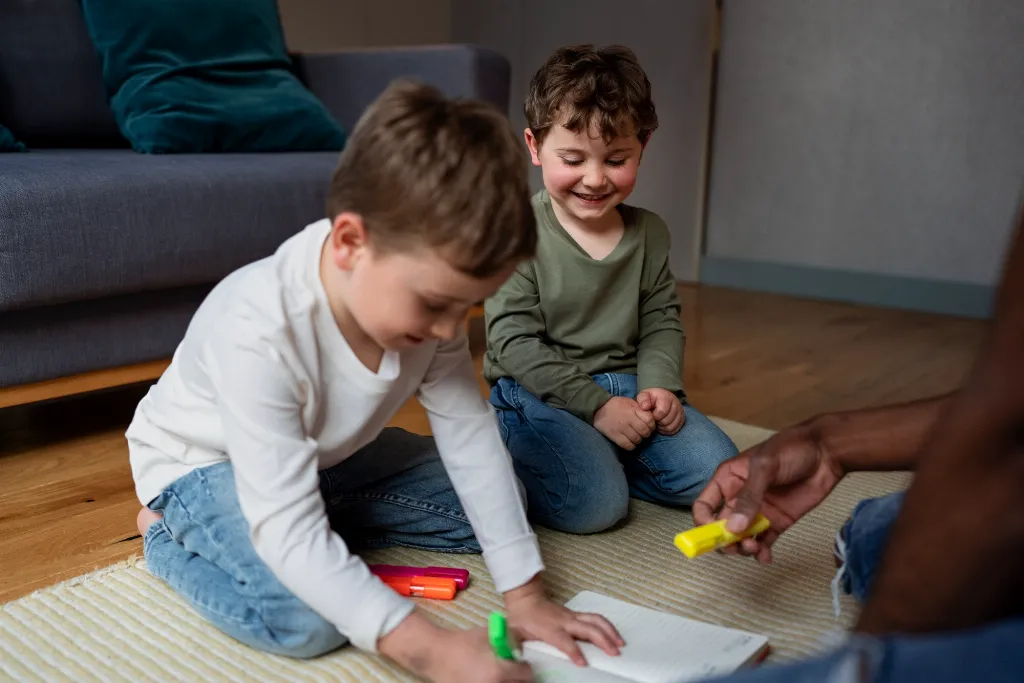
These strategies align with ZERO TO THREE’s discussion of co-regulation: toddlers learn to manage feelings through connected, responsive interactions before they can regulate independently.
How should teachers respond when a two-year-old is overwhelmed?
During a meltdown, the child’s capacity to process language is reduced. The immediate priority is safety and connection, not a lesson. Get close without crowding, lower your voice, and use one short sentence at a time.
- Connect: Move to the child’s level and communicate presence: “I’m here.”
- Label: Offer a tentative feeling word: “You’re really mad.”
- Set a limit: “I won’t let you hit. Hands stay safe.”
- Offer one choice: “Breathe with me or squeeze the ball?”
- Coach later: After calm returns, practice one replacement phrase: “Next time, say ‘help please.’”
Co-regulation means the adult lends calm through voice, posture, proximity, breathing, and predictable care. The NAEYC discussion of coregulation in infant-toddler classrooms describes how children depend on responsive adults while their regulatory capacities are developing.
A calm-down area can support this process when it is presented as a choice rather than isolation. Include a soft mat, a small stuffed animal, two visual calm choices, and a safe sensory item. Stay nearby. Do not require the child to sit there, and do not use it as time-out. A child may need to cry in your arms, walk with you, or simply have fewer words and less stimulation.
How can activities support inclusion, relationships, and family partnership?
Social-emotional teaching must reflect children’s developmental profiles, cultures, languages, temperaments, and communication styles. A child may express emotion through pointing, sign language, gestures, sounds, facial expressions, or a home language. These are meaningful forms of communication. Offer picture cards, gestures, objects, and modeled language rather than assuming every child can answer verbally.
Use diverse images and avoid presenting one facial expression as the only correct representation of an emotion. Explain that people may look different when they feel sad, excited, or angry. For children with sensory sensitivities, reduce noise, provide space, and avoid requiring eye contact or imitation.
Relationships are the foundation for every activity. Learn each child’s comfort preferences, triggers, and successful calming routines. Share classroom language with families and invite reciprocal information:
- “What words does your child use for feelings at home?”
- “What helps your child settle after frustration?”
- “Are there comfort objects, songs, or routines we should include?”
Document strengths rather than only problems. Record that a child pointed to “mad,” waited briefly, accepted help, or returned to play. The CDC encourages adults to monitor development and discuss concerns with families and health professionals; developmental milestones are not a substitute for individualized screening. If concerns persist, collaborate with families and appropriate specialists.
State requirements vary - check your state licensing agency before using a specific curriculum, documenting training, or making referrals.
What common mistakes can providers avoid?
Even well-intentioned practices can become counterproductive when expectations exceed toddler development. The most common mistakes are preventable through consistency and reflection.
- Teaching only during crises: Practice feelings and breathing during calm routines so the skills are familiar later.
- Introducing too many emotions: Start with two or three words and add complexity slowly.
- Correcting the feeling: Replace “You’re not mad” with “You might be mad. Let’s see what you need.”
- Using long explanations: During distress, use one feeling label, one safety limit, and one choice.
- Forcing participation: Permit children to watch, point, gesture, or try later.
- Using a calm corner as punishment: Model it as a supportive space and remain available.
- Expecting independent regulation: Two-year-olds still need substantial adult co-regulation.
Directors can help by aligning staff scripts, scheduling brief coaching conversations, and ensuring materials are accessible throughout the day. Observe whether adults validate feelings, maintain safety, and teach replacement skills. A useful weekly reflection asks: What emotion words did children hear? Which tools were practiced? Which children communicated a need in a new way?
For teams seeking more support with behavior and classroom responses, The ABCs of Behavior: Turning Challenges into Learning Opportunities Buy Now $55.00 connects behavior observation with positive guidance, self-regulation, and empathetic intervention.
Summary: How can big feelings become big growth?
Effective social-emotional activities for two-year-olds are brief, repeated, relational, and playful. Begin with a small emotional vocabulary, use books and puppets to rehearse language, add movement and sensory experiences, and respond to distress through connection, safety, and co-regulation. Expect gradual progress: a gesture, a word, a pause, or a willingness to accept comfort may represent significant development.
A practical plan for this week is simple:
- Choose two feeling words and two calm tools.
- Add a two-minute feelings check-in during arrival.
- Use one puppet script during a predictable conflict.
- Practice a breathing or movement game when children are calm.
- Share the same language with families and record one small strength.
When adults remain steady and curious, children learn that feelings are safe to communicate and that support is available. Big feelings do not need to disappear before learning can occur; with responsive relationships and developmentally appropriate practice, those feelings become opportunities for connection, communication, and #selfregulation.
Frequently asked questions
How long should an activity last?
For most two-year-olds, two to seven minutes is sufficient. Repeat short activities rather than extending one lesson.
What if a child chooses the “wrong” emotion?
Ask, “Tell me about your choice,” or simply model another possibility. Emotion identification can be subjective, and the conversation matters more than perfect accuracy.
Should teachers make children talk about feelings?
No. Offer pointing, gestures, facial expressions, objects, or a home-language word. Verbal expression develops gradually.
Can these activities stop tantrums?
They cannot eliminate normal toddler distress, but consistent practice can give children more ways to communicate and recover with adult support.
When should a program seek additional support?
Partner with families and consult qualified professionals when concerns are persistent, affect participation or relationships, involve safety, or occur alongside developmental regression or loss of skills.
Additional ChildCareEd courses for staff development
- 45 Hour Child Growth and Development
- CDA Home Visitor Subject Area 3 Part 3 Birth to 5
- 45 Hour Preschool Methods and Materials
- 45 hour Growth and Development Birth-age 12 ONLINE
- Pediatric RSV First Aid & CPR/AED
- CDA Bridge Bundle: Family Child Care without Portfolio Review
- CDA Bridge Bundle: Infant/Toddler without Portfolio Review
- CDA Bridge Bundle: Preschool without Portfolio Review
- Texas Director Credential
- Tiny Hands, Big Dreams: Fostering Creativity in Preschoolers
- Actividades de Fiesta para Niños de Preescolar y Primaria
- Normas de Licenciamiento de Cuidado Infantil en Virginia para Centros Diurnos Infantiles y Hogares Diurnos Familiares
- How can positive guidance help manage big feelings during indoor play in Oklahoma classrooms?
- What Social-Emotional Learning Activities Work Best for Toddlers in Minnesota Classrooms?
- How can child care teams help children manage big emotions?
- Emotion Sorting Activities for Social-Emotional Learning
- How to Teach Feelings with an Emotion Sorting Activity
- Emotion Sorting for Kids: Learning Feelings Through Play
- Being Told No: Helping Children Manage Big Feelings
- What are the important developmental milestones for toddlers and how can caregivers track them?
- How can child care teams help children manage big feelings?
- Can we tame the ‘monsters’ of big emotions in young children?
- How can friendly-monster crafts teach children about feelings?
- How can we help children identify and express emotions in child care?
- How can child care providers teach children to name and manage emotions?
- How can we build emotional vocabulary through books and play?
- Feelings Activities for Toddlers: Building Social and Emotional Skills
- Social-Emotional Activities for 2-Year-Olds: Big Feelings, Little Words, Big Growth
- Feelings Activities for Toddlers: Point, Move, Match, and Name It
