Helping young children identify and express emotions is one of the most valuable skills child care providers can teach. This article gives providers and directors practical, classroom-ready strategies for building emotional vocabulary, recognizing children’s verbal and nonverbal cues, validating feelings, and teaching safe ways to communicate needs. It also explains how stories, emotion cards, role-play, calming spaces, predictable routines, and supportive adult language can help children move from intense reactions toward self-regulation and problem-solving. To strengthen staff practice, explore ChildCareEd’s self-paced online course Self-Regulation & Change: Helping Children Cope  Buy Now $16.00, which covers responsive care, consistent routines, prosocial behavior, transitions, and strategies for fostering self-regulation. Programs can also benefit from Connections That Count: Building Relationships in Child Care Buy Now $55.00, which supports positive relationships, cooperation, emotional development, and respectful classroom communities. By naming feelings without judgment and repeatedly practicing calming and communication skills, educators can help children feel understood, remain safe, and build healthier relationships.
State requirements vary - check your state licensing agency for documentation or training specifics tied to social-emotional curricula and staff qualifications.
What is emotional literacy and why does it matter?
Emotional literacy is the ability to recognize, label, understand, and respond to emotions in yourself and others. Research and field guides show that children with a growing feeling vocabulary manage frustration better, behave more cooperatively, and are ready to learn more consistently. For a research-grounded overview, see the CSEFEL briefs on emotional literacy and teaching social-emotional skills as part of CSEFEL resources. ChildCareEd’s overview on emotional literacy frames the skill as foundational — often called the “new literacy” — because children who name feelings can reflect, ask for help, and sustain attention in group routines as part of Why Emotional Literacy Is the New Literacy.
Why it matters (short):
- Children who can name feelings substitute words for aggressive actions, improving safety and relationships.
- Emotional awareness supports self-regulation and engagement; regulated children learn more easily (see the CDC review on early childhood education benefits as part of Early Childhood Education | CDC).
- Strong adult modeling and consistent practice accelerate emotional vocabulary growth (see practical staff strategies at ChildCareEd: How can we help children recognize and express their feelings?).
How can teachers build emotional vocabulary and recognition during daily routines?
Emotional vocabulary grows fastest when it’s embedded in everyday moments. Use short, repeated language and visual supports. The following enumerated strategies are classroom-tested and easy to adopt.
- 😊 Model feeling language throughout the day: narrate your emotions briefly (“I’m feeling tired; I’m going to take a calm minute”) — this mirrors recommendations from CSEFEL’s briefs.
- 🗣️ Use a consistent check-in: every morning, let each child point to or name a feeling on a chart. ChildCareEd’s article on check-ins explains simple scripts and charts as part of practical classroom tools.
- 📚 Pause in story time: ask “How does this character feel? What clues tell us?” — this is a low-pressure way to practice inference and vocabulary (ideas from ECMH).
- 🎵 Adapt songs and fingerplays to include feeling words and short coping steps (e.g., "If you’re frustrated, take a breath").
- 🪞Use mirrors and face games: children learn face cues quickly when they can see themselves and imitate expressions — see activity libraries at Emotion Sorting Activities Buy Now $0.00.
Keep prompts short and tangible: name a feeling, state a simple cause, and offer a single, doable next step. Repeat those three parts often so children internalize the pattern.
Which classroom activities and materials best support expression and co-regulation?
Play-based activities let children practice naming feelings and choosing calming actions in low-stakes moments. Use materials that invite sorting, acting, and small-group conversation. Research- and field-tested packs from ChildCareEd emphasize sorting, role-play, and calm-down toolkits.
- 😊 Emotion sorting centers: set up baskets or mats labeled with simple feelings and cards/photos to sort. ChildCareEd’s guide Emotion Sorting Activities explains age adjustments and games.
- 🧸 Puppets & role-play: let puppets model asking for help, saying “I feel ____,” or trying a breathing strategy — this supports perspective-taking (see scripted stories and book nooks in CSEFEL Tools).
- 📷 Photo & real-face materials: include pictures of diverse children and caregivers showing feelings so kids learn differences in expression (resources at Emotions Match Activity Buy Now $0.00).
- 🧘 Calm-down corner + toolkit: include textur
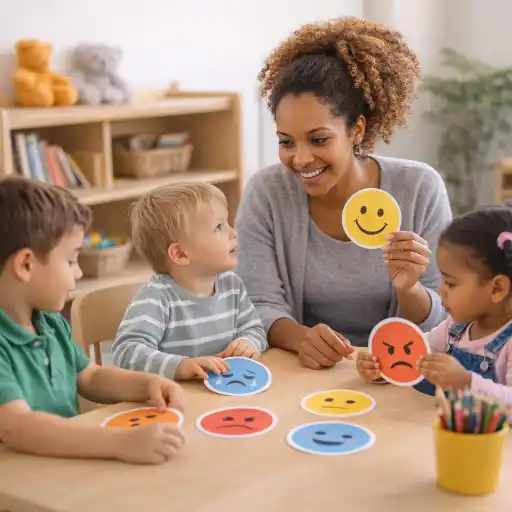 ed items, a breathing prompt, emotion cards, and a small visual plan. Use the Calm-Down pairing step from ChildCareEd activities like Big Feelings: Teaching Kids to Manage Difficult Emotions.
 - 🎭 Movement & charades: practicing emotion faces and body language through movement builds recognition and gives kinetic outlets.
Differentiate by age: start with 2–3 core feelings for toddlers and add nuance (proud, embarrassed, frustrated) for preschoolers. For printables and mixed-age PDF packs, see ChildCareEd’s activity library as part of Emotion Sorting Activities Buy Now $0.00. Programs aiming to reinforce general word knowledge alongside emotion vocabulary can download a free vocabulary kit for your classroom that pairs emergent-literacy activities with ready-to-use word lists and printable materials to use alongside emotion-focused lessons.
How should staff respond during big moments and involve families effectively?
When emotions run high, quick, calm adult responses reduce escalation and create teachable moments later. Aim to co-regulate first; teach when the child is calm. The following stepwise approach is straightforward and evidence-aligned.
- 👋 Get close and low: approach at eye level to reduce threat and show presence.
- 🧾 Name the feeling: say a short label — “You look really mad” — then offer safety limits: “Hands stay safe.” (Guidance from ChildCareEd and CSEFEL).
- 🫧 Offer one calm choice: a breathing break, a squeeze toy, or a quiet spot — keep options predictable.
- 🔁 Teach after: once calm, briefly reflect: “You were mad when the toy broke. Next time you can say ‘help please’.”
- 🤝 Partner with families: use neutral descriptions, share observations, and co-create consistent plans. See practical scripts at How Do I Talk to Parents About Behaviors Their Child Learned at Home?.
Screen and escalate thoughtfully: for children showing persistent challenges, consider using screening tools and guidance from ECMHC resources like Finding Social Emotional Screening Tools. State requirements vary - check your state licensing agency for referral and reporting expectations.
Conclusion — Quick next steps and FAQs
Put this into practice this week with a three-step starter plan:
- 😊 Add a 2-minute feelings check-in at arrival each day.
- 🧩 Set up one emotion sorting center and rotate it into free-choice play.
- 🤝 Share a single-script message with families about naming feelings and one home activity to try.
Staff training and printable packs are available from ChildCareEd and CSEFEL (see links throughout this article). Consider brief staff huddles to standardize phrases and to practice co-regulation responses so your whole team speaks the same emotional language.
FAQ (quick):
- Q: What if a child refuses to point or talk about feelings?
A: Offer alternatives: point to a face, show a mirror, or hand a card. Don’t force verbalization during upset moments; teach later when calm (see ChildCareEd guidance). - Q: How many feeling words should I teach at once?
A: Start with 3–4 (happy, sad, mad, scared) and add one new word each week with activities (per Big Feelings, Little Hands). - Q: When should I screen or seek mental health consultation?
A: If emotion dysregulation persists across weeks, impacts learning, or harms peers, use screening tools and consult mental health specialists; references at ECMH: Screening Tools. - Q: Which classroom resource is most cost-effective?
A: Low-cost: emotion cards, a feelings chart, and a small calm box. ChildCareEd offers free PDFs and lesson packs (see Emotion Sorting Activities Buy Now $0.00).
Final encouragement: small, consistent practices + team alignment produce measurable change. Praise attempts, model feeling words, and make calm choices visible. If your program wants deeper training, consider ChildCareEd courses linked above; they’re practical, staff-friendly, and geared to early childhood settings.
- A Thoughtful Approach to Children's Mental Health
- Opportunity for Growth: Emotional Development
- CDA Bridge Bundle: Family Child Care without Portfolio Review
- Healing Young Hearts: Stress and Grief
- CDA Bridge Bundle: Infant/Toddler without Portfolio Review
- CDA Bridge Bundle: Preschool without Portfolio Review
- Texas Director Credential
- Brighter Futures: Social Emotional Development
- Open Heart, Open Art
- Supporting Children's Independence
- National Grouch Day: Turning Grouches into Giggles, Teaching Kids about Handling Negative Emotions
- Party Hats and Emotional Regulation: Helping Little Ones Navigate Big New Year Feelings
- CDA Certification en Español: Recursos y Consejos para Educadores Bilingües
- What Parents and Educators Need to Know About Child Safety
- Proporciones de Cuidado Infantil y Tamaños de Grupo por Edad en Maryland (Guía Rápida para Centros y Hogares)
- Proporciones de Cuidado Infantil y Tamaños de Grupo por Edad en Nueva Jersey (Guía Rápida para Centros y Hogares)
- Proporciones de Cuidado Infantil y Tamaños de Grupo por Edad en Virginia (Guía Rápida para Centros y Hogares)
- Cómo Trabajar en el Cuidado Infantil en Carolina del Norte: Requisitos y Pasos
- How can child care teams help children manage big emotions?
- Celebrando la amistad en el cuidado infantil durante el Día de los Mejores Amigos
- Canciones, juegos y preguntas de círculo para niños
- Cómo simplificar la capacitación para sus empleados de daycare
- Can we tame the ‘monsters’ of big emotions in young children?
- How can we help children identify and express emotions in child care?
- How Can Child Care Providers Support Children’s Mental Wellness?
- How Can Child Care Providers Teach Children to Express Their Feelings With Words?
- How Can Child Care Providers Support Kindergarten Emotions on the First Day of School?
- How Can We Build an Emotion Vocabulary Children Can Actually Use?
