Toddlers experience big emotions before they have the words to explain them. ChildCareEd’s online, self-paced Brighter Futures: Social Emotional Development  Buy Now $16.00 course helps educators support emotional development through positive interactions and responsive teaching strategies. Teachers can also use the free Feelings Color Match Buy Now $0.00 activity to help toddlers recognize, match, and begin naming common emotions. Below, you’ll find playful feelings activities that build emotional vocabulary, self-awareness, empathy, and early self-regulation skills.
Why do feelings activities matter for toddlers?
1) Why it matters: Social-emotional learning lays the groundwork for learning, relationships, and safety. When toddlers can label a feeling and call for help, they are less likely to lash out and more likely to join peers in play. Research and practice from ChildCareEd emphasize that naming feelings and teaching simple calm strategies supports attention and reduces disruptive incidents; see practical classroom resources in Emotions for Kids and course materials like Brighter Futures Buy Now $16.00.
2) Developmental context: Toddlers are building language and self-regulation rapidly. The CDC milestone guidance reminds us that by age three children are increasingly able to join play and calm faster with adult help — but they still need routines and modeling (CDC Milestones).
3) Practical payoff: Short, playful activities boost emotion vocabulary, #toddlers’ ability to ask for help, and teachers’ capacity to coach calm choices. Over time these repeatable routines strengthen neural pathways for self-control and empathy.
What simple activities can I use tomorrow in a toddler room?
Use short, repeatable activities (3–7 minutes) and weave them into routines. Try this enumerated menu you can rotate weekly:
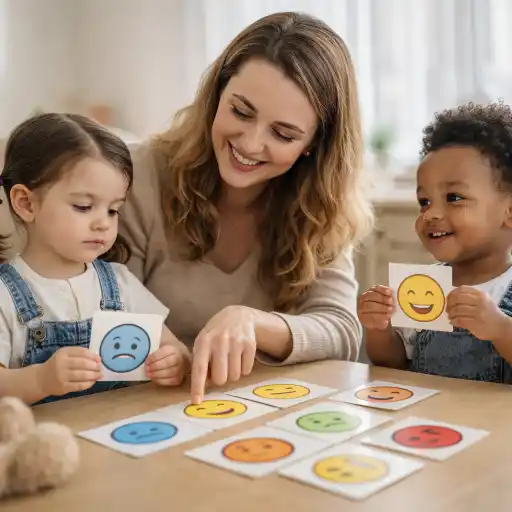
- 🙂 Emotion picture cards: 1) Display 4 faces at child height, 2) Invite children to point during arrival. Example resource: Emotion Sorting.
- 🎵 Feelings songs: Sing a 1-minute “Hello — How do you feel?” song. Use different voices and faces to model expression (CECMHC ideas).
- 🪞 Mirror faces: Hold a mirror; make a face (happy/sad/mad) and have each child copy. This supports recognition and facial awareness.
- 📚 Storytime discussions: Pause twice in a short book: ask “How does that character feel?” Use picture cards to help non-readers; see ChildCareEd story activity ideas (Emotions for Kids).
- 🧸 Puppet play: Use two puppets to role-play grabbing a toy and model scripts: “Can I have a turn?” or “I’m sad — I need help.” (See CSEFEL scripted stories: CSEFEL strategies.)
- ✋ Sharing & turn-taking games: Use a timer or song to signal turns; praise when children wait and use words.
- 😌 Calm-down choices: Offer 2–3 visuals (breathe, squeeze ball, read a book) in a cozy corner; teach it when children are calm (Calm-Down Corner).
- 🔁 Naming during routines: Narrate feelings at diapering, meals, and transitions: “You look tired; that means your body needs rest.”
Tip: Keep language consistent, repeat the same short phrases, and let children choose the calm tool so the strategy becomes theirs. These activities build core #feelings vocabulary for toddlers and give teachers tools to coach in the moment.
How do these activities build specific social and emotional skills?
1) Map activity → skill. Use simple pairings so staff see the learning target each time they practice. Examples:
- 🧠 Emotion picture cards → recognition & labeling. Naming feelings reduces frustration when children need help (How to Recognize and Express Feelings).
- 🗣️ Puppet scripts → language for needs & conflict resolution (e.g., “Can I have a turn?”). CSEFEL’s scripted stories are a model for short social scripts (CSEFEL).
- 🤝 Sharing games → turn-taking, patience, and cooperative play. Timers and songs make waiting concrete for toddlers.
- 😌 Calm-down choices + corner → self-calming, impulse control, and co-regulation with adults (Emotional Regulation Tools).
- 📚 Storytime discussions → empathy and perspective-taking (children practice noticing cues and predicting feelings).
2) Why skill sequencing matters: Start with recognition, add expression (words or gestures), then model a calming or sharing strategy. For ideas to adapt these routines as children move into preschool and extend emotion literacy through longer, interactive activities, see Exploring Emotions: Fun and Educational Preschool Activities. Repetition and adult modeling create the scaffolding toddlers need. Over weeks you will see small behavior changes: fewer grabs, more pointing to a face card, and increased use of calm tools. These are measurable wins for staff and families.
How should staff implement activities with patience and developmentally appropriate expectations?
1) Implementation principles:
- 🎯 Keep it short: 2–5 minute practices, repeated daily during calm moments.
- 🧩 Scaffold: Start with 2–3 feelings (happy, sad, mad) and add words slowly.
- 🤝 Co-regulate: Use the simple order Connect → Calm → Coach: get low, name the feeling, offer one calm choice, then briefly teach.
- 📌 Be consistent: Use the same phrases, visuals, and routines across staff.
- 📣 Communicate with families: Share the words and tools you use so children get the same message at home.
2) Common mistakes and how to avoid them:
- ❌ Teaching only during meltdowns → ✅ Practice when calm so skills transfer.
- ❌ Offering too many words at once → ✅ Limit choices; add slowly.
- ❌ Using the calm corner as punishment → ✅ Teach it as a choice and model visits.
- ❌ Long lectures in the moment → ✅ Use one short sentence + one clear option.
3) Be patient and strength-based: Expect gradual progress. Toddlers need steady repetition, encouragement, and predictable limits. Reinforce small steps: pointing to the right card, attempting a breath, or waiting a few more seconds for a turn. These wins build confidence for both the child and the #teachers supporting them.
How can directors and teams support teachers and measure progress?
1) Team supports:
- 📚 Provide brief trainings: Use ChildCareEd courses like Brighter Futures Buy Now $16.00 or Opportunity for Growth Buy Now $16.00 to build staff vocabulary and routines.
- 👥 Coaching & modeling: Directors or mentors observe 10–15 minute blocks and give one specific, kind suggestion to the teacher each week.
- 📝 Track small data: Use a 1-line log for repeated meltdowns—note time, trigger, what helped. Patterns guide next steps.
- 🤝 Family partnership: Share simple home activities (feelings songs, mirror faces) so practice continues beyond the classroom (Parent tips).
- 🔗 Use community supports: If a child shows frequent long meltdowns or safety concerns, involve your mental health consultant or follow screening/referral guidance (see CDC guidance and ECMH C ideas).
2) Measuring progress:
- ✅ Frequency: Is the number of meltdowns decreasing?
- ✅ Language: Does the child point to a feeling card or use a word more often?
- ✅ Tool use: Does the child select a calm choice rather than escalate?
3) Invest in sustainability: Add SEL goals into staff schedules, include short coaching time, and celebrate team wins. Practical ChildCareEd resources and free printables (calm-down posters, emotion cards) make the work feasible and aligned across classrooms (Brighter Futures resources
Summary
1) Key steps to start this week: 1) Pick two feeling words and two calm tools, 2) Practice a 2–3 minute activity daily (arrival or circle), 3) Teach a simple calm corner and model visits, and 4) Track one small indicator of change. 2) Use play-based activities (emotion cards, songs, mirrors, puppets, storytime conversation, sharing games, naming feelings in routines) and keep expectations realistic. 3) Support teachers with brief coaching and training (see ChildCareEd courses linked above). You are doing meaningful work: short, consistent routines and patient, strength-based responses give toddlers the foundation to name needs, calm their bodies, and connect with peers. Small moments add up to big gains for your #toddlers, their families, and your #teachers.
FAQ (quick):
- Q: How long should a calm corner visit be? A: 2–5 minutes unless staff stays nearby longer. See Calm-Down Corner.
- Q: What if a child refuses to use an activity? A: Offer one choice, stay nearby, model the tool, and try again later when calm.
- Q: When to refer? A: If frequent, long meltdowns persist despite consistent practice, partner with families and consult a mental health professional.
- CDA Home Visitor Subject Area 3 Part 3 Birth to 5
- Birth to Five CDA Credential with Portfolio Review
- CDA Infants/Toddlers: Importance of Consistent Care
- Opportunity for Growth: Emotional Development
- CDA Bridge Bundle: Family Child Care without Portfolio Review
- Are They Ready for Kindergarten?
- CDA Bridge Bundle: Infant/Toddler without Portfolio Review
- CDA Bridge Bundle: Preschool without Portfolio Review
- 45-Hour Infant and Toddler Curriculum
- Brighter Futures: Social Emotional Development
- Bye Bye Winter: The Role of Outdoor Play in Early Childhood Development
- Building Social Foundations
- Supporting Social Relationships Among Young Children
- Hungry for Play: The Power of Play-Based Learning in Early Education
- Frosty Fun: Trauma-Informed Play for Resilient Young Learners
- How motor skills shape child development and creative ways educators can foster them.
- CDA Certification en Español: Recursos y Consejos para Educadores Bilingües
- 🔍 ¿Qué ves cuando observas a un niño aprender?
- ¿Cómo explicar los colores a un niño ciego? Actividades con tacto, sonido y emociones
- Apoyo en Español para Capacitaciones Grupales Presenciales y por Zoom en Cursos Selectos
- Actividades de Motricidad Gruesa que Desarrollan el Equilibrio, la Coordinación y la Fuerza
- Actividades de Otoño Fáciles para Preescolares esta Temporada
- What Social-Emotional Learning Activities Work Best for Toddlers in Minnesota Classrooms?
- Canciones, juegos y preguntas de círculo para niños
- Feelings Activities for Toddlers: Building Social and Emotional Skills
- Social-Emotional Activities for 2-Year-Olds: Big Feelings, Little Words, Big Growth
- Feelings Activities for Toddlers: Point, Move, Match, and Name It
- How Can You Help a Child Hold Two Feelings About the Same Event?
