Children grow a lot during play and daily routines. This short guide helps Georgia child care providers and directors notice the important signs of growth, spot worries early, and plan next steps that are simple and kind. Use focused #observation in your #Georg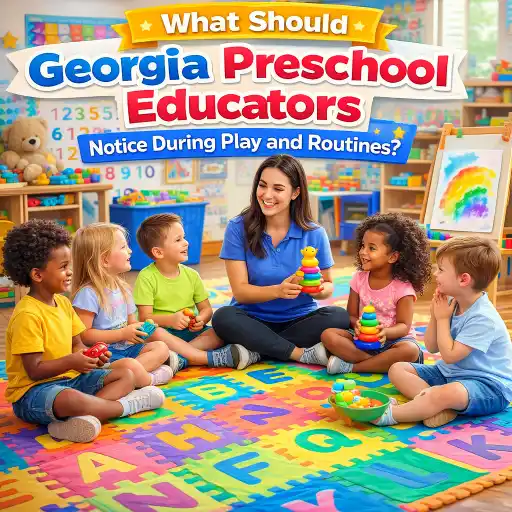 ia #preschool room to watch #routines and #milestones. Remember: state requirements vary - check your state licensing agency.
Why does watching play and routines matter?
2. 🔍 Early noticing helps children get help faster. The CDC milestone pages list age steps to share with families: Milestones by 4 Years and Milestones by 30 Months.
3. 💙 Good watching builds trusting talks with families. ChildCareEd has scripts and ideas at What should Georgia early childhood educators watch for in preschool behavior?.
What signs of growth should I notice during play?
- 😊 Social play: Notice if the child joins a game, takes turns, or offers pretend roles. Look for cooperation and help.
- 🔤 Language: Note new words, short sentences, asking "who/what/where" questions, or following two-step directions. CDC milestone pages give examples: 4-year and 30-month lists.
- 🧩 Thinking and problem solving: Watch if a child tries new ways to solve a block challenge or completes a simple puzzle.
- ✋ Fine motor: Note holding a crayon, cutting with scissors, or stringing beads.
- 🏃 Gross motor: Watch running, hopping, catching a ball, or taking safe risks outdoors. See play and active learning ideas in the 10 Hour Health & Safety Orientation
 Buy Now $80.00.
Cite facts, not labels. Write short notes like: "3/10, block area: Maya stacked 6 blocks and said, 'tower'". For tools and checklists, try the Classroom Observation Checklist.
How do routines show learning and behavior?
2. Numbered ways routines reveal development:
- 😊 Independence: Does the child hang up their coat, pour a drink, or help set the table?
- ⏳ Self-regulation: Can the child wait 1–2 minutes or follow a short clean-up song?
- 🗣️ Social language: Does the child ask for help or say "my turn"?
- 🔄 Flexibility: Can the child change from play to circle time with a 2-minute warning?
Practical steps:
- 😊 Post a picture schedule at child height and practice it daily (Routines & Big Feelings).
- 🎵 Use the same cue (song, timer) for transitions.
- 📋 Track when trouble happens (time, trigger) and change the routine: shorter circle time, extra movement break, or visual supports.
Why it matters: Routines are natural teaching moments. Children learn steps, words, and calm strategies while you keep the day moving.
How do I observe fairly and document what I see?
1. ✍️ Keep notes factual: date, time, location, what happened, and any words the child said. ChildCareEd gives forms and examples at How do I run effective classroom observations.
2. Simple methods to use:
- ⏱ Time sampling — check behavior in short blocks. Good for routines.
- 🎯 Event sampling — write each time a specific event happens (sharing, hitting).
- 📝 Anecdotal notes — short story-style notes with exact words and actions.
3. Practice to reduce bias:
- 😊 Use two observers when you can and compare notes to build agreement (Observation Techniques).
- 🔍 Stick to facts, not feelings: write "grabbed truck", not "aggressive".
- 📷 With family permission, use photos or short videos for clarity (Recording Tips).
Common mistakes and how to avoid them:
- ❌ Only note problems → ✅ Also record strengths and successes.
- ❌ Vague notes → ✅ Use one clear example with date/time.
- ❌ Waiting too long → ✅ Re-check every 2–4 weeks and use short goals.
How do I partner with families, and what are the next steps?
1. 🤝 Start with strengths: share one positive example, then one observation. ChildCareEd has scripts for talking with families.
2. Simple family meeting steps:
- 😊 Prepare 2 clear examples (date, what happened).
- 🛠 Make a 1–3 step plan: teach 1 skill, pick one classroom strategy, set a 2-week check-in.
- 🔁 Re-check and adjust after 4–6 weeks.
3. When to get extra help:
- 🛑 If safety is a concern (child hurts others or self).
- 🛑 If little progress is made after consistent steps.
- 🛑 If language or loss of skills is noticed — suggest hearing check and screening (see CDC milestones and local early intervention).
4. Use local and state resources: Georgia DECAL rules affect training and referrals. Learn more on training and required hours at Georgia Health & Safety training Buy Now $80.00 and other ChildCareEd courses like 45-Hour Preschool Curriculum Buy Now $399.00$275.00. Remember: state requirements vary - check your state licensing agency.
FAQ (quick)
- Q: How often should we observe? A: Short notes daily and one deeper observation each month work well (Observe with purpose).
- Q: What if a family disagrees? A: Listen, show specific examples, and invite their observations.
- Q: When refer for screening? A: If a child loses skills, has very unclear speech, or safety is at risk. Use CDC and local early intervention steps.
- Q: How to keep staff ready? A: Short trainings, peer coaching, and using checklists help—see CSEFEL.
Conclusion
1. Watch play and routines with purpose: pick one focus, write facts, and use short goals.
2. Use visual schedules, calm strategies, and consistent cues to teach through routines. ChildCareEd resources linked above have ready tools and scripts.
3. Partner with families kindly and act early when you see patterns that worry you. For Georgia providers, check DECAL guidance and training options. Your steady watching, kind words, and small steps make a big difference in each child’s growth.
1. 🔁 Routines (arrival, snack, clean-up) help children predict the day. Predictability lowers stress and boosts learning. See routine tips at How Can I Make Transitions and Daily Routines Easier?.1. 😊 Children show skills in play and routines that they don’t show on a worksheet. See examples at What Do You See When You Watch a Child Learn?.1. ✅ Use a focused goal: pick one thing to watch each time (language, social play, or fine motor). See steps at How can teachers observe children's development effectively?.
- 45 Hour Child Growth and Development
- 45 Hour Preschool Methods and Materials
- 45 Hour Infant and Toddler Methods and Materials
- 45 Hour School Age Methods and Materials
- CDA Bridge Bundle: Preschool without Portfolio Review
- Play, Learn, Grow
- Texas Director Credential
- 10 Hour Health and Safety Orientation Training
- How to Become a Preschool Lead Teacher in Georgia
- CDA Certification en Español: Recursos y Consejos para Educadores Bilingües
- Cuáles Son las Señales de Alerta en el Desarrollo Infantil que Todo Educador Debe Conocer?
- 😫🧸 ¿Qué hacer cuando un bebé no quiere dormir la siesta en el aula?
- ❄️ ¿Qué actividades al aire libre funcionan bien para los niños de Illinois en cada estación? 🌷🍂
- ¿Cómo pueden los equipos de cuidado infantil practicar habilidades rápidas de primeros auxilios en situaciones reales?
- Consejos de Supervisión Activa para Salones de Preescolar y el Juego al Aire Libre
- How can Georgia preschool teachers use positive guidance to help preschoolers share during indoor play?
- How can rainy day indoor activities help preschoolers learn kindness and cooperation in Georgia?
- Which Georgia Parks and Nature Centers Are Best for Preschool Field Trip Adventures?
- What should Georgia preschool educators notice during play and routines?
- What Happens After You Apply for CAPS in Georgia?
- What Can You Do If You Don’t Qualify for Georgia CAPS Child Care Assistance?
- How Can Child Care Providers Use Observation and Assessment to Support Every Child?
- How Can Child Care Providers Assess Children Through Everyday Activities?
- How Can You Link a Preschool Learning Center to a Clear Teaching Goal?
- How Often Should Early Childhood Educators Observe Each Child?
- What Should Child Care Providers Prioritize When Preschool Readiness Goals Compete for Time?
- How Do You Set Up a Developmentally Appropriate Preschool Classroom?
