Introduction
Assessment in #early-childhood starts with watching children closely. When we watch with purpose, we learn about each child’s needs, strengths, and next steps. Good observation helps teachers plan learning, support behavior, and share real information with families. Use these ideas to make observation clear, fair, and useful in your #classroom. Purposeful observation is part of strong #assessment work that #centers each child and builds trust with #families and the teaching team.
Why this matters: observation gives us real data about a child’s play, language, and how they solve problems. It helps us spot when extra help is needed early. For tools and training, see ChildCareEd resources like Observations in Childcare and the course Tracking Progress, Shaping Futures  Buy Now $55.00.
Why does purposeful observation matter?
Purposeful observation matters because it tells us what children can do and how they learn. When we observe, we watch the whole child — social play, language, thinking, and motor skills. This helps us plan activities that fit each child’s level. Here are clear reasons to observe with purpose:
- 📌 It shows real skills: We document what a child actually does during play or routines (for #example, lunchtime or block play) as shown in Observations in Childcare.
- 🔍 It helps us spot needs early: Regular checks can reveal delays or behaviors that need support..
- 📈 It informs goals and instruction: Observations turn into short-term steps and long-term goals, a focus of courses like Observing & Assessing in Child Care Buy Now $16.00.
In short: purposeful observation makes teaching stronger, kinder, and fairer. It helps us put each child’s #development and #strengths first.
How can we observe objectively and avoid bias?
Objective observation means writing down what we see without adding feelings or guesses. This keeps notes useful for planning and sharing. Here are steps to observe more objectively:
- 🔎 Define what you will watch for. Pick a skill or routine (e.g., sharing at table time). Use clear labels like "child points to picture" rather than "child is shy."
- 📝 Use simple tools: anecdotal notes, checklists, time sampling, or event sampling. ChildCareEd gives sample forms and templates in their resources.
- 📷 Record #examples: photos, short video clips, or work samples help show what you mean. Add a short caption with date and what was happening.
- 🔄 Train and calibrate: Practice coding the same short video with colleagues. Meet to compare notes and adjust your definitions.
Common mistakes and how to avoid them:
- ❗ Mistake: Writing opinions. Fix: Stick to facts (what happened, not why).
- ❗ Mistake: Watching only hard moments. Fix: Observe routines and play so you see both strengths and challenges.
What methods and tools should we use for purposeful assessment?
Choose tools that fit your classroom and child. No single tool fits every need, so use a mix. Here are common methods and when to use them:
- ⏱ Time sampling: record whether a behavior happens in set time intervals. Good for attention, routines, or behaviors that repeat.
- 🎯 Event sampling: write down every time a specific event happens (e.g., hitting, offering help). Use for behavior analysis and to build goals.
- 🧩 Work samples & portfolios: collect drawings, photos, and writing to show #growth over time.
If behavior is a concern, consider a Functional Behavior Assessment to learn why it happens and plan supports (FBA guide).
Training matters: ChildCareEd offers courses like Preschool Assessments & Observations Buy Now $24.00 and Observations And Goal Setting Buy Now $24.00 to build skills. Also remember: state requirements vary - check your state licensing agency.
How do we turn observations into goals and share them with families? 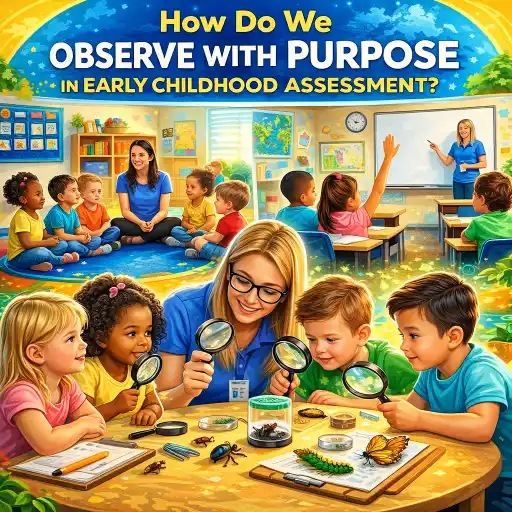
Observations are useful only if we use them. Turn notes into clear, small goals and share them with families in a positive way. Follow these steps:
- 📑 Summarize: Write a short summary of what you saw. Include date, setting, and exact actions (example: "On 3/ #4 at block area, Sam stacked 6 blocks and named colors").
- 🎯 Set one to three simple goals: Make them short-term and measurable. Example: "Sam will stack 8 blocks in a row during block play, 3 out of 5 tries."
- 🛠 Plan supports: List 2–3 ways teachers will help (model stacking, offer bigger blocks, give praise). Link strategies to routines so goals are part of the day.
- 🔁 Track progress: Re-observe and note if the goal is met. Update the plan and share progress regularly in quick notes or short meetings.
When to refer: If progress is slow despite good supports, consult specialists and follow local referral steps. Use multiple measures and document carefully to support referrals, as described in ChildCareEd courses like Tracking Progress Buy Now $55.00.
Conclusion
Purposeful observation is a simple but powerful way to understand children. When we watch without bias, use clear tools, and turn data into small goals, children get the right help at the right time. Keep records that are factual, share them kindly with #families, and use them to guide teaching and #assessment decisions. Training and practice make this easier; explore ChildCareEd courses and free resources linked above for step-by-step help.
Quick FAQ (short answers):
- Q: How often should we observe? A: Regularly — during routines and play. Short daily notes plus deeper observations each month work well.
- Q: Who writes observations? A: Teachers and aides who know the child best. Use more than one observer when you can.
- Q: How long keep records? A: Keep them for the child’s time in your program and follow your state rules.
- Q: What if a family disagrees with an observation? A: Listen, share examples, and invite family examples. Work together on goals.
Final tip: start small. Pick one routine, try an anecdotal note system, and build from there. Your careful watching helps children grow. Keep supporting each child’s #development and celebrate progress every day.
- Planning for Every Child: Responsive Strategies in Action
- CDA Infants/Toddlers: Benefits to Observing
- Tracking Progress, Shaping Futures: Observation & Assessment Skills
- Privacy Matters: Documentation and Observation in Early Learning
- Early Childhood Education
- Culture, Communication, and Collaboration in Assessment
- Texas Director Credential
- CDA Subject Area 7
- Mastering Observation Techniques in the Montessori Classroom
- A Watchful Eye: Supervision in Early Childhood
- CDA Certification en Español: Recursos y Consejos para Educadores Bilingües
- Teaching with Purpose
- 🔍 ¿Qué ves cuando observas a un niño aprender?
- 🪁¿Cómo puede el juego apoyar de manera poderosa a los niños con autismo?🧩
- Cómo Abrir Una Quardería En Casa Sin Dinero?
- Recursos en Español sobre el Sueño Seguro del Bebé
- Retraso del Habla en la Guardería: Cómo Pueden Ayudar los Proveedores
- Cómo Ser Maestra de Preescolar en Illinois
- How can Florida preschool staff assess children during everyday activities?
- How can we make observation and assessment simple and useful in childcare?
- Cómo simplificar la capacitación para sus empleados de daycare
- How can we reliably avoid bias during observation and assessment?
- Building a Better Head Start Lesson Plan: 7 Things Every Teacher Should Include
- How Can You Observe Children Without Interrupting Their Play?
- How Can Child Care Providers Share Small Concerns Before They Become Big Conversations?
- How Can You Track Children’s Development Without Turning Everything Into a Test?
- How Can You Observe Children Without Interrupting Their Play?
- How Do You Talk to Parents About Developmental Concerns?
- How Can Preschool Providers Observe Early Number Recognition During Math Play?
