As a Florida child care provider or director, your daily observations help shape what children learn and how safe they are. W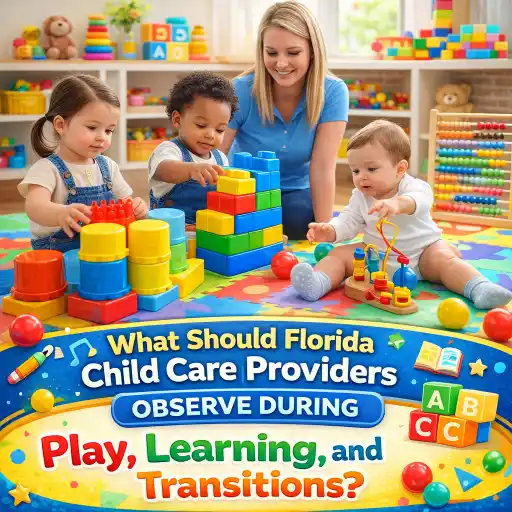 atch short moments during free play, small-group lessons, and moves between activities. These notes tell you what children can do, what they need next, and what to share with families. Keep observations short, factual, and linked to routines. Remember: state requirements vary - check your state licensing agency.
1) What should I notice during free play?
- 😊 Social moves: Who the child plays with, how they share, and how they solve disagreements. These show self-help and social skills. See tips on focused viewing at How do I run effective classroom observations (Checklist included)?
- 🔎 Language use: New words, questions asked, and ways children tell stories — important for vocabulary growth. ChildCareEd’s play-based learning guide explains how play builds language (What Is Play-Based Learning and Why Does It Work?).
- 🧩 Problem solving: How a child plans with blocks or fixes a toy — look for trial-and-error and persistence.
- ⚽ Motor skills and safe choices: Climbing, balancing, or cutting with scissors — useful for health and supervision.
- 📈 Attention & interest: What holds a child’s attention and for how long; this helps plan next activities.
Quick practice: pick one child and one focus (language or sharing). Watch 5–10 minutes and write one factual sentence: who, what, when. Put that sentence in the child’s portfolio. This habit supports strong #observation, helps your #children, and keeps notes manageable.
2) What should I observe during structured learning and small groups?
- 🎯 Skills shown: Can the child follow 2-step directions, identify a letter, or retell a short story? Note successes and next steps. For tools on turning notes into goals, see How we can document child progress effectively?.
- 👂 Participation and listening: Does the child answer questions, wait a turn, or need prompts? These signs guide scaffolds and support.
- ✏️ Fine motor and pre-writing: Look at grip, cutting, or drawing — use samples in a portfolio as shown in Creating Effective Child Portfolios.
- 🔁 Response to prompts: Note what teacher language helped — repeating, modeling, or giving a choice. Use that language again next time.
- 📊 Short checks: 1–2 minute snapshots (first sound, count to 5, name 3 colors) give quick data. Keep results in a simple chart for the week.
Practical link: plan one small-group focus per day and rotate children so each child gets weekly targeted time. Use ChildCareEd lesson and assessment resources to align with Florida standards (Division of Early Learning Professional Learning Modules). Keep notes brief and connected to real classroom routines to make them actionable. Include #play and family updates for stronger partnerships.
3) What should I watch during transitions and routines?
- 🔔 Timing and cues: Notice whether verbal warnings, songs, or visual schedules help. Research-backed tips on smooth transitions are in How can positive guidance make indoor transitions calm, and the CSEFEL brief on transitions (CSEFEL What Works Brief #4).
- 🙂 Emotional responses: Does the child calm quickly, need help, or get upset? These clues suggest teaching needs (practice calm scripts or previewing).
- 👀 Supervision & safety: Are sightlines clear? Use active supervision steps like scanning and counting during moves (7 Active Supervision Strategies).
- 🧭 Independence skills: Can the child hang their coat, clean up, or line up with minimal help? These skills predict classroom readiness and independence.
- 🔁 Predictability: Note if routines are consistent across staff. Inconsistency shows a need for shared scripts and coaching.
Try a quick two-week plan: pick one transition (bathroom to circle), add a visual schedule and a 2-minute warning, observe three times, and record two facts each time. Share results in a staff huddle. Small changes reduce stress for staff and children, support #transitions, and free up time for real teaching.
4) How do I record observations, avoid bias, and use findings with families?
Good notes are short, objective, and lead to clear next steps. Use the same simple tools across staff so records stay consistent and trusted.
- 📋 Keep facts, not judgments: write actions and exact quotes ("said 'my truck'" or "stacked 6 blocks"). ChildCareEd gives practical forms and guidance in How do I run effective classroom observations and documentation ideas at How can we document child progress effectively?.
- 📷 Use photos and work samples with family permission: add one photo per week to the child’s portfolio (Creating Effective Child Portfolios).
- 👥 Reduce bias: use two observers sometimes, compare notes, and train staff on objective language.
- 🎯 Turn notes into goals: 1 summary → 1–3 measurable goals → 2 teacher supports → re-check in 2–4 weeks. ChildCareEd’s goal-setting guides walk you through this step-by-step.
- 🤝 Share with families: start with strengths, show one example, ask for their view, and offer easy home activities. State rules for records and privacy differ, so state requirements vary - check your state licensing agency.
Common mistakes and quick fixes:
- ❗ Writing opinions instead of facts — fix: stick to what you saw and heard.
- ❗ Observing only hard moments — fix: capture play and routines to show strengths.
- ❗ No follow-up — fix: set a re-check date and update the plan.
Summary and Quick Checklist
Why it matters: focused observation helps you plan better, spot supports early, and build trust with families. It turns everyday moments into clear teaching steps that help children grow.
- 🔎 Pick 1 focus per child this week (language, sharing, independence).
- 🕒 Watch 5–15 minutes, write one factual sentence (who, what, when, where).
- ✏️ Add a photo or work sample with permission to the portfolio.
- 🎯 Make 1 measurable goal and 2 teacher supports; re-check in 2–4 weeks.
- 🤝 Share one strength and one next step with the family.
FAQ (short):
- Q: How often to observe? A: Quick daily notes plus one deeper monthly check is practical. See observation checklist.
- Q: Who writes observations? A: The staff who know the child best; add another observer when possible.
- Q: How long keep records? A: Follow program policy and state rules; state requirements vary - check your state licensing agency.
- Q: What if a family disagrees? A: Listen, show concrete examples, invite their observations, and make a shared plan.
Use ChildCareEd resources for forms, course training, and short templates to make this work easier day-to-day: free resources. Your simple, consistent observations will improve teaching, strengthen family partnerships, and boost outcomes for the #preschoolers in your care. Happy observing!
Small groups are where you teach targeted skills. Watch the child’s responses to instruction and how the teacher moves matter. Use short, consistent checks so your #learning plans improve week to week. Free play is a goldmine for learning. Focus on a few things so your notes stay quick and useful. Try to watch for: Transitions are learning moments and common trouble spots. Watching transitions helps you reduce disruptions and teach self-regulation. Short, planned observation shows what supports help each child move smoothly.- 45 Hour Child Growth and Development
- Tracking Progress, Shaping Futures: Observation & Assessment Skills
- Bienvenido! Welcoming All Families
- Unlocking Support for Florida Childcare
- Positive Attention: Interactions & Supervision for Infants & Toddlers
- Texas Director Credential
- Mastering Observation Techniques in the Montessori Classroom
- Every Moment Matters: Schedules and Transitions
- 😫🧸 ¿Qué hacer cuando un bebé no quiere dormir la siesta en el aula?
- ❄️ ¿Qué actividades al aire libre funcionan bien para los niños de Illinois en cada estación? 🌷🍂
- ¿Cómo pueden los equipos de cuidado infantil practicar habilidades rápidas de primeros auxilios en situaciones reales?
- Capacitación en Salud y Seguridad Preventiva en Línea para Proveedores de Cuidado Infantil
- Proporciones de Cuidado Infantil y Tamaños de Grupo por Edad en Maryland (Guía Rápida para Centros y Hogares)
- Actividades de Otoño Fáciles para Preescolares esta Temporada
- Consejos de Supervisión Activa para Salones de Preescolar y el Juego al Aire Libre
- Capacitación Previa al Servicio para Proveedores de Cuidado Infantil en Georgia
- How can Florida teachers prepare for a CLASS observation without stress?
- What should Florida child care providers observe during play, learning, and transitions?
- How can Florida preschool staff assess children during everyday activities?
- How can I support inclusion in Florida play and daily routines?
- What are the supervision basics for child care providers in Florida?
- What are Florida's child care ratios and group sizes by age for centers and homes?
- Mixed-Age Daycare Schedule: How to Plan a Day for Different Age Groups
- How Can Child Care Providers Support Healthy Toddler Development?
- How Can Child Care Providers Create Effective Learning Centers in Small Spaces?
- How Can Child Care Providers Assess Children Through Everyday Activities?
- What Early Signs of Autism May Child Care Providers Notice?
- ¿Todos los niños deben participar en el tiempo de círculo?
