This short guide shows how #play shapes the #brain and #development of #children in #Minnesota. It is for child care providers and directors who want clear, practical steps to support children under 5. Read on for simple science, hands-on ideas, common pitfalls, and ways to explain play to families and regulators.
Why this matters: Play is not busywork. The first five years build the f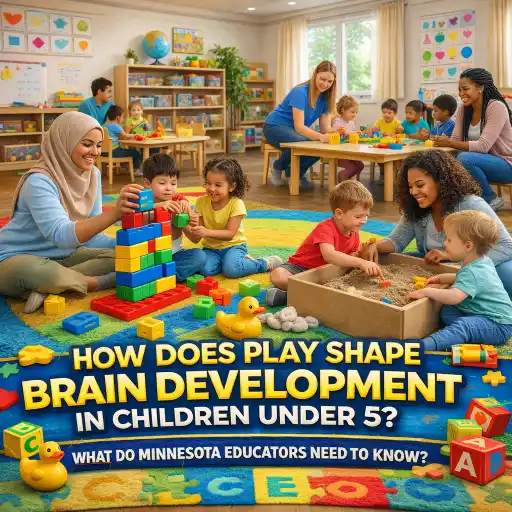 oundation for learning, self-control, and language. The CDC notes early experiences shape a child’s lifelong health and learning, and play is one of the best everyday tools to build that foundation (CDC: Early Brain Development). Minnesota educators can use play to support strong outcomes in classrooms and to meet family expectations.
What happens in a child’s brain when they play?
2) Rapid change in early months: Research shows toddlers’ brains change fast. For example, at about 16 months, children use more brain regions for control and following directions, a key step toward managing behavior.
3) Different types of play activate different skills:
- Sensorimotor play (infants): touches, sights, and sounds build early maps of the world — see ChildCareEd on sensory play.
- Pretend play (toddlers/preschoolers): supports symbolic thinking and later reading — research links pretend play to cognitive gains (ECRP).
- Social play: grows language, turn-taking, and #self-regulation (executive function) (ChildCareEd).
4) Practical note: When children lead play, they often reach the right level of challenge to learn quickly — so follow the child’s curiosity rather than over-directing.
How does play boost language, social skills, and thinking before kindergarten?
2) Social skills: During play, children negotiate roles, share materials, and solve small conflicts. Unstructured play gives them time to practice these skills — Help Me Grow MN emphasizes giving kids freedom to explore in free play (Why Unstructured Play Is Important).
3) Cognitive skills: Building, simple games, and pretend play help with counting, planning, memory, and flexible thinking. Play-based learning links play to stronger math and problem-solving later — see ChildCareEd’s review of play-based learning (Play-Based Learning and Cognitive Growth).
4) Executive function: Games with rules, turn-taking, and clean-up routines help children practice waiting, shifting attention, and finishing tasks — all skills that kindergarten teachers notice quickly.
5) Quick examples you can try tomorrow:
- 🧸 Dramatic center with props: encourage full sentences like, “I will be the cashier.”
- 🔢 Block challenge: count and test which tower stands best.
- 🎵 Song + movement: build rhythm, memory, and vocabulary.
What practical steps can Minnesota educators take to support play-based brain growth?
2) Daily schedule: Build in long, uninterrupted play blocks. Research recommends regular time for free, child-led play to enable deeper engagement (APS summary).
3) Adult role: Do less teaching, more scaffolding — watch, narrate, ask open questions (“What will happen if you add one more block?”), and join briefly to extend language.
4) Safety and supervision: Supervise well, but let children solve small problems. State rules vary — state requirements vary - check your state licensing agency. ChildCareEd’s supervision-focused course gives tips for safe, literacy-rich play (Play Safe, Think Big)  Buy Now $10.00.
5) Partner with families: Share simple home play ideas and explain why play matters. Use local resources like Help Me Grow MN for family handouts (Help Me Grow MN).
Common mistakes and how to avoid them:
- ❌ Mistake: Replacing play with worksheets to ‘teach’ skills. ✅ Fix: Use play to teach the same skills — counting with snacks, letters in dramatic play.
- ❌ Mistake: Too-short play times. ✅ Fix: Schedule at least 30–60 minutes of uninterrupted play when possible.
- ❌ Mistake: Over-direction. ✅ Fix: Observe first, then ask one open question to nudge learning.
How can educators measure impact and explain play to families and licensing?
1) Observe and record: Use simple checklists and anecdotal notes to capture language, problem-solving, and social moves during play. ChildCareEd offers tools and milestone checklists you can adapt (ChildCareEd resources).
2) Use examples: When sharing with families or inspectors, give 3 concrete stories of a child’s progress (before, during, after play). Example: “At the block table, Mia used three new words and learned how to steady a leaning tower.”
3) Link to research and local guidance: Cite CDC notes on early brain health (CDC), and local resources like Help Me Grow MN for community credibility (Help Me Grow MN).
4) Track progress over time: Make brief charts showing growth in language counts, turn-taking, or following multi-step directions. This shows regulators and families that play is purposeful and measurable.
5) When in doubt: state requirements vary - check your state licensing agency. Keep documentation clear: goals, time for play, staff support, and safety steps.
FAQ (quick answers):
- Q: How much play time is enough? A: Aim for daily open-ended play; 30–60 minutes uninterrupted is ideal for deeper learning.
- Q: Does messy play count? A: Yes — sensory play builds strong brain maps; plan easy cleanup and supervision.
- Q: How to help non-English families? A: Use gestures, pictures, and translate simple play ideas; ChildCareEd offers Spanish support in trainings (Play, Learn, Grow) Buy Now $25.00.
- Q: Will parents accept play over worksheets? A: Share short stories and simple progress notes showing skills built through play.
Summary: 1) Play builds the brain by creating connections across language, memory, emotion, and planning. 2) Practical steps — good environment, long play blocks, adult scaffolds, family partnership — make play powerful. 3) Measure with notes and simple charts and connect practice to trusted resources like ChildCareEd and Help Me Grow MN. State requirements vary - check your state licensing agency.
For more classroom tools and training, start with ChildCareEd’s articles and courses on play-based learning and language through play (ChildCareEd). For a concise educator-focused overview of how play supports learning and available training, see The Play’s the Thing!.
1) Brain wiring: Every time a child explores or repeats an action, new connections (synapses) form. Play lights up many brain areas at once — memory, emotion, language, and planning — which makes strong, lasting learning. See ChildCareEd’s explanation of how play supports brain growth (How Play Supports Brain Development).1) Environment: Offer open-ended materials (boxes, scarves, blocks, sensory bins). ChildCareEd has concrete ideas and courses, such as Play, Learn, Grow Buy Now $25.00, and Play Safe, Think Big Buy Now $10.00, to help plan centers.1) Language: Play creates real reasons to talk. Story play, puppets, and dramatic centers (doctor, grocery) invite new words and sentence practice. ChildCareEd highlights many language-rich play ideas in Boosting Language Through Play.- 45 Hour Child Growth and Development
- CDA Home Visitor Subject Area 3 Part 3 Birth to 5
- Bienvenido! Welcoming All Families
- 45 Hour Infant and Toddler Methods and Materials
- 45-Hour Infant and Toddler Curriculum
- CDA Home Visitor Credential Birth to 5
- Texas Director Credential
- 45 hour Growth and Development Birth-age 12 ONLINE
- CDA Certification en Español: Recursos y Consejos para Educadores Bilingües
- Boosting Language Through Play
- 😫🧸 ¿Qué hacer cuando un bebé no quiere dormir la siesta en el aula?
- 👧 ¿Cómo iniciar y abrir una guardería en Texas? Lo que necesitas saber
- Cómo Abrir Una Quardería En Casa Sin Dinero?
- 10 Ejemplos de Cómo la Cultura Influye en el Desarrollo Infantil
- Capacitación en Salud y Seguridad Preventiva en Línea para Proveedores de Cuidado Infantil
- Regulaciones de Licenciamiento de Cuidado Infantil en California para Centros y Hogares de Cuidado Infantil Familiar
- Normas de Licenciamiento de Cuidado Infantil en Virginia para Centros Diurnos Infantiles y Hogares Diurnos Familiares
- Proporciones de Cuidado Infantil y Tamaños de Grupo por Edad en Maryland (Guía Rápida para Centros y Hogares)
- Lista para Abrir una Guardería en Casa en Virginia: Cómo Empezar
- Lista para Guardería en Casa en Illinois: Cómo Iniciar una Guardería en el Hogar
- Lista para Guardería en Casa en Texas: Cómo Iniciar una Guardería en el Hogar
- Cómo Trabajar en el Cuidado Infantil en California: Requisitos y Pasos
- Cómo Ser Maestra de Preescolar en Dakota del Norte
- Capacitación Previa al Servicio para Proveedores de Cuidado Infantil en Dakota del Norte
- How does play shape brain development in children under 5 — what do Minnesota educators need to know?
- Can Minnesota Childcare Directors Complete Their 40-Hour Requirement Entirely Online?
- How can Minnesota child care settings support Dual Language Learners?
- How Does the Brain Develop During the First Five Years?
