A child who hesitates when asked to count may still be a curious mathematical thinker waiting for a low-pressure invitation. With playful routines, encouraging language, and room to try again, child care providers can help children see themselves as capable learners; the Early Mathematics Through Play course Buy Now $24.00 offers a deeper set of developmentally appropriate strategies for integrating math into classroom life. Read on for simple approaches you can begin using with the children in your care.
Why does confidence matter in early math?
Confidence shapes whether children are willing to explore an unfamiliar problem, share an idea, and persist when an answer does not come quickly. Early math is not merely reciting number words; children also compare quantities, notice patterns, describe shapes, estimate, and reason about how objects relate. When these experiences feel welcoming, children can build both mathematical understanding and a positive sense of themselves as learners.
Young children learn from adults’ attitudes as well as their direct instruction. Statements such as “I’m not a math person” can unintentionally suggest that mathematical ability is fixed or belongs only to some people. Instead, model curiosity: “I wonder which tower is taller. Let’s compare them.” Research-informed guidance from NAEYC emphasizes playful, developmentally appropriate experiences and a classroom culture that values persistence and learning from mistakes.
Confidence does not mean every child must answer immediately or enjoy every activity. It means children have a safe opportunity to participate, make sense of an idea, and experience progress. You can nurture that sense of capability through ordinary moments—in the block area, at snack, during cleanup, and outdoors—without adding a formal lesson to every part of the day.
How can everyday routines make math feel approachable?
Daily routines give children meaningful reasons to use math. Connect number words to objects they can see and handle, and use a few clear math terms as you describe what is happening. For example, count cups while setting the table, compare two groups of blocks, or notice a repeating pattern in a song. The IES guide to teaching math to young children describes ways to explore number, shape, pattern, measurement, and data through everyday activities.
- At snack, ask, “How many plates do we need?” or “Does everyone have the same number of crackers?”
- During cleanup, compare groups: “Which basket has more cars? How could we check?”
- In the block area, invite children to notice height, shape, balance, or position: “What could go underneath to make it steady?”
- On a walk, look for shapes and patterns, or count steps to a familiar place.
- 🎵 Use clapping, movement, and simple songs to make counting and repeating patterns lively.
Keep the interaction brief and responsive. Follow children’s interests, and do not turn every question into a test. If a child is focused on building, a simple comment—“You used three long blocks on the bottom”—may be more inviting than stopping play to demand an answer. Familiar routines let children meet the same ideas repeatedly in different contexts, helping them connect words, quantities, and actions.
What language helps children feel capable of learning math?
Specific, process-focused feedback tells children what they did that supported their learning. Instead of relying only on broad praise such as “You’re so smart,” notice the strategy: “You touched each bear as you counted, so you kept track.” This reinforces useful approaches and signals that effort, thinking, and trying another way are valued.
Open-ended questions can make children’s reasoning visible without making them feel they are being quizzed. Try prompts such as:
- “What do you notice?”
- “How did you figure that out?”
- “What could we try another way?”
- “How could we check your idea?”
Give children enough time to respond. Some may explain with words; others may point, move objects, gesture, or demonstrate. These are all meaningful ways to communicate mathematical thinking. When possible, welcome children’s home languages and use objects, pictures, or gestures to support understanding.
Adult language matters, too. Model a flexible attitude by thinking aloud: “I counted too quickly and lost my place. I’ll slow down and point to each one.” This shows that mistakes are part of learning, not evidence that someone cannot do math. DREME’s guidance on building positive math attitudes recommends asking about children’s thinking, focusing praise on effort, and keeping math exploration encouraging.
How should educators respond to mistakes and frustration?
A wrong answer can reveal how a child is approaching a problem. Pause before correcting or supplying the solution. Ask the child what they noticed, offer a concrete tool if useful, and invite them to check their idea. For instance, if a child counts a group of buttons inaccurately, you might place them in a line and suggest touching each button once as you count together.
Protect the child’s dignity: avoid public comparisons, teasing, or describing a child as “bad at math.” Children develop at different rates and may be tired, distracted, unfamiliar with the materials, or working across languages. One response in one activity is not a measure of a child’s overall ability. Observe patterns across experiences and use them to plan helpful next steps.
- Stay calm and curious: “Let’s look at it together.”
- Break the task into a smaller step or offer objects, pictures, or a number path.
- Recognize what is already working: “You found the first two numbers. Let’s see what comes next.”
- If frustration rises, pause, shift to easier play, or return later.
NAEYC’s discussion of persistence and positive math attitudes encourages teachers to let children work through appropriately challenging tasks rather than stepping in too quickly. Support is not the same as leaving a child stuck: offer a hint, a model, or a tool, then give them space to continue. This balance communicates trust in the child’s ability to learn.
Which playful activities build confidence without pressure?
Choose activities that invite exploration and allow more than one way to participate. Use familiar, safe classroom materials, and adjust the amount of challenge to the child’s current understanding. A child who is beginning to count may enjoy matching one object to each space; a child ready for more can compare two sets or explain how they know one has more.
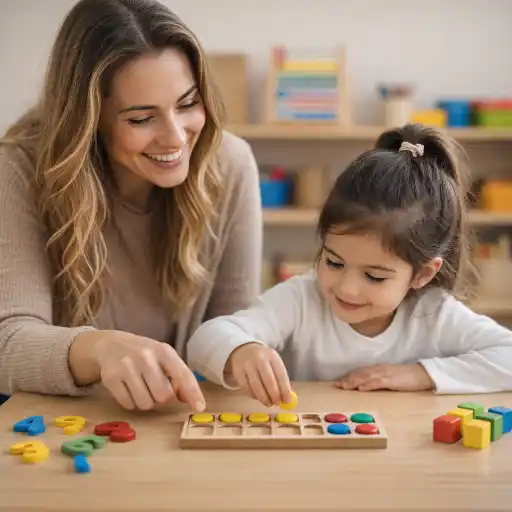
- Build and compare: Make two block towers and discuss which is taller, shorter, or the same height.
- Sort and describe: Group toys by color, shape, or size, then invite children to invent a different sorting rule.
- Continue a pattern: Arrange large, safe objects in a simple repeating sequence, such as red-blue-red-blue, and ask what might come next.
- Count in motion: Count jumps, steps, or claps together, letting children set the pace.
- Share fairly: Use toy food or other play materials to explore giving one item to each person and noticing whether any remain.
Keep an eye on safety and accessibility. Choose materials appropriate for the children’s ages and abilities, supervise closely, and avoid small loose parts with children who may mouth objects. Offer alternatives such as large pieces, picture cards, gestures, or a peer partner so children with different motor, language, or sensory needs can join in.
How can providers build a consistent, supportive math culture?
Children’s confidence grows when the adults and environment around them consistently communicate that math belongs to everyone. Directors can support staff by making useful materials accessible, modeling encouraging math talk, and creating time for brief team reflection. Teachers can notice when children naturally count, compare, build, or make patterns, then plan a small next step that extends that interest.
Share simple ideas with families, too. Invite them to count stairs, compare socks while sorting laundry, or talk about shapes during a walk. These suggestions recognize that families already bring valuable mathematical knowledge and experiences to children’s lives. Keep communication welcoming and adaptable; there is no single right way to explore math at home.
Consider a quick observation loop: notice a child’s strategy, record one useful detail, and plan one manageable extension. For example: “Sam matched one cup to each plate at snack; next, invite him to count how many cups are needed.” Documentation should help guide teaching rather than become a judgment of the child. State requirements vary - check your state licensing agency for relevant assessment and documentation expectations.
For additional professional learning, explore No Such Thing as Boring Math  Buy Now $24.00, which focuses on playful exploration, and Math Foundations in Early Childhood Buy Now $16.00, which addresses hands-on strategies for integrating math into teaching. The Letter & Number Planning in Child Care course Buy Now $24.00 offers another option for educators planning developmentally appropriate learning experiences. Review each course’s details and check local requirements before relying on training toward any specific hours.
Conclusion: What simple steps help children build early math confidence?
Children build early math confidence when they have frequent chances to explore meaningful ideas, hear respectful and specific encouragement, and try again without fear of embarrassment. Make math visible in routines and play, ask questions that invite thinking, and treat mistakes as information that can guide your next response.
Start small: choose one routine this week, add a short counting or comparison moment, and notice how children respond. Offer materials and prompts that fit each child, celebrate persistence and strategies, and pause when an activity becomes frustrating. With consistent, joyful interactions, providers can help children experience math as something they can explore, understand, and enjoy.
- Building Bridges for Dual Language Learners
- Early Mathematics Through Play
- CDA Home Visitor Subject Area 3 Part 3 Birth to 5
- CDA Home Visitor Subject Area 2 Part 3 Birth to 5
- Building Bridges for Dual Language Learners: For Workforce Solutions
- Birth to Five CDA Credential with Portfolio Review
- CDA Bridge Bundle: Family Child Care without Portfolio Review
- CDA Bridge Bundle: Infant/Toddler without Portfolio Review
- CDA Bridge Bundle: Preschool without Portfolio Review
- Professional Integrity in Child Care
- CDA Certification en Español: Recursos y Consejos para Educadores Bilingües
- Cómo Crear Tu Portafolio CDA Paso a Paso
- Consejos de Supervisión Activa para Salones de Preescolar y el Juego al Aire Libre
- How can I use simple math activities for preschoolers every day?
- How can everyday play build number sense in young children?
- How Do I Introduce Measurement to Young Children?
- How Can Early Math Activities Build Young Children’s Mathematical Thinking?
- How Can Concrete Models Help Children Understand Subtraction Before Worksheets?
- How Can Listening and Movement Games Build Children’s Shape Recognition?
- A Child Counts Correctly but Cannot Show the Quantity: What Comes Next?
- How Can One Plant Help Children Notice Gradual Change Outdoors?
- What Are Simple Ways to Build Early Math Skills During Daily Classroom Routines?
- How Can Toddler Classroom Jobs Build Early Math Beyond Counting?
- How Can Simple Fall Activities Support Kindergarten Readiness Through Play?
- How Can Preschool Providers Observe Early Number Recognition During Math Play?
- How Can Preschoolers Recognize Small Quantities Without Counting Every Object?
- How Can Missing-Number Games Strengthen Early Math Confidence?
- How Can Preschoolers Explore Parts and Wholes Before Learning Fraction Symbols?
- What Are Simple Ways to Help Children Build Confidence in Early Math?
