Every transition, snack, and cleanup offers a low-preparation chance to help children notice how math works in their world. Explore practical ways to build counting, comparison, patterns, measurement, and spatial thinking into routines—and consider Math Foundations in Early Childhood  Buy Now $16.00 for guided strategies and hands-on activities that can strengthen your classroom practice. For a play-centered extension, Early Mathematics Through Play Buy Now $24.00 explores how educators can make mathematical ideas meaningful across the preschool day.
For child care providers and directors, making math part of the ordinary rhythm of care does not require a separate lesson or elaborate materials. Children learn from brief, repeated interactions: counting plates at snack, comparing towers in block play, or noticing whose line is longer. These everyday moments help children connect number words, quantities, shapes, patterns, and space to experiences they understand.
The goal is not to quiz children or hurry them toward the “right” answer. It is to notice the mathematics already present, name it, invite children to think aloud, and offer another chance to explore. Research-informed guidance recommends both dedicated math instruction and integration throughout the school day; routines make that integration manageable and authentic.
Why do everyday math moments matter?
Early mathematical thinking includes much more than reciting numbers. Children explore quantity when they ask for more, compare groups, or share food; geometry and spatial reasoning emerge as they fit objects together, build, and follow directions. Measurement begins when children compare tall and short towers or discover that a large scoop fills a container faster. Patterns appear in songs, movement, and familiar sequences.
Frequent opportunities to see and talk about these concepts help children develop mathematical language and apply ideas across different situations. The Institute of Education Sciences’ practice guide recommends teaching math through developmental progressions, monitoring children’s learning, helping them describe the world mathematically, and integrating math across the day. In practice, that means learning can happen in planned activities and in the small moments already built into the schedule.
Routine-based learning also respects the realities of early childhood settings. Educators have full days, multiple needs to balance, and limited time to prepare. A purposeful question during a transition or mealtime can build on what children are doing without interrupting the flow of care. These interactions support curiosity, confidence, communication, and problem-solving—not just number recognition.
How can arrival, transitions, and cleanup become math practice?
Predictable routines give children repeated chances to explore the same idea in a familiar setting. At arrival, children can place name cards on an attendance chart. Ask, “How many friends are here?” or “Are there more children here or still on their way?” A simple class graph can make the information visible and prompt comparison.
Transitions are a natural place for counting and spatial language. Count steps to the playground, clap a short pattern while lining up, or invite children to follow a two-part direction: “Walk around the table, then stand beside the door.” For children who are still learning these concepts, model the words and actions rather than expecting independent responses.
Cleanup can support sorting, classification, and one-to-one matching. Offer a clear, achievable prompt: “Put the three books on this shelf,” or “Let’s gather the round blocks first.” Once children are comfortable, add a new attribute or ask them to explain their sorting rule.
- Arrival: count name cards or compare attendance groups.
- On the move: count steps, notice positions, or follow directions using under, over, beside, and behind.
- Cleanup: sort by shape, color, size, or where materials belong.
- 🧩 Try the same short activity again later in the week, adjusting the challenge as children become more confident.
What math can children discover during meals and play?
Mealtimes offer authentic opportunities for counting, matching, comparing, and sharing. Invite children to help set the table by placing one cup or plate at each spot. Ask, “Do we have enough?” and count together to check. Children can compare portions using words such as more, fewer, and the same. Keep the interaction relaxed and responsive to children’s interest and mealtime needs.
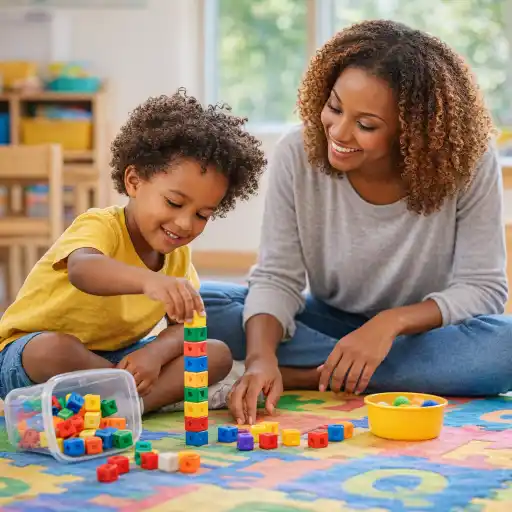
In block play, describe what children are already building: “Your tower is taller than the one beside it,” or “Which block could go underneath to make it steady?” Instead of turning play into a test, use open questions such as “What do you notice?” and “How could we find out?” This kind of math talk connects vocabulary with children’s own strategies.
Outdoors, children can compare the length of shadows, look for shapes, or measure a short distance with footsteps. At the sensory table, cups and scoops invite exploration of full, empty, more, and less. Songs and movement games offer easy ways to notice patterns: clap, stomp, clap, stomp—and ask what might come next. Use materials already on hand, and keep small objects out of reach of children who may mouth them.
How can educators adapt math moments for different ages and learners?
Children develop mathematical ideas at different rates, and a mixed-age classroom may include a wide range of skills. Match the prompt to each child’s interests, communication, motor abilities, and current understanding. For infants and toddlers, narrate simple comparisons and actions: “One block in, one block out,” or “Your cup is full.” Provide safe, large materials for exploring stacking, filling, emptying, and fitting.
Preschoolers may be ready to count objects with one number word for each item, sort objects by more than one feature, extend a repeating pattern, or compare lengths using blocks. Some children may benefit from a smaller set, a visual model, extra wait time, or a gesture instead of a verbal response. Others may be ready to predict what happens if one item is added or removed.
Rather than assuming that every child should complete the same task in the same way, treat different strategies as useful information. Repeat a successful activity and increase its challenge gradually. Use children’s home languages and familiar cultural experiences as resources when possible; mathematical ideas can be expressed through words, gestures, objects, and play.
- Start with concrete objects children can move, touch, or compare.
- Offer visual cues, gestures, choices, or additional time when helpful.
- For a greater challenge, ask children to explain a pattern, compare two groups, or predict what changes when one item is added.
How can teachers observe progress without adding paperwork?
Brief, purposeful observation helps educators understand what children know and decide what to offer next. Focus on a specific behavior: Does a child touch each object while counting? Can the child identify which group has more? Does the child use position words or continue a simple pattern? These observations provide more useful information than judging a child only by a final answer.
Keep notes short and actionable. For example: “During snack, Jordan matched one cracker to each plate; next time, invite Jordan to check whether the groups have the same number.” A quick photo of a block structure, pattern, or class graph can also capture children’s thinking—particularly when paired with a brief note about what the child said or did.
Common pitfalls are easy to address. Avoid relying on worksheets when children can explore with real objects, introducing too many new terms at once, or treating speed and accuracy as the only signs of understanding. When a child makes a mistake, pause and ask how they figured it out; then model or offer another opportunity. State requirements vary - check your state licensing agency when aligning documentation or professional development with local expectations.
Conclusion: What simple steps can you try this week?
Building early math skills during daily routines begins with noticing—not adding a complicated lesson to an already busy day. Choose one idea, such as counting, comparing, patterning, or spatial language, and find two or three natural places to revisit it. You might count name cards at arrival, share snack with one item per plate, and sort blocks during cleanup.
Use clear, friendly math language, invite children to explain or show their thinking, and adapt the challenge to what you observe. Repeat useful activities so children can build familiarity, while making small adjustments for those ready for a next step. Capture an occasional observation to help staff plan together and share one easy routine-based idea with families.
The central question—what are simple ways to build early math skills during daily classroom routines?—has a practical answer: make mathematical ideas visible in the moments children already experience. Consistent, playful interactions help children connect math to real life and give educators meaningful opportunities to support their growth. For more structured professional learning, explore Math Foundations in Early Childhood Buy Now $16.00, Early Mathematics Through Play Buy Now $24.00, No Such Thing as Boring Math Buy Now $24.00, Letter & Number Planning in Child Care Buy Now $24.00, and Enhancing STEM Education for Infants and Toddlers Buy Now $16.00. Check course details and applicable training requirements for your program.
- Early Mathematics Through Play
- CDA Subject Area 2
- CDA Home Visitor Subject Area 3 Part 3 Birth to 5
- CDA Home Visitor Subject Area 2 Part 3 Birth to 5
- Birth to Five CDA Credential with Portfolio Review
- Positive Attention: Interactions & Supervision for Infants & Toddlers
- Self-Regulation & Change: Helping Children Cope
- CDA: Stand With Respect and Professionalism
- Enhancing STEM Education for Infants and Toddlers
- Every Moment Matters: Schedules and Transitions
- Mathematical Skill Development
- ❄️ ¿Qué actividades al aire libre funcionan bien para los niños de Illinois en cada estación? 🌷🍂
- Consejos de Supervisión Activa para Salones de Preescolar y el Juego al Aire Libre
- How Do Art Activities Support Cognitive Growth in North Dakota Preschoolers?
- How can we teach letters, numbers, and early literacy to young children?
- How Do Early Language Skills Affect a Child's Success in School?
- How Can I Use Fun Math Activities for Preschoolers Every Day?
- What are the most important school readiness skills for preschoolers?
- How can Florida educators build strong foundations for infants, toddlers and K–3 readiness together?
- What skills do preschoolers need to be ready for school?
- Why Does Self-Regulation Matter More Than ABCs for Minnesota Kindergarten Readiness?
- How Can Child Care Programs Effectively Support Executive Function Skills in Young Children?
- How can preschool classrooms effectively support early math skills?
- How can we best prepare preschool children for kindergarten?
- How can everyday play build number sense in young children?
- How can preschool programs intentionally support early math skills every day?
- How Can Preschool Programs Best Prepare Children for Kindergarten?
- How Can Early Math Activities Build Young Children’s Mathematical Thinking?
- What Are Simple Ways to Build Early Math Skills During Daily Classroom Routines?
- How Can Toddler Classroom Jobs Build Early Math Beyond Counting?
