Small, playful math moments help children grow. This article shares easy, hands-on ideas you can use every day with your #preschool group. You will find simple activities, planning tips, ways to check progress, and mistakes to avoid. Use these ideas with infants through pre-K. For many printable games and lesson ideas, see How Can I Use Fun Math Activities for Preschoolers Every Day? and What Preschool Math Skills Should I Teach and When?. Remember: state requirements vary - check your state licensing agency.
Why does early #math matter for our classroom?
2. Math talk builds language and social skills. Asking “How many?” or “Which group has more?” helps children use number words and explain ideas, which supports vocabulary and peer play (ChildCareEd).
3. Daily, short math moments create calm confidence. Quick wins (3–10 minutes) make math feel fun, not scary. Large studies also show early math supports broader school outcomes and attention to learning (RAND summary).
Why it matters: When you add tiny, playful math chances to routines, children build lasting #skills and confidence. Keep it playful and natural.
What simple activities work best by age?
- Infants & toddlers (0–2 years)
- 🔹 Sensory bins with big and small objects to compare size and #counting. See infant/toddler math lesson ideas in ChildCareEd's everyday math post. You can also combine sensory exploration with brain-building play—see sensory and brain-power activities to extend these math moments.
- 🔸 Stack and sort toys. Keep piles simple and name sizes: "big, medium, small."
- Age 3
- 🍪 Snack-time counting: count crackers or fruit slices together—quick and meaningful. (See Counting Fun ideas.)
- 🎲 Roll-and-graph games help with early data and number sense (many free PDFs on ChildCareEd).
- Age 4
- 🍕 Shape pizza: make pizzas with paper shapes and count slices. Try the Pizza Shape Activity Buy Now $0.00 and related worksheets.
- ➡️ Ten-frame play and simple pattern work for early addition. For concrete addition and subtraction activities that use manipulatives and playful story problems, see the Preschool Arithmetic Activity.
- Age 5
- 🧩 Measurement with blocks and simple place-value play. See ChildCareEd lessons on what to teach and when.
- 🔢 Puzzles and matching games for number recognition and subitizing.
Tip: watch for choking hazards with small items and adapt materials by age. For more themed tools, visit ChildCareEd's Math Activities Resource.
How do I plan, teach, and check progress without heavy paperwork?
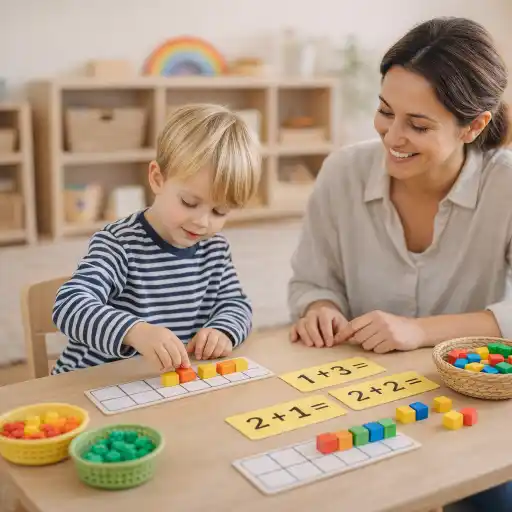
Keep it simple: observe, plan tiny goals, teach short activities, and note one-line observations. ChildCareEd suggests mixing play, routines, and short lessons rather than worksheets (ChildCareEd).
- Observe first: watch play for natural math—counting, sorting, patterning. Record one or two behaviors per child (example: "counts to 6 with 1:1 correspondence").
- Plan tiny lessons: choose one goal and 2–3 activities for the week. Keep each activity 3–10 minutes.
- 🔹 Example: Goal = count to 10. Activities: snack counting, roll-and-cover game, number cards at centers.
- Assess through play: use short tasks—matching a number to a dot card, completing a five-piece puzzle. Write a one-line note after watching.
- Use math talk: ask open questions like "How many?" "Which has more?" The words help learning; see research and ChildCareEd resources for support (Teaching Math to Young Children).
- Keep records short and practical. If you must document more, remember state rules: state requirements vary - check your state licensing agency.
What common mistakes should I avoid and how can families help?
Many providers want to teach more than kids can use. Here are common pitfalls and fixes, plus family ideas you can share.
- ⚠️ Mistake: Too many worksheets. Fix: prefer hands-on play and 1 short printable if useful. ChildCareEd warns about overusing worksheets (Teaching Math to Young Children).
- ⚠️ Mistake: Introducing too many new words at once. Fix: teach 2–3 math words (like more/fewer) and repeat them in routines.
- ⚠️ Mistake: Skipping observation. Fix: watch free play to choose the right next step for each child.
How families can help:
- 📣 Send one simple home activity: count stairs, match socks, or do a short nature walk and tally finds (see a nature walk idea at No Time For Flash Cards).
- 👪 Host a math play night using easy roll-and-graph games from ChildCareEd so families see how to play at home.
- 💬 Share quick notes: "Today we counted fruit slices—try it at home!" It’s low-burden and builds #skills.
Common mistakes and family tips help avoid burnout and keep math playful. For more free activities and PDFs, check ChildCareEd's lesson library and resource pages like Math Activities Resource.
Conclusion
Short, playful #math moments every day add up. Start with observation, use hands-on activities for each age, teach a few words, and assess with play. Share quick home activities with families and rotate simple materials so math stays fresh. For ready-to-use games and printables, explore ChildCareEd resources such as How Can I Use Fun Math Activities for Preschoolers Every Day?, seasonal roll-and-graph PDFs, and the Math Foundations materials. You are helping children build big learning with small, joyful steps. Keep it playful and celebrate each small win.
Quick FAQ
- Q: When should I start math? A: From infancy—count during routines and play.
- Q: Are worksheets okay? A: Use very few; prefer manipulatives and games.
- Q: How often to check skills? A: Brief play-based checks every 2–4 weeks work well.
- Q: Where to get printables? A: ChildCareEd's activity library has many free PDFs and lesson plans.
- 45 Hour Child Growth and Development
- CDA Home Visitor Subject Area 3 Part 3 Birth to 5
- 45 Hour Preschool Methods and Materials
- Tracking Progress, Shaping Futures: Observation & Assessment Skills
- Moving About the Classroom: Effective Transitions for Everyday
- 45 Hour Infant and Toddler Methods and Materials
- Pediatric RSV First Aid & CPR/AED
- Equity in Action with Head Start
- Texas Director Credential
- Ice Cream and Asteroids!
- Mathematical Skill Development
- ¿Cuáles son las mejores actividades del Día de la Tierra para niños en casa o en el aula?
- Early Childhood Lesson Plan Examples for Toddlers and Preschoolers
- Memorial Day Activities for Kids: Simple Ways to Honor the Day
- How can I plan peach-themed summer activities for preschoolers in Georgia?
- How can we bring a farmers market and fresh fruit activities to preschoolers in California?
- What age-appropriate learning activities should we use for infants, toddlers & preschoolers in New York?
- How can I teach colors, shapes & numbers through play in Michigan classrooms?
- A Simple Guide to Toddler and Preschool Lesson Plans
- Exploring Cultures with Around the World Activities
- Pumpkin, Leaves, and Apples: Fall Activities for Preschoolers
- Celebrando la amistad en el cuidado infantil durante el Día de los Mejores Amigos
- National Ice Cream Day: Sweet Activities for Preschoolers
- How Can I Use Fun Math Activities for Preschoolers Every Day?
- What skills do preschoolers need to be ready for school?
- How can I use simple math activities for preschoolers every day?
- How Can Simple Cooking Activities Teach Skills in North Dakota Child Care Programs?
- How can North Dakota child care providers build number sense in everyday routines?
- Can Counting Activities Really Feel Like Play?
