Teaching young children to notice #colors, #shapes, and #numbers is easy when you use play. This article helps child care providers and directors in #Michigan learn simple ways to teach these ideas using short games, daily routines, and hands-on materials. You will find ready-to-use ideas, links to helpful resources like Counting Fun for Preschoolers and the Pizza Shape Activity Worksheet Buy Now $0.00, plus tips for working with families. Remember: state requirements vary - check your state licensing agency.
Why does teaching colors, shapes, and numbers through play matter in Michigan?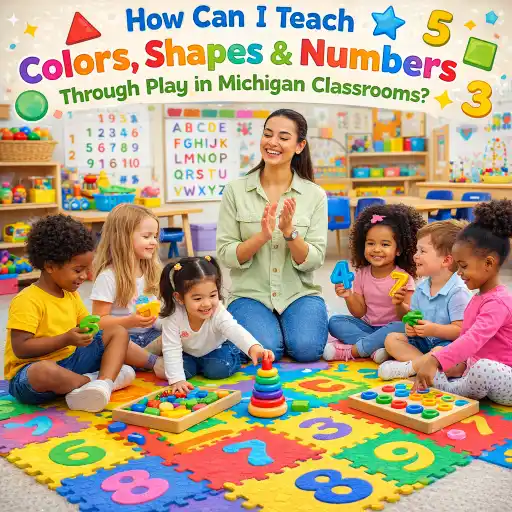
1) Play helps children learn naturally. When children touch, match, and sort, their brains form strong ideas about math and the world. Research and classroom guides say early #math and shape talk during play helps later school success. See ideas in What Preschool Math Skills Should I Teach and When?.
3) Play is flexible for mixed-age groups. You can use one setup for infants through preschoolers by changing the challenge level. Child care centers in Michigan can use simple play invitations to meet many learning goals at once—language, fine motor, and social skills—while teaching #numbers and #shapes. For Michigan-specific ideas and safety notes, see local planning guidance and age-appropriate activities for Michigan.
Why it matters: When children learn through play, they practice talking about ideas (math talk), they use their hands, and they learn with friends. These moments are the building blocks for kindergarten and beyond.
How do I plan playful activities that teach colors, shapes, and numbers?
Use a short plan that you can repeat every day. Try these steps:
- Decide one small goal (e.g., count to five, find circles, match red items).
- Playful math skills: For staff who want to deepen their confidence in teaching early math through play, ChildCareEd's No Such Thing as Boring Math
 Buy Now $24.00 is a 3-hour online course packed with practical strategies for making counting, sorting, and pattern work engaging and meaningful — a direct complement to the activity ideas and math centers described in this guide.
 - Gather 3 materials that fit the goal. Example: colored cups, plastic shapes, number cards. For ready printables, try Penguin Color Match Buy Now $0.00 and the Play-Doh Flower Math Activity Buy Now $0.00.
- Set a short invitation (5–15 minutes). Say what to do and show one example.
- Observe and join. Ask one open question like, "How many red blocks do you have?"
- End with a quick clean-up and one praise statement.
Use these quick activity ideas:
- 🎲 Roll & graph: kids roll a die and add that many counters. See seasonal Roll & Graph ideas in Math Lesson Plan for Infants/Toddlers Buy Now $0.00.
- 🍕 Shape pizza: children match triangle, circle, square toppings to a paper pizza. Printable: Pizza Shape Activity Worksheet Buy Now $0.00.
- 🧩 Counting trays: small toys + number cards from Counting Fun for Preschoolers.
Keep language simple and repeat words: "circle," "square," "two," "more." Small, repeated play invitations help children move from noticing to naming to using ideas on their own. For more ways to weave counting and shapes into familiar contexts, try short narrative activities from Math Stories to give concepts a meaningful, story-based context children can relate to.
What activities work best for different ages in my classroom?
Use simple play that matches each age. Below are easy ideas you can set up today.
🎓 Understanding preschool development: To help staff match colors, shapes, and number activities to the right developmental stage, ChildCareEd's How Preschoolers Develop Buy Now $32.00 is a 4-hour online course covering key milestones and learning patterns in preschool-age children, giving providers the developmental foundation to plan play invitations that challenge without overwhelming.
- Infants (0–12 months):
- 🍼 Soft shape boards, large color scarves, and tummy-time toys. Describe what you see: "Big red ball."
- 👶 Simple one-to-one games: place one ring on a cone and count out loud to one or two. See infant math lesson examples in Math Lesson Plan for Infants/Toddlers Buy Now $0.00.
- Toddlers (1–3 years):
- 🍚 Sensory bins with big colored scoops for sorting by #color or size. Use matching language like "more" and "less."
- 🏃♂️ Gross-motor shape hunt: find circles to step on, squares to jump to. See play-based ideas in The Power of Play.
- Preschoolers (3–5 years):
- 🍕 Shape pizza and pattern-making: use the Pizza Shape Activity Worksheet Buy Now $0.00.
- 🧩 Counting games and number puzzles from Counting Fun for Preschoolers.
- 🔢 Play-based math centers: playdough number stamping (Play-Doh Flower Math Buy Now $0.00) and sorting leaves (Leaf Sort Activity Buy Now $0.00).
- Mixed-age tips:
- 🎯 Offer 3 levels at once: adult help, small prompts, and independent challenge so each child can join.
- 🔁 Repeat favorites and raise the challenge slowly (count higher, add more shapes).
For more manipulative ideas and lists, see guidance on must-have math materials like counters and linking cubes.
How do I check progress, avoid common mistakes, and partner with families?
Check progress with short observations instead of tests. Here are easy steps you can use every week.
- Observe: Watch one child at play for 3–5 minutes and note one skill (counts to five, matches shapes, sorts colors).
- Record: Write a one-line note or take a quick photo and save it to the child's file.
- Plan next step: Ask, "What small goal next week?" (e.g., count to ten, name 4 shapes).
Common mistakes and how to fix them:
- ⚠️ Mistake: Rushing to worksheets. Fix: Use hands-on play first, paper later.
- ⚠️ Mistake: Teaching too many new words at once. Fix: Teach 1–2 words and use them in routines.
- ⚠️ Mistake: No family connection. Fix: Send one simple home idea: "Count spoons at dinner tonight."
Partnering with families:
- 📣 Share short notes or pictures showing what you did that week and one home activity.
- 👪 Host a 20-minute math-play night or send a short video showing how to play a counting game.
- 📘 Offer copies of center activities or links to printables like the Counting Fun pack.
State and safety: state requirements vary - check your state licensing agency for adult-child ratios, materials rules, and food policies before using edible items in play.
Conclusion
1) Play-based learning makes #colors, #shapes, and #numbers real and fun for children. 2) Use short invitations, repeat often, and change challenge levels for different ages. 3) Observe, record one small step, and share one home idea with families. ChildCareEd has many ready-to-use activities and printables to save you time: explore counting and shape activities like Counting Fun, Pizza Shape Activity Buy Now $0.00, and Play-Doh Flower Math Buy Now $0.00.
FAQ (quick):
- Q: How long should a play math activity last? A: 5–15 minutes for focused invitations; center time can be longer.
- Q: Can mixed ages use the same activity? A: Yes—offer 3 challenge levels, and everyone can join.
- Q: Are worksheets okay? A: Use very few—prefer hands-on first.
- Q: Where to find more ideas? A: Visit ChildCareEd resource pages linked above and local Michigan early childhood supports.
You are doing important work. Small playful moments every day help children leave your classroom ready for kindergarten. For more lesson plans and printable activities, see ChildCareEd resources linked through this article.
2) Play keeps young children engaged. Children pay attention longer when learning is part of a game or routine—like counting snack pieces or sorting blocks. This also builds confidence so children try harder and feel proud.- 45 Hour Child Growth and Development
- CDA Home Visitor Subject Area 3 Part 3 Birth to 5
- Many Colors, One Canvas: MD ECE Conference
- 45 Hour Preschool Methods and Materials
- Power of Art: Bldg Self-Esteem & Positive Behavior for ALL Abilities
- Moving About the Classroom: Effective Transitions for Everyday
- 45 Hour Infant and Toddler Methods and Materials
- Texas Director Credential
- Wellness in Action: Teaching Healthy Habits to Children
- CDA Certification en Español: Recursos y Consejos para Educadores Bilingües
- 👶 ¿Cuáles son las proporciones y grupos requeridos en Dakota del Norte? 🏫
- Recursos en Español sobre el Sueño Seguro del Bebé
- ¿Cómo puedo usar escenarios de juego de roles de primeros auxilios en mi aula?
- 10 Ejemplos de Cómo la Cultura Influye en el Desarrollo Infantil
- Proporciones de Cuidado Infantil y Tamaños de Grupo por Edad en Nueva Jersey (Guía Rápida para Centros y Hogares)
- Lista para Guardería en Casa en Texas: Cómo Iniciar una Guardería en el Hogar
- Por Qué la Supervisión Activa Es Clave para la Seguridad en el Cuidado Infantil
- Cómo Trabajar en el Cuidado Infantil en Carolina del Norte: Requisitos y Pasos
- Cómo Trabajar en el Cuidado Infantil en California: Requisitos y Pasos
- Cómo Ser Maestra de Preescolar en Illinois
- Cómo Ser Maestra de Preescolar en Maryland
- How Do Art Activities Support Cognitive Growth in North Dakota Preschoolers?
- How can I teach colors, shapes & numbers through play in Michigan classrooms?
- Celebrando la amistad en el cuidado infantil durante el Día de los Mejores Amigos
- Canciones, juegos y preguntas de círculo para niños
- Cómo simplificar la capacitación para sus empleados de daycare
- What Does Michigan's Well-Being Data Mean for Child Care Providers?
- What Are the Best Print-and-Play Activities for Substitute Teachers?
- What Should a 3-Year-Old Be Learning at Preschool?
