A child changes their vote after seeing the classroom graph take shape—and suddenly a simple poll raises questions about fairness, choice, and what the data means. Responding thoughtfully can turn that moment into meaningful learning about revising ideas, counting, and representing information. For strategies you can use across playful math experiences, explore Early Mathematics Through Play Buy Now $24.00, a course that helps providers bring number sense, data, and reasoning into everyday classroom routines.
Why does a changed vote deserve more than a quick correction?
When a child asks to move their vote, the graph becomes more than a display of preferences. It becomes a shared record that children can question, interpret, and revise. A child may change their mind because they noticed another option, heard a peer’s explanation, misunderstood the choices, or simply realized that their preference shifted. Those are ordinary parts of thinking—not evidence that the child is being difficult.
Handling the change with calm curiosity also communicates that children’s ideas matter. At the same time, the class can explore an important mathematical question: if the data changes, how should the graph show that change? Preschoolers can investigate this concretely by moving a name card or marker and observing how the group totals shift.
Graphing activities give children opportunities to sort, count, compare, and explain. The Illinois Early Learning Project’s guidance on real graphs for preschoolers recommends using concrete objects and encouraging children to explain what they notice. A classroom vote offers that same hands-on entry point, while also creating a natural opportunity to practice respectful listening and flexible thinking.
Try framing the revision as an investigation rather than a problem: “You’ve changed your mind. Let’s see how moving your card changes our graph.” That validates the child and keeps the class focused on learning.
How can you respond when a child wants to change a vote?
First, acknowledge the request without judgment. A neutral response—“You’d like to move your vote from blocks to books”—shows that you heard the child without suggesting that changing an opinion is wrong. If helpful, ask a brief, open question: “What made you decide?” The child may explain, or may simply say, “I like this one now.” Either answer can be accepted without requiring a lengthy justification.
Next, make the classroom’s process visible and consistent. If the vote is still open, explain that children may revise their choice until the poll closes. If the class has already counted and discussed the results, you might say, “We’ve finished this vote, so we’ll keep that graph as our record. We can make a new graph for another question.” A clear routine helps prevent confusion and supports children’s understanding that data represents choices made at a particular time.
- Use calm, matter-of-fact language; avoid teasing or expressing disappointment.
- Show the child how to move their card or marker, then recount together if needed.
- Let the class know whether the poll is open, closed, or being repeated.
- For children who communicate nonverbally, offer picture choices, gestures, or supported ways to indicate a new preference.
These small accommodations preserve the purpose of the activity: children are learning to represent choices and make sense of a changing set of information, not being tested on whether they maintain one answer.
How can a vote change become a hands-on math investigation?
Use the change to make the graph’s mechanics visible. Invite the child to move their vote card from one column to another. Then ask the group what changed: “Which column has one fewer card now? Which has one more?” Count each column slowly, matching one number word to one card. For some children, the visual movement will make the change easier to understand than an explanation alone.
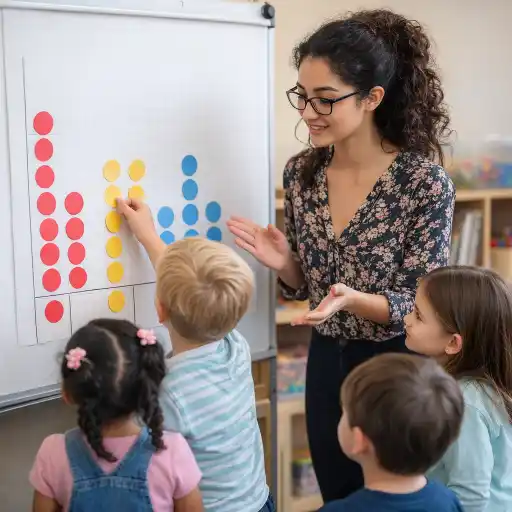
Keep the question and categories clear. A poll such as “Which story should we read next?” with two or three picture choices is usually easier to interpret than a question with many overlapping answers. You can begin with a prediction, collect votes, and revisit the graph after any revisions. Ask questions that invite observation rather than a single right answer:
- “What do you notice about the columns now?”
- “Which choice has more votes? How can we tell?”
- “Did moving one card change which column has the most?”
- “Are any choices tied?”
Preschool graphing can connect classification, counting, one-to-one correspondence, and comparison. The Education Development Center’s overview of preschool data collection and analysis describes how children can use simple graphs to explore real classroom questions. A revised vote offers a small, concrete example of data changing and a chance for children to explain what the updated display tells them.
How can you keep the voting process fair and inclusive?
Fairness does not require every child to make the same kind of choice or explain it in the same way. It does require a process children can understand. Before voting, state the options, show a visual for each one, and clarify whether each child gets one vote. Explain whether children may change a vote and when voting ends. Predictability helps children participate with confidence and makes the resulting graph easier to interpret.
Consider access as you plan. Children may participate by placing a name card, pointing to a picture, using a communication device, or asking an adult to move a marker on their behalf. Keep the choices culturally respectful and avoid questions that disclose private information or put children in the position of being compared personally. For example, preferences about books or play activities are generally more comfortable than questions about family circumstances or appearance.
It can also help to distinguish a preference poll from a decision-making process. A vote may guide the next read-aloud, but the teacher remains responsible for safe, inclusive, and practical classroom decisions. Explain this simply: “Your votes help us choose a story when we can. Grown-ups still make sure our choices work for everyone.”
When a child changes a vote, apply the same rule you would use for any child. Avoid allowing a more vocal child to change repeatedly while limiting others. A consistent, accessible process protects each child’s voice and keeps the graph useful as a record of the group’s choices.
What common mistakes should providers avoid?
One common mistake is treating a changed vote as misbehavior or indecision that needs correction. Young children are still developing language, self-awareness, and the ability to anticipate how a choice will feel. Changing a preference can be a reasonable response to new information or a clearer understanding of the options. A supportive adult can recognize the change while still maintaining the activity’s agreed-upon boundaries.
Another pitfall is altering the graph without explaining the change. If a card moves silently, children may not understand why the totals changed. Narrate the action and recount together. Conversely, avoid turning a brief moment into a high-pressure lesson about consistency, honesty, or winning. The purpose is to explore data and classroom decision-making, not to judge a child’s character.
- Do not ridicule a child or ask peers to persuade them to keep their original choice.
- Do not change totals without physically updating the graph.
- Avoid polls with too many choices or unclear categories for the group’s developmental level.
- Do not imply that the most popular choice is automatically the best choice.
- Do not promise that a poll will determine an outcome if safety or practical considerations may override it.
Start with concrete materials such as picture cards, sticky notes, or counters, then invite children to compare the updated columns. Keep the tone playful and the activity brief. If a vote becomes emotionally charged, pause the graphing, acknowledge feelings, and return to the process when the group is ready. State requirements vary - check your state licensing agency when aligning curriculum, documentation, or professional development with local expectations.
How can providers turn the moment into professional growth?
After the activity, take a moment to reflect on what children demonstrated. Did they understand that one card represents one vote? Could they see that moving a card changes two totals? Did they use words such as more, fewer, same, or most? These observations can help you decide whether to repeat the activity with simpler choices, add a counting prompt, or invite children to explain the results in their own words.
Directors can support staff by making classroom graphing a shared practice rather than a one-time display. Teams might agree on a common routine for introducing choices, accepting revisions, closing a poll, and recounting. A brief planning conversation can help educators adapt the experience for different ages, communication styles, and developmental needs.
For broader guidance on designing playful early math experiences—including counting, patterns, measurement, and reasoning—consider No Such Thing as Boring Math  Buy Now $24.00. Providers looking for strategies to build math-rich learning environments may also explore Math Foundations in Early Childhood Buy Now $16.00, Letter & Number Planning in Child Care Buy Now $24.00, and Lesson Planning for Preschoolers Buy Now $24.00. These courses offer related professional learning; review each course description and check local requirements to determine what fits your goals.
Conclusion: What should you do when a child changes their vote?
When a child changes their vote on the classroom graph, respond with respect, make the process clear, and use the revision as an opportunity to explore how data changes. If voting is still open, let the child move their marker and help the class recount. If the poll is closed, explain the boundary kindly and offer a fresh opportunity to gather opinions later.
The central goal is not to make children stick with an earlier choice; it is to help them participate in a fair process and understand what the graph represents. Concrete materials, clear routines, inclusive ways to respond, and questions such as “What do you notice?” make the moment useful for early mathematics and classroom community. A changed vote is not a disruption to learning—it can be the start of a valuable conversation.
Explore the featured resource: The Change My Vote Classroom Graph Kit can complement this activity. Review the resource details to see how it may support your classroom graphing routine.
- 45 Hour Child Growth and Development
- Moving About the Classroom: Effective Transitions for Everyday
- CDA Family Child Care Credential with Portfolio Review
- CDA Bridge Bundle: Preschool
- Pediatric RSV First Aid & CPR/AED
- CDA Bridge Bundle: Family Child Care
- CDA Bridge Bundle: Infant/Toddler
- Texas Director Credential
- Technology as a Classroom Tool
- CDA Certification en Español: Recursos y Consejos para Educadores Bilingües
- 😫🧸 ¿Qué hacer cuando un bebé no quiere dormir la siesta en el aula?
- 👧 ¿Cómo iniciar y abrir una guardería en Texas? Lo que necesitas saber
- 🚨 Reporte Obligatorio en Nevada
- Qué capacitación se requiere para ser director de cuidado infantil en Texas?
- March Madness in Child Care: Simple Activities for Big Energy Days
- Read, Sing, Play! National Reading Month Activities for Every Age Group
- Recursos en Español sobre el Sueño Seguro del Bebé
- 10 Ejemplos de Cómo la Cultura Influye en el Desarrollo Infantil
- Capacitación en Salud y Seguridad Preventiva en Línea para Proveedores de Cuidado Infantil
- Proporciones de Cuidado Infantil y Tamaños de Grupo por Edad en Maryland (Guía Rápida para Centros y Hogares)
- Lista para Guardería en Casa en Illinois: Cómo Iniciar una Guardería en el Hogar
- Retraso del Habla en la Guardería: Cómo Pueden Ayudar los Proveedores
- Cómo Ser Maestra de Preescolar en Dakota del Norte
- Capacitación Previa al Servicio para Proveedores de Cuidado Infantil en Dakota del Norte
- Pumpkin Math Without the Worksheets: Hands-On Pre-K Learning
- How Can You Create Easy Preschool Math Centers with Print, Prep, and Start Learning?
- How Can Early Math Activities Build Young Children’s Mathematical Thinking?
- Can a Classroom Graph Mislead Children? How Picture Size and Spacing Shape What They See
- What Should You Do When a Child Changes Their Vote on the Classroom Graph?
