Want counting to be a low-prep classroom win that children ask for, not avoid? Try short, playful routines and hands-on ideas that build number sense while keeping the day joyful. A great next step is ChildCareEd’s Math Foundations in Early Childhood  Buy Now $16.00, which shows how to integrate counting into play, routines, and free-choice centers to earn practical training hours and improve classroom practice. Also consider Letter & Number Planning in Child Care Buy Now $24.00 for quick, themed counting lessons and printable activities you can use tomorrow.
How can counting feel like play in my classroom?
Counting that feels like play blends movement, choice, and everyday materials so children practice number skills without a worksheet in sight. Use toys, snack items, gross-motor cues, or a simple board-game path and invite children to lead the activity. Research and practitioner guides show that short, repeated play sessions build numeracy more reliably than prolonged drills; the meta-analytic evidence on board games and linear-number play demonstrates measurable benefits from brief, frequent play sessions (see the review summarized in Phys.org).
Why it matters: Play-based counting supports #math vocabulary, one-to-one correspondence, and early problem solving while preserving engagement and self-regulation. Integrating counting into play helps children transfer skills across routines and keeps your classroom peaceful and purposeful.
Practical hook: convert a favorite dramatic-play center into a counting context (e.g., a grocery stand where children count items for customers) or offer a weekly manipulative bin labeled with numeral cards. For ready-to-use seasonal ideas, see activities such as Counting Fun for Preschoolers as part of your activity bank. For more ideas like number fishing and ways to integrate math into classroom experiences, see Adding math to the early childhood classroom. State requirements vary - check your state licensing agency.
Key hashtags: #counting #play #preschoolers #math #engagement
What hands-on activities work best for different ages?
Match the complexity of counting tasks to developmental readiness. For infants/toddlers, aim for perceptual and routine-based counting (two spoons at meal time, stacking rings). Three-year-olds benefit from 1:1 correspondence games—use clothespins, pom-poms, or snack pieces so they can touch as they count. Four-year-olds can use ten-frames, simple roll-and-graph games, and small-group board games to practice cardinality; the evidence on short board-game play indicates even 10-minute sessions can improve counting and number recognition. Five-year-olds are ready for early place-value play, measurement with nonstandard units, and multi-step counting problems embedded in play.
- Infants/toddlers: sensory bins, simple sorting, repeating counting during routines.
- Age 3: snack-counting, matching number cards with counters, simple puzzles.
- Age 4: ten-frames, shape-count crafts, roll & graph games like the free PDFs on ChildCareEd.
- Age 5: measurement stations, place-value bundling games, and small-group number board games.
- 🧠 Keep materials rotated and accessible: a small math shelf with 4–6 games supports independent exploration.
For turnkey lesson planning and age-differentiated ideas, consider the ChildCareEd course No Such Thing as Boring Math Buy Now $24.00 or the printable activity collections in Letter & Number Planning in Child Care Buy Now $24.00. State requirements vary - check your state licensing agency.
Key hashtags: #counting #play #preschoolers #math #engagement
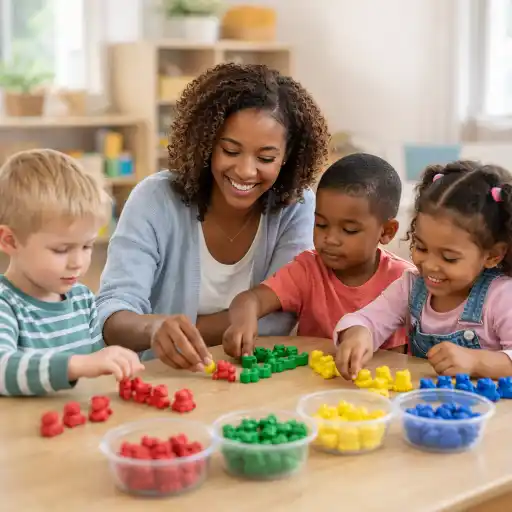
How do I plan short, playful counting moments each day?
Pick one target skill for the week (e.g., 1–1 correspondence to 10) and slot three daily, low-prep moments where that skill fits naturally: arrival, snack, and clean-up. Use the "micro-lesson" approach—3–10 minutes, hands-on, and repeated. Example plan: Monday arrival game (find the cubby number), snack counting (count berries), afternoon center (ten-frame matching).
Simple planning template:
- Goal: choose one measurable skill for the week.
- Moments: list 3 natural moments (arrival, snack, free play).
- Materials: keep a small bin of manipulatives and one printable game per week.
- Observe: take one short note per child across the week (e.g., "counts to 7 with 1:1 correspondence").
Use quick, playful assessment during routines rather than formal tests. For staff learning and program alignment, Play, Learn, Grow Buy Now $25.00 offers guidance on scaffolding play so counting opportunities are purposeful and measurable.
Key hashtags: #counting #play #preschoolers #math #engagement
What common mistakes should I avoid and how can I fix them?
Counting activities can backfire if they become worksheets, are developmentally mismatched, or remove child choice. Avoid these common pitfalls and use the fixes below:
- ⚠️ Mistake: Overusing worksheets that separate counting from manipulatives. Fix: Always pair a short printable with hands-on play—let children show counting with objects first, then use a page as reflection.
- ⚠️ Mistake: Introducing too much new language at once. Fix: Teach 2–3 math words repeatedly across routines (e.g., more/fewer, before/after).
- ⚠️ Mistake: Too-long direct instruction. Fix: Keep teacher-directed moments to 3–10 minutes and return learners to centers for practice.
- ⚠️ Mistake: Not differentiating. Fix: Offer layered challenges in the same activity (simpler counting set for some, extension tasks for others).
How to avoid burnout: stock a rotating math shelf with ready games, share short home activities with families, and use one-line observation notes for planning. For additional strategies on making math playful and accessible, explore The Best Promotion is Play Buy Now $35.00 which connects play principles directly to intentional teaching.
Key hashtags: #counting #play #preschoolers #math #engagement
How do I measure progress and involve families?
Measure progress with brief, play-based checks every 2–4 weeks: a counted set photographed, a child matching numerals to counters, or a recorded 30-second observation of a child counting in play. Keep records minimal—one-line observations per child are often enough to plan the next step.
Family engagement strategies that work:
- 📣 Send one simple home activity weekly (e.g., "Count steps tonight") rather than long worksheets.
- 👪 Host a short math-play night or share a take-home roll-and-graph game so families see how play supports learning.
- ➡️ Provide examples of counting talk: model questions families can use—"How many? Which has more?"
Quick FAQ
- Q: When should we start? A: From infancy—count during routines and play.
- Q: Are short games effective? A: Yes—research and practice show even brief, repeated game play improves numeracy.
- Q: How often to assess? A: Brief, play-based checks every 2–4 weeks.
- Q: Where to get printables and games? A: See ChildCareEd’s free roll-and-graph PDFs and activity pages such as Dreidel Roll & Graph Buy Now $0.00 and Hibernating Bear Flip & Cover Buy Now $0.00.
Key hashtags: #counting #play #preschoolers #math #engagement
Conclusion
Counting can and should feel like play: short, repeated, hands-on moments build deep #math understanding while keeping children curious and confident. Start by choosing one small weekly goal, slotting three natural moments to practice it, rotating accessible materials on a math shelf, and sharing one simple home activity with families. If you want guided lesson plans and course-backed strategies, the ChildCareEd trainings linked above provide practical next steps to strengthen staff skills and classroom practice. Remember the central question—can counting feel like play?—and let your classroom answer it every day: yes.
- 45 Hour Child Growth and Development
- Early Mathematics Through Play
- Bienvenido! Welcoming All Families
- 45 Hour Infant and Toddler Methods and Materials
- Connections That Count: Building Relationships in Child Care
- Texas Director Credential
- Every Moment Matters: Schedules and Transitions
- Stay Alert! Steps to Emergency Prep Online Version
- Ready, Set, Kindergarten!
- What Skills Really Matter for Kindergarten Readiness (and Why Worksheets Aren't the Answer)?
- ¿Cuáles son las mejores actividades del Día de la Tierra para niños en casa o en el aula?
- ¿Cómo puedo usar escenarios de juego de roles de primeros auxilios en mi aula?
- Actividades de Motricidad Gruesa que Desarrollan el Equilibrio, la Coordinación y la Fuerza
- 10 Ejemplos de Cómo la Cultura Influye en el Desarrollo Infantil
- Can play-based learning and academic readiness work together for New York educators?
- How can I teach colors, shapes & numbers through play in Michigan classrooms?
- What can DC early childhood educators learn by watching children play?
- Did Nevada’s 'Powered by Play' Conference Show Why Play-Based Learning Still Matters?
- How did Georgia’s "Play With Purpose" teacher event show the power of intentional play?
- Celebrando la amistad en el cuidado infantil durante el Día de los Mejores Amigos
- Canciones, juegos y preguntas de círculo para niños
- How Does Guided Play Build School-Ready Skills in New York Preschoolers?
- What simple early literacy activities really help children learn?
- Do Toys Come Alive: How Can Pretend Play Spark Creativity in Your Daycare?
- What Can Child Care Providers Learn from Children's Favorite Games?
- Can Counting Activities Really Feel Like Play?
- Teaching Math to Young Children: Why Counting to 20 Doesn’t Mean They Understand 20
- How Can Child Care Providers Plan a Balanced Summer Learning Routine for Young Children?
