A child in the middle of a meltdown usually cannot access calm simply because an adult says, “Calm down.” Understanding why co-regulation comes first can help you respond with connection, clear limits, and developmentally appropriate coaching; ChildCareEd’s Self-Regulation & Change: Helping Children Cope  Buy Now $16.00 offers practical learning about responsive care, routines, transitions, and coping skills. For preschool-focused strategies and activities you can put into practice, explore From Tantrums to Triumphs: Equipping Preschoolers with Self-Regulation Skills Buy Now $25.00 as a helpful next step.
Why does co-regulation come before self-regulation?
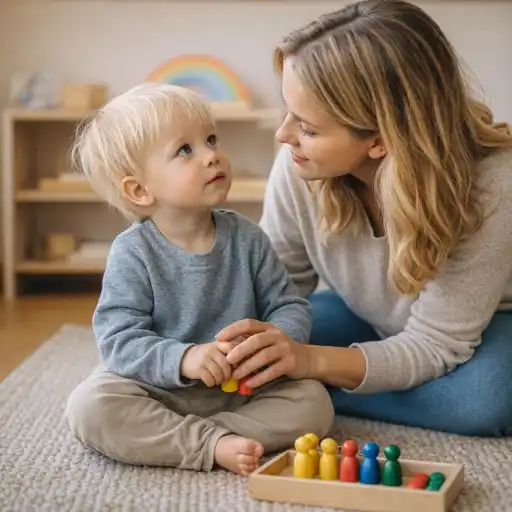
Young children are still developing the capacities needed to manage intense feelings, attention, impulses, and behavior independently. When distress rises, they may have difficulty understanding a long explanation, remembering a rule, or choosing a coping strategy. A responsive adult helps organize the moment through presence, a steady voice, and appropriate support. In everyday terms, a child first learns to settle with someone before they can reliably settle on their own.
Co-regulation is not about suppressing feelings or preventing every frustration. It means helping a child remain safe and feel understood while their emotional intensity eases. NAEYC describes how teachers share their calm with infants and toddlers through attuned responses, comfort, and predictable care. ZERO TO THREE likewise emphasizes that supportive interactions help young children gradually develop coping strategies and emotional awareness.
This matters for learning, too. When a child feels overwhelmed, access to play, communication, and problem-solving may be limited. Once an adult helps restore a sense of safety, the child is more available to reconnect, practice a skill, or repair a conflict. Consistent #relationships create the dependable base from which children can take developmental risks.
- Connection: “I’m here with you” communicates availability.
- Structure: A clear, calm limit keeps people safe.
- Practice: Repeated support gives children opportunities to internalize strategies.
How are co-regulation and self-regulation different?
Co-regulation is an interactive process: an adult notices a child’s cues and responds with comfort, structure, modeling, or guidance. Self-regulation is the child’s growing capacity to manage feelings, attention, thoughts, and actions with increasing independence. The two are connected, but they are not interchangeable. Co-regulation is a developmental scaffold, not a shortcut or a replacement for the child’s own learning.
Early development research describes a gradual movement from external support toward more independent strategies. A child may first calm with an adult nearby, then accept a familiar option, later ask for help, and eventually choose a strategy independently. This progression is neither linear nor identical for every child. A preschooler who takes a breath during a familiar game may still need substantial adult support after a peer conflict or during a difficult separation.
Support should fit the child’s age, communication, temperament, and immediate needs:
- Infants: Respond to cues, meet basic needs, reduce stimulation, and use gentle voice, touch, rocking, or singing as appropriate.
- Toddlers: Offer closeness, simple feeling words, movement, and one or two manageable choices.
- Preschoolers: Model coping tools, practice replacement phrases, and coach simple problem-solving once calm has returned.
Instead of asking, “Why can’t this child calm down?” try, “What support is needed right now, and what small skill can we practice next?” This shift treats behavior as information rather than a character flaw and helps educators respond with dignity and purpose.
What can providers do when a child is overwhelmed?
A shared, simple response can help staff stay consistent during emotionally intense moments. Try Connect → Calm → Coach. The sequence matters: children are generally better able to learn and problem-solve after their distress has begun to ease. Research on educator practice also highlights the value of noticing children’s cues and reflecting on how adult decisions shape responses in the classroom.
- Connect. Move close without crowding. Use a steady voice and acknowledge the feeling: “You’re disappointed. I’m here.”
- Calm. Reduce language and stimulation. Offer one familiar support, such as sitting nearby, slow breathing together, a safe object to squeeze, or a quieter space. Do not insist that the child use a tool immediately.
- Coach. When the child is more settled, state the limit and teach one next step: “You were angry. I won’t let you hit. You can say, ‘My turn next,’ or come get me.”
Safety remains essential. If a child is hitting, biting, throwing an unsafe object, or trying to run, calmly prevent harm, protect other children, and follow your program’s procedures. Compassionate support can include a firm boundary: “You may be mad. I will not let you hurt someone.”
- 🧑🤝🧑 “I’m here. Let’s get safe together.”
- “Would you like me close by, or would you like a little space?”
- “First we get safe; then we can work it out.”
Adults need regulation support, too. Notice signs such as a tight jaw, tense shoulders, or a rising urge to shout. Pause, slow your movements, and ask a colleague to step in when possible. Teams can reflect and repair after a difficult moment; perfect composure is not the standard.
How can classrooms build these skills before a crisis?
Children learn coping skills through repeated, low-pressure practice—not through a lecture in the middle of a meltdown. Weave short, playful opportunities into daily routines and make them accessible to children with different languages, communication styles, sensory needs, and abilities. Practice when children are calm so strategies are familiar when stress arrives.
- Play with stopping and waiting: Freeze Dance, Red Light/Green Light, and simple turn-taking games let children practice pausing and shifting attention.
- Explore calming breath: Invite children to pretend to smell a flower and blow a candle, blow bubbles, or trace a finger slowly while breathing.
- Use movement: Offer stretching, animal walks, or wall pushes when safe and appropriate; some children regulate better through movement than stillness.
- Build emotion language: Use books, puppets, photos, gestures, and home-language words to talk about feelings and body clues.
- Rehearse communication: Practice phrases such as “Help, please,” “Stop,” “I need space,” and “Can I have a turn?”
Keep activities brief and praise observable effort: “You waited while Maya finished,” or “You noticed you needed help and told me.” Avoid assuming one strategy works for every child. The CSEFEL guidance on self-management likewise emphasizes clear steps, visual supports, positive feedback, and gradually reducing adult prompts as children gain competence.
Directors can support staff by agreeing on a few shared phrases, making time for brief reflection, and reviewing which strategies help individual children. A self-regulation practice guide can also help teams plan simple activities and consistent responses.
How do relationships, routines, and the environment help?
Co-regulation is built across ordinary moments—not only when a child is distressed. Warm greetings, responsive caregiving, playful interactions, and reliable follow-through communicate that adults notice children and can be trusted. Learn each child’s preferences, communication cues, temperament, family routines, and cultural context. Family members are important partners and may offer insight into words or comforts that are familiar to the child.
Predictable routines and thoughtful room design can reduce unnecessary stress and make expectations easier to understand:
- Post a picture schedule at children’s eye level and refer to it throughout the day.
- Give a short warning, countdown, song, or helper role before transitions.
- Use “first–then” language and one direction at a time when a routine is difficult.
- Separate noisy, active areas from quieter spaces when the room allows.
- Offer a voluntary, supervised calm space with a few safe, familiar tools.
A calm space should never be punishment or forced isolation. Introduce it during calm moments, model how to use it, and stay nearby as appropriate. Some children will feel safer regulating beside an adult than alone. NAEYC’s infant-toddler guidance underscores that relational, environmental, and experiential supports work together.
Staff wellbeing is part of the environment. Directors can support co-regulation by arranging coverage when possible, creating time for reflective supervision, and encouraging nonjudgmental team debriefs. State requirements vary - check your state licensing agency for training, supervision, and documentation expectations.
How can teams avoid pitfalls and decide when to seek added support?
Co-regulation is compassionate and purposeful; it does not mean allowing unsafe behavior or expecting the adult to solve every difficulty for the child. Common missteps can increase distress or delay learning. Teams can use these alternatives:
- “Calm down” without support: Stay nearby, reduce demands, and offer one familiar option.
- Long explanations during peak distress: Use brief language and save problem-solving for later.
- Expecting immediate independence: Provide support now, then gradually reduce prompts as the child is ready.
- Turning a calm space into time-out: Teach it as a voluntary, supervised resource.
- Using inconsistent adult responses: Agree on a few shared phrases and safety steps across the team.
Observe patterns without labeling the child. Note what happened beforehand, the behavior you observed, how long it lasted, what adults tried, and what helped. Consider context such as fatigue, hunger, transitions, sensory load, communication needs, or changes at home. If distress is frequent or prolonged, safety is a concern, there is significant regression, or consistent strategies are not helping, collaborate with the family, director, mental health consultant, early intervention provider, or another qualified professional. Seeking support is a thoughtful part of care, not a sign of failure.
For continued professional learning, ChildCareEd offers Early Emotional Wellness Buy Now $16.00, Social Foundations and Responsive Classrooms Buy Now $24.00, and From Tantrums to Triumphs Buy Now $25.00. Each course approaches children’s emotional development from a practical classroom perspective.
Conclusion: Why does co-regulation come first?
Co-regulation comes before self-regulation because young children develop independent coping skills through repeated experiences of being supported, understood, and kept safe. A responsive adult helps a child get through the immediate moment, models strategies, and offers chances to practice when the child is ready. Over time, children can take on more of that work themselves.
- Connect before coaching; calm the moment before expecting problem-solving.
- Hold clear safety limits while validating feelings.
- Practice coping tools during calm routines and adapt them to each child.
- Use predictable environments, family partnership, and consistent team language.
- Reflect, document patterns, and seek additional support when concerns persist.
The goal is not a classroom without big feelings. It is a classroom where children can experience feelings safely, rely on caring adults, and gradually build the skills to manage more for themselves.
- Emergency and Disaster Preparedness
- What Makes Me Special: An Overview of Autism and ADHD
- Pediatric RSV First Aid & CPR/AED
- CDA Bridge Bundle: Family Child Care without Portfolio Review
- CDA Bridge Bundle: Infant/Toddler without Portfolio Review
- CDA Bridge Bundle: Preschool without Portfolio Review
- Texas Director Credential
- Access for All: Inclusion and the ADA
- Supporting Social Relationships Among Young Children
- 🔍 ¿Qué ves cuando observas a un niño aprender?
- 🍼📋 ¿Qué necesitas para trabajar en el cuidado infantil en Texas?
- 👧 ¿Cómo iniciar y abrir una guardería en Texas? Lo que necesitas saber
- Cómo Abrir Una Quardería En Casa Sin Dinero?
- Normas de Licenciamiento de Cuidado Infantil en Virginia para Centros Diurnos Infantiles y Hogares Diurnos Familiares
- Lista para Abrir una Guardería en Casa en Virginia: Cómo Empezar
- Lista para Guardería en Casa en Illinois: Cómo Iniciar una Guardería en el Hogar
- Cómo Trabajar en el Cuidado Infantil en Virginia: Requisitos y Pasos
- Capacitación Previa al Servicio para Proveedores de Cuidado Infantil en Texas
- Daycare Center Requirements in Virginia
- How can child care providers support emotional regulation in young children?
- Being Told No: Helping Children Manage Big Feelings
- Can we tame the ‘monsters’ of big emotions in young children?
- How Can Staying Calm Help Children Calm Down? Co-Regulation Strategies for Child Care Teams
- How Do You Explain Ego to a Child Without Making It Sound Like a Bad Thing?
- How Can Child Care Providers Help Children Develop Self-Control?
- How Can Teachers Support Children With Big Emotions?
- How Can Teachers Build Emotional Regulation Into Daily Routines?
- How Can Child Care Providers Help Children Develop Self-Control?
