Children build strength, balance, coordination, and confidence through everyday movement—but meaningful opportunities require intentional planning. Explore practical strategies below, then deepen your practice with Balancing Physically Active Play in Child Care Buy Now $25.00, which helps providers design schedules that combine structured and unstructured movement while supporting healthy developmental milestones.
Gross motor development includes movement produced by the large muscles of the arms, legs, trunk, and torso. Running, climbing, jumping, throwing, kicking, balancing, and changing body position are all examples. These abilities are not isolated physical accomplishments; they support children’s independence, participation, self-regulation, spatial reasoning, and access to play and learning.
For a broader foundation in play-based practice, providers may also explore The Best Promotion is Play Buy Now $35.00, a three-hour course addressing how meaningful play supports physical, cognitive, language, and social development.
Why does gross motor development matter in early childhood?
Movement is one of children’s primary ways of learning about themselves and their environments. As children crawl, walk, climb, and manipulate space, they develop body awareness, postural control, coordination, and confidence. These capacities support participation in self-care routines, playground play, group games, and classroom transitions.
Gross motor experiences also connect with cognitive and social development. A child navigating an obstacle course is planning, sequencing, and solving problems. A child playing a cooperative ball game is practicing communication, turn-taking, frustration tolerance, and shared attention. Research summarized in the connection between movement and cognitive growth describes how intentional physical activity can support attention, executive function, memory, and problem-solving.
- 🟢 Physical foundation: Large-muscle movement strengthens balance, stability, endurance, and coordination.
- Learning readiness: Movement can help children organize attention and engage with later classroom tasks.
- Social-emotional growth: Active play creates opportunities for cooperation, confidence, and self-regulation.
- Independence: Carrying, climbing, reaching, and navigating space support practical daily participation.
Gross motor development is also foundational for fine motor control. Stable posture and shoulder strength help children participate in drawing, manipulating tools, and early writing experiences. A movement-rich program therefore supports the whole child rather than treating physical development as separate from curriculum. For ideas that also nurture children's natural development through fine motor activities, see this guide to supporting children's natural development.
What should providers observe across the early years?
Developmental milestones provide a useful framework, but they should never become rigid labels. Children acquire skills at different rates, and performance may vary according to temperament, opportunity, culture, health, sensory preferences, and familiarity with the environment. Providers can use milestone information to guide observation and planning, not to compare children publicly.
Infants may gradually lift their heads, roll, reach, sit, crawl, pull to stand, and transition between positions. Toddlers often develop independent walking, running, climbing with support, kicking, carrying, and beginning jumping skills. Preschoolers commonly refine running, hopping, jumping, throwing, catching, pedaling, balancing, and negotiating playground structures. The developmental milestone guidance offers examples of gross motor skills across early childhood.
Observe skills in natural contexts:
- How does the child move between learning areas?
- Can the child change speed, direction, or body position?
- How does the child respond to uneven surfaces, stairs, or climbing opportunities?
- Does the child persist, seek help, or avoid particular movement experiences?
- Can the child participate in group movement while following simple cues?
Document specific behavior rather than impressions. “Walked across the taped line with arms extended and stopped twice” is more useful than “poor balance.” If a child loses previously acquired skills, appears substantially behind peers, or has persistent difficulty participating, document observations and follow program referral procedures. Screening is not diagnosis; families should be encouraged to consult qualified health or early-intervention professionals when concerns arise. Training such as Developmental Screening in Early Childhood  Buy Now $16.00 can strengthen staff knowledge about observation, documentation, and collaboration.
Which indoor and outdoor experiences build large-muscle skills?
Effective movement activities do not require expensive equipment. The strongest plans offer repeated practice, meaningful choices, manageable challenges, and opportunities for both structured and self-directed play. A clear indoor area, painter’s tape, soft balls, beanbags, scarves, cushions, hoops, and music can support a surprisingly broad curriculum.
Indoor possibilities include:
- Tape pathways for stepping, tiptoeing, hopping, or walking backward with support.
- Animal walks such as crawling like a bear, waddling like a penguin, or jumping like a frog.
- Balloon keep-up, freeze dance, and start-stop games that develop coordination and listening.
- Simple obstacle courses using tunnels, cushions, low platforms, and targets.
- Beanbag tosses into baskets placed at different distances.
Outdoor environments provide varied surfaces, open space, and authentic physical challenges. Invite children to walk on grass, mulch, or gentle slopes; climb age-appropriate equipment; pedal tricycles; chase bubbles; kick toward targets; and carry small watering cans. Purposeful work such as raking, digging, sweeping, and gardening can build strength while fostering responsibility and connection to nature. ChildCareEd’s indoor and outdoor gross motor guide provides additional low-preparation ideas.
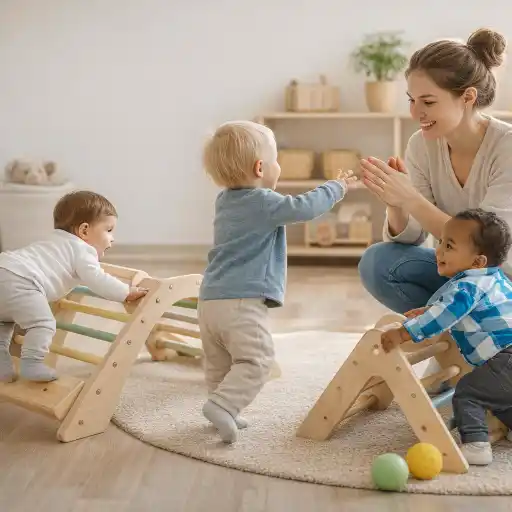
Balance teacher-guided activities with free movement. A 12-week study summarized in the literature found that both structured and unstructured physical activity supported preschool children’s locomotor and object-control development. The implication is practical: children benefit from intentional instruction, but they also need time to explore, repeat, invent, and challenge themselves.
How can providers make gross motor play inclusive?
Inclusive movement begins with a shift in perspective: the goal is participation, agency, and growth—not identical performance. Plan the learning objective first, then vary the equipment, distance, pace, position, or social arrangement so each child can access it.
- Offer choices such as “step or hop,” “roll or throw,” and “walk or run.”
- Use larger, lighter, softer, or textured equipment to support grasping and tracking.
- Reduce distance, lower targets, widen pathways, or slow the tempo.
- Provide seated, supported, or partner-based versions of activities.
- Use picture cues, demonstrations, predictable routines, and a consistent stop signal.
- Assign meaningful roles such as equipment helper, score-free encourager, or music leader.
For children with disabilities, collaborate with families and relevant specialists. A child may use mobility equipment, orthotics, communication technology, visual supports, or adapted materials. These supports should be integrated naturally rather than presented as a reason for exclusion. The Virtual Lab School’s guidance on supporting physical development emphasizes adapting environments and experiences so all children can participate.
Adults should also examine their own assumptions. Avoid equating quietness with inability or high activity with competence. Some children need time to watch before joining; others need sensory regulation, a smaller group, or a predictable entry point. Offer encouragement that names effort and strategy: “You found a way to cross the path carefully,” rather than evaluating bodies or speed.
Additional professional learning may be useful. Including All Children and the Americans with Disabilities Act Buy Now $35.00 addresses inclusionary practices, accommodations, and legal responsibilities in child care settings.
How can programs plan, supervise, and assess movement effectively?
Movement becomes sustainable when it is embedded in the daily rhythm rather than reserved for an occasional “gross motor time.” Short, frequent experiences can occur during arrival, transitions, centers, story reenactments, outdoor play, and before quiet work. The Virtual Lab School notes that recommended activity can be divided into manageable intervals, combining structured and unstructured opportunities.
A practical daily rhythm might include:
- Morning: five minutes of animal walks, stretching, or a tape pathway.
- Transition: children move to the next area using a safe, playful cue.
- Outdoor block: free play alongside one planned challenge or station.
- Afternoon reset: two minutes of music, marching, or start-stop movement.
Active supervision requires more than being present. Scan continuously, position adults for clear sight lines, anticipate conflicts, check equipment, and adjust the challenge before risk becomes unsafe. Inspect surfaces and materials, remove tripping hazards, establish boundaries, and teach children how to stop. State requirements vary - check your state licensing agency before changing equipment, supervision plans, or outdoor procedures.
Assessment should be authentic and ongoing. The NAEYC guidance on observation and assessment recommends purposeful, developmentally, culturally, and linguistically responsive documentation. Keep a brief checklist or anecdotal record focused on one skill at a time, such as balancing for several seconds, stopping on cue, throwing toward a target, or joining a cooperative game. Use observations to plan the next small challenge, not to rank children.
Common mistakes include making activities too difficult, allowing long waits, emphasizing competition, and overlooking children who hesitate. Solve these problems with stations, small groups, two-level challenges, noncompetitive games, and predictable invitations to participate.
How can families and teams reinforce progress?
Children benefit when movement is valued consistently across home and program settings. Share concrete observations with families: “Today Maya carried a watering can across the garden and adjusted her steps when the ground changed.” Specific communication helps families understand what the child is learning and invites them to contribute culturally relevant ideas.
Offer simple home suggestions that do not require specialized equipment:
- Walk along a sidewalk crack or taped line while holding an adult’s hand if needed.
- Kick a soft ball toward a laundry basket or large target.
- Dance, freeze, and copy one another’s movements.
- Visit a playground and allow the child to choose a manageable challenge.
- Carry light household items, water plants, or help with simple outdoor tasks.
Team reflection is equally important. During staff meetings, review which children are participating, which adaptations are helping, and whether the environment creates unnecessary waiting or exclusion. Use brief video-free observation notes, staff discussion, and family input to refine the plan. Protect confidentiality and follow consent policies when sharing photographs or developmental information.
Programs can also connect movement with language, math, science, and dramatic play. Count jumps, compare distances, describe fast and slow, investigate how surfaces affect rolling, or reenact a story through movement. This approach honors children’s natural learning pathways and makes the curriculum more coherent.
Conclusion: What is the most effective approach to gross motor development?
The most effective approach is consistent, playful, inclusive, and intentional. Providers support gross motor development when they offer daily opportunities to run, jump, climb, balance, throw, kick, dance, carry, and explore; observe children in authentic contexts; adapt experiences without lowering expectations; and use documentation to plan meaningful next steps.
Remember the central principles:
- Movement supports physical, cognitive, social, emotional, and self-help development.
- Short, frequent experiences can be woven into routines indoors and outdoors.
- Both structured activities and child-directed play contribute to motor competence.
- Inclusion means changing the pathway so every child can participate and experience success.
- Observation guides planning, while screening and referral decisions require appropriate professionals and family partnership.
- Safety depends on active supervision, thoughtful environments, and awareness of applicable requirements.
Your daily invitations matter. A taped line, a song, a ball, a garden task, or a carefully adapted obstacle course can become a powerful opportunity for #movement, #balance, #coordination, #confidence, and #inclusion. When children experience movement as joyful and accessible, they are more likely to keep exploring—and those small moments add up to meaningful development.
- Beyond the Classroom: Connecting Families to Essential Services
- 45 Hour Preschool Methods and Materials
- From Play to Planning: Building Culturally Competent, Child-Centered Curriculum
- Pediatric RSV First Aid & CPR/AED
- Culture, Communication, and Collaboration in Assessment
- Creating Engaging and Meaningful Learning Experiences
- Texas Director Credential
- Building Bridges for Dual Language Learners
- Engaging Families for Child Success
- Environments That Inspire Independence and Exploration
- Terrible Two's Can Be Terribly Fun!
- Bye Bye Winter: The Role of Outdoor Play in Early Childhood Development
- Identifying Developmental Milestones in Children
- Montessori for Toddlers: Fostering Independence and Learning
- How motor skills shape child development and creative ways educators can foster them.
- CDA Certification en Español: Recursos y Consejos para Educadores Bilingües
- 🔍 ¿Qué ves cuando observas a un niño aprender?
- Actividades de Motricidad Gruesa que Desarrollan el Equilibrio, la Coordinación y la Fuerza
- Proporciones de Cuidado Infantil y Tamaños de Grupo por Edad en Maryland (Guía Rápida para Centros y Hogares)
- Proporciones de Cuidado Infantil y Tamaños de Grupo por Edad en Virginia (Guía Rápida para Centros y Hogares)
- Capacitación CDA gratuita en Illinois
- How can I build gross motor skills indoors and outdoors for the children in my program?
- How can I keep Children Active Indoors On Cold Days?
- What fun, practical activities help build fine and gross motor skills in early childhood classrooms?
- How Can Child Care Providers Support Gross Motor Development in Every Child?
- Which Outdoor Play Activities Best Boost Gross Motor Development?
- What Gross Motor Skills Should Children Develop at Each Age?
