When sight-word practice feels like one more task to prepare, small, purposeful routines can make a meaningful difference. This guide offers practical ways to connect word recognition with phonics, movement, play, and meaningful reading; for deeper professional learning, explore Science of Reading Foundations in the Pre-K Classroom Buy Now $16.00 to strengthen your understanding of early literacy and build more intentional classroom practices.
Why does sight word recognition matter in kindergarten?
Kindergarten children encounter high-frequency words constantly in read-alouds, shared writing, decodable texts, classroom labels, and everyday print. When students recognize familiar words efficiently, they can devote more attention to meaning, sentence structure, and the joy of reading. However, recognition should not be reduced to memorizing disconnected visual shapes.
High-frequency words include both regularly spelled words and words with unexpected spellings. Reading Rockets describes a useful distinction: decodable words can be treated as “Flash Words,” while words containing an unexpected spelling feature can be taught as “Heart Words,” with the irregular portion explicitly identified. This approach helps children understand why a word is read a certain way rather than feeling that every word must be memorized from scratch.
The goal is automaticity supported by sound-symbol knowledge, phonemic awareness, meaning, and repeated encounters. Research on orthographic mapping similarly emphasizes connecting pronunciation, spelling, and meaning in memory. For child care providers and kindergarten teachers, that means short, frequent practice is often more effective than occasional lengthy drills.
- Teach a small number of words at a time.
- Connect each word to known letter-sound patterns.
- Identify the unexpected spelling feature in irregular words.
- Practice reading, spelling, and using the word in context.
How can teachers choose and introduce words efficiently?
Begin with the instructional sequence rather than a large list. Select words that children are likely to encounter in current texts and that connect to phonics patterns they have already learned. For example, words such as can, not, and did can usually be decoded with early phonics knowledge. Words such as said, was, or you may require attention to an unexpected spelling feature.
Introduce perhaps three or four words during a focused lesson, then retain previously taught words for cumulative review. Write each word clearly and guide children to look closely at every letter. For a regular word, ask students to say the sounds and blend them. For an irregular word, identify the parts that match expected sound-spelling relationships and mark the part that must be learned “by heart.” Avoid presenting the entire word as mysterious.
A brief routine might look like this:
- Say the word naturally and use it in a sentence.
- Have children repeat the word and discuss its meaning.
- Map the sounds to letters or letter groups.
- Read the word, cover it, write it, and check it.
- Return to the word later in a sentence or connected text.
Keep the tone encouraging. If a child struggles, reduce the number of words, provide a model, and offer another supported attempt. Recognition develops over time through successful, distributed practice.
Which low-prep activities provide meaningful repetition?
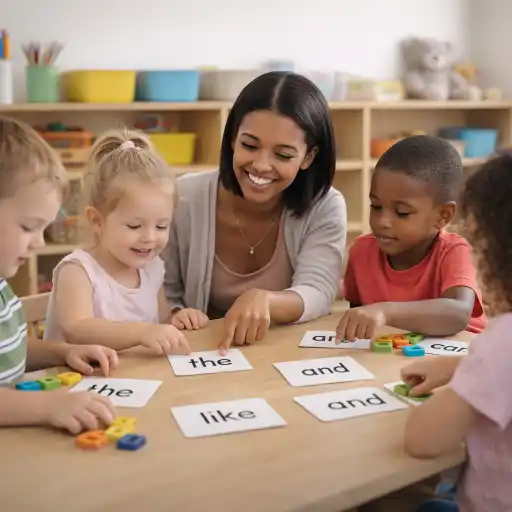
Repetition is necessary, but it does not need to look like a worksheet. A few index cards, magnetic letters, sticky notes, or a dry-erase board can support multiple forms of practice. The key is to require students to look carefully, say the word, and connect it to meaning.
- Word tents: Write four to six target words on folded cards. Call out a word, use it in a sentence, or spell it aloud; children hold up the matching card.
- Read-build-write: Students read a word, build it with magnetic letters or loose parts, write it, and reread it.
- Sticky-note hunt: Place target words around the room. Children find one, read it, and record or use it in a sentence.
- Cover and reveal: Write a word on a whiteboard, cover one letter or letter group, and invite children to identify what is missing.
- 🎲 Roll and read: Assign each number on a die to a word. Children roll, read the corresponding word, and move a counter.
Hands-on materials can also strengthen fine-motor engagement. Children may form words with play dough, write in sand, stamp letters, clip alphabet clothespins to a word card, or string alphabet beads in sequence. These activities are most effective when the adult consistently prompts students to read and spell the word rather than simply manipulate materials.
Keep the materials reusable. One laminated mat, a set of blank cards, and a small container of letters can support many weeks of instruction.
How can movement, centers, and play increase engagement?
Young children often sustain attention more readily when literacy includes movement and social interaction. Movement does not replace explicit teaching; it creates additional opportunities to retrieve and apply what has been taught. A classroom can use the same small word set in several predictable games, reducing both preparation time and the cognitive load of learning new directions.
Try a floor pathway made from word cards. A child reads each card while hopping, stepping, or moving a toy toward a finish line. In a partner version, one child selects a card and the other reads it before moving a game piece. For a “word detective” game, place words in books, on labels, or in a morning message and invite children to locate them in context.
Literacy centers are especially useful because they allow targeted practice while the teacher works with a small group. Keep the activity format stable and change only the word set. Possible centers include:
- a matching or memory game using duplicate word cards;
- a simple bingo game in which children listen, locate, and read;
- sentence strips that combine target words with decodable vocabulary;
- a word-building tray using magnetic letters, blocks, or letter tiles;
- a shared book hunt in which children highlight or point to familiar words.
Teach expectations explicitly: take turns, read before moving, ask for help, and return materials. Playful practice should remain academically purposeful and emotionally safe, especially for children who already feel that reading is difficult.
How can teachers differentiate practice and monitor progress?
Not every child needs the same words, level of support, or response format. Use brief observations to determine whether a child can recognize a word in isolation, locate it in text, spell it, and use it meaningfully. A child may succeed with a card but struggle in a sentence, or read a word accurately but not yet spell it. These differences are instructional information, not evidence of failure.
Consider a simple three-level system:
- Emerging: Work with two or three words, provide a model, and allow pointing, matching, tracing, or oral responses.
- Developing: Use four to six words and ask children to read, build, write, and locate them in short sentences.
- Extending: Ask children to sort words by spelling features, write original sentences, or explain the regular and irregular parts.
Review mastered words alongside new words so students experience success while maintaining retrieval practice. Avoid using speed as the only measure. Accuracy, independence, transfer to connected text, and willingness to attempt a word are also important indicators.
For multilingual learners, clarify pronunciation and meaning, use visuals and gestures, and invite connections to children’s home languages when appropriate. For children with fine-motor or visual needs, offer larger print, tactile letters, oral spelling, or partner support. State requirements vary - check your state licensing agency when aligning literacy instruction, assessment, or professional development with local expectations.
What common mistakes should teachers avoid?
One common mistake is treating every high-frequency word as an exception. Many frequently used words are fully or largely decodable once children have learned the relevant phonics patterns. Presenting these words as arbitrary shapes can weaken children’s confidence in using sound-symbol knowledge.
A second mistake is introducing too many words at once. Large weekly lists may create the appearance of coverage without producing durable learning. A smaller set taught explicitly, revisited frequently, and connected to text is more manageable for children and educators.
Another pitfall is practicing words only in isolation. Flashcards can provide a quick check, but children also need to see words in meaningful sentences and books. Context supports vocabulary, syntax, comprehension, and transfer.
- Do not correct by simply saying, “You should know this.” Prompt children to look at the letters and sounds.
- Do not make games so competitive that hesitant readers withdraw.
- Do not use timed drills as the primary measure of progress.
- Do not send home unexplained word lists; provide families with one or two simple games.
For continued professional growth, educators may also explore Classroom Tools for Emergent Literacy Buy Now $25.00, Language and Literacy Foundations in Pre-K  Buy Now $16.00, and Letter & Number Planning in Child Care Buy Now $24.00. These courses can help providers connect daily activities, intentional planning, and early literacy development.
Conclusion: What is the simplest effective plan?
Low-prep sight word instruction works best when it is explicit, cumulative, playful, and connected to phonics and meaning. Choose a small group of useful words, identify regular and unexpected spelling features, and revisit the words through quick routines such as word tents, read-build-write practice, movement games, centers, and shared reading.
Monitor more than isolated recall. Notice whether children can recognize words in context, explain or use their meanings, spell them with support, and transfer the learning to new sentences. Differentiate the number of words, materials, response modes, and amount of adult support without lowering expectations.
The central question is not how many sight words kindergarten children can memorize. It is how effectively they can build durable connections among sounds, letters, pronunciations, meanings, and texts. With a few reusable materials and consistent teaching moves, providers and directors can create daily practice that strengthens literacy while preserving children’s confidence and curiosity.
- Hidden in Plain Sight: Depression in Young Children
- Birth to Five CDA Credential with Portfolio Review
- Money Matters in Medicine
- Setting the Stage: Story Time
- Play with Purpose: Supporting Children with Autism
- Creating Engaging and Meaningful Learning Experiences
- Sensitive Periods in Montessori: Guiding Natural Learning
- Wellness in Action: Teaching Healthy Habits to Children
- Montessori Cultural Activities: Exploring the World Through Play and Learning
- Professional Integrity in Child Care
- Labor Day Activities
- CDA Certification en Español: Recursos y Consejos para Educadores Bilingües
- Actividades de Motricidad Gruesa que Desarrollan el Equilibrio, la Coordinación y la Fuerza
- 10 Ejemplos de Cómo la Cultura Influye en el Desarrollo Infantil
- Proporciones de Cuidado Infantil y Tamaños de Grupo por Edad en Virginia (Guía Rápida para Centros y Hogares)
- Cómo Celebrar el Día Nacional del Kindergarten
- How can we prepare preschoolers for kindergarten success?
- How can New York childcare programs help children in the concrete jungle fall in love with nature?
- Celebrando la amistad en el cuidado infantil durante el Día de los Mejores Amigos
- What are the benefits of earning a CDA credential?
- How Can Simple Cooking Activities Teach Skills in North Dakota Child Care Programs?
- How can we host a Daycare Mini Olympics that builds movement and teamwork?
- How can child care programs build strong readers before kindergarten?
- Kindergarten Songs for Circle Time: 15 Sing-and-Move Ideas That Sneak in Learning
- How Can Teachers Support Children Starting Kindergarten This Fall?
- How Can Child Care Providers Design Learning Centers That Support Play and Development?
- How Can You Teach Sight Words Through Games, Movement, and Play?
- How Can Kindergarten Teachers Strengthen Sight Word Recognition with Low-Prep Activities?
- How Can Holiday Word Games Strengthen Visual Scanning and Spelling?
- How Can You Differentiate Sight-Word Bingo for Mixed-Ability Groups?
