Can a simple “harvest delivery” turn a wobbly walk into meaningful practice with balance, coordination, and self-control? Try these fall-themed games to help preschoolers build confidence while carrying soft “apples,” leaves, or pumpkins, and explore Balancing Physically Active Play in Child Care for deeper guidance on planning active play within a balanced day. The course explores how to use available materials for engaging movement experiences; the ideas below offer a playful place to begin.
Why are fall balance games worth making room for?
Balance is more than standing still. Children use static balance to hold a position and dynamic balance to stay steady while moving, turning, stepping, or carrying an object. These skills support everyday participation—from navigating the classroom and dressing to joining playground games. A seasonal delivery challenge gives children a reason to practice naturally: they are not completing drills so much as helping a pretend farm get its harvest to market.
Carrying a light object encourages children to adjust their posture, pace, and movements. A beanbag balanced on the head or hand also adds a manageable problem to solve: “How can I move so my apple stays safe?” Children may experiment with where to look, how widely to place their feet, or when to slow down. These playful trials can support body awareness, coordination, and persistence.
Group games add social learning. Children practice waiting, taking turns, encouraging classmates, and responding to a shared signal. Keep the focus on effort and discovery rather than speed or who can carry the most. A child who pauses, tries again, or chooses an easier path is actively learning.
Regular, short movement opportunities can fit into transitions, outdoor time, or a small-group activity. For additional ideas that build gross motor skills through movement, see gross motor activities for balance, coordination, and strength.
How can you set up a safe harvest delivery route?
Start with a quick space check rather than an elaborate course. Choose a level, dry surface and a clear route with enough room between children. Indoors, move obstacles out of the path and secure loose rugs; outdoors, inspect the ground for wet leaves, holes, sticks, and other tripping hazards. Use visible start and finish markers such as floor spots, cones, or baskets.
Gather soft, lightweight “harvest” items: beanbags, fabric leaves, or small plush pumpkins. Select objects that are easy to grip and appropriate for the children in your group. Avoid small parts for children who may mouth materials, and inspect props before play. Put the delivery basket within easy reach and make the route short enough that children can complete it without rushing.
- Demonstrate the route and show how to start, stop, and return an item.
- Establish one clear cue, such as “Freeze, little farmers!”
- Position yourself to see the route and all children; arrange the group to avoid crowding.
- Offer a seated or supported alternative, such as passing the harvest item into a basket.
- 🍁 Invite children to choose a fall character or movement, while keeping the path and pace controlled.
Active supervision means watching, listening, and anticipating where children may need support—not merely staying nearby. Follow your program’s safety policies and applicable rules. State requirements vary - check your state licensing agency. The CDC’s guidance on outdoor play and safety in early care and education also highlights age-appropriate equipment, hazard checks, and close supervision.
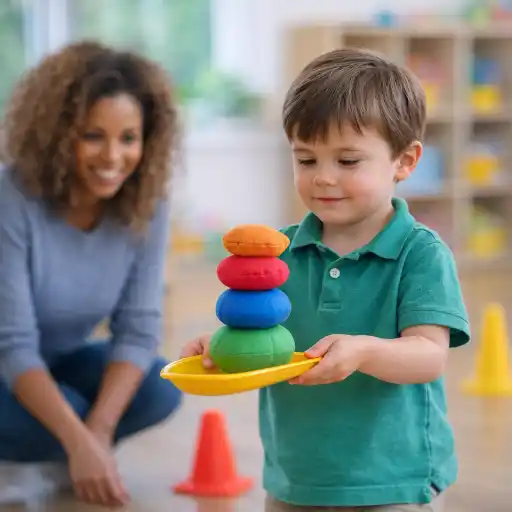
Which fall balance games can you play with preschoolers?
Keep instructions brief and demonstrate each activity before inviting children to try. Start with a simple version, then add one small change if children seem comfortable. These games can be played individually, in pairs, or at low-wait stations.
- Apple-on-the-Plate Walk: Children carry a beanbag “apple” on a flat paper plate from one basket to another. Begin with two hands on the plate; later, invite children to use one hand or follow a gentle curved path.
- Leaf Line Delivery: Place a strip of painter’s tape on the floor or use a wide path outdoors. Children walk along it while carrying a soft leaf on one shoulder or in a hand. Keep the line flat on the ground; a raised beam is not needed.
- Pumpkin Post: Children carry a lightweight plush pumpkin to a matching-color basket. Add simple stops—pause at a “hay bale” spot, turn around, then continue.
- Squirrel’s Acorn Errand: Children carry a soft beanbag in a cupped hand, walk to a basket, and gently place it inside. Invite a squat-and-stand only if it is comfortable for the child and space allows.
- Harvest Helper Freeze: Children move slowly with a soft item while music plays, then stop and hold a comfortable pose when it pauses. No child is “out”; restart together.
Beanbags are useful because they are soft and do not roll away as easily as balls. For related ideas, see beanbag balance and movement games and the Beanbag Balances activity, which encourages children to choose different places to balance a beanbag and adapt the challenge.
How can you adjust the challenge so every child can participate?
Children will approach balance games with different movement skills, confidence, sensory preferences, and interests. Inclusion does not require everyone to perform the same action. Keep the shared purpose—moving or delivering a fall item—while offering several ways to take part.
Make the task easier by shortening the route, using a larger or lighter object, carrying it with two hands, or walking beside a wall or sturdy support. A child may deliver the item while seated, roll it along a clear surface, or hand it to a peer who places it in the basket. Picture cues and a quick demonstration can help children understand the sequence without relying on lengthy directions.
To add challenge, change only one feature at a time: ask a child to pause at a marker, walk around a wide obstacle, carry the item on a different body part, or follow a gentle zigzag. Avoid adding speed, raised surfaces, or several new rules at once. Children should be able to opt for a simpler version or watch before joining.
- Offer choices: “Would you like to carry the apple in your hands or on your plate?”
- Use cooperative goals, such as delivering all the harvest together, instead of racing.
- Give children meaningful roles: carrier, basket helper, path designer, or cue caller.
- Notice effort with specific feedback: “You slowed down at the turn to keep the leaf steady.”
Use observation to understand what supports participation. If developmental concerns persist, document specific examples and follow your program’s referral process, collaborating with families and qualified professionals as appropriate.
How can you keep the game engaging without sacrificing safety?
Set a calm, playful tone: the group is delivering supplies to a pretend fall market, not competing to finish first. A short story prompt—“The squirrel needs apples before the wind arrives”—can make repeated practice feel fresh. Invite children to suggest a movement or name the delivery stations, while adults maintain clear boundaries and supervise continuously.
Reduce waiting by setting up two or three simple lanes or parallel delivery spots. Keep group size appropriate for the available space, and pause or simplify the game if children begin rushing, crowding, or losing awareness of the route. Use a consistent stop cue and practice it before the first round. After play, invite children to return the props to a basket and transition to a story, drawing, or quieter activity.
Common pitfalls are easy to prevent:
- Making it a race: Emphasize steady movement, personal progress, and teamwork.
- Adding too many obstacles: Begin with a clear path and introduce only a manageable variation.
- Using unsuitable materials: Choose soft, lightweight props that fit children’s ages and abilities.
- Leaving children waiting: Use stations, small groups, or helper roles so everyone remains involved.
- Supervising from one fixed spot: Position yourself to maintain sight lines and respond as children move.
Use movement as a positive part of the day, not as a reward to withhold. The related ChildCareEd course, Balancing Physically Active Play in Child Care, offers a broader framework for fitting structured and unstructured activity into children’s routines.
Conclusion: Can preschoolers carry the harvest without dropping it?
They can practice—and enjoy the process—when the route is clear, the materials are manageable, and the challenge fits each child. Fall delivery games invite preschoolers to develop balance, coordination, body awareness, and self-regulation through meaningful pretend play. Begin with a short, simple walk, then offer choices such as carrying an apple, following a ground-level line, or helping a partner deliver the harvest.
Remember the main goal: not a perfect, unbroken delivery, but a safe opportunity for every child to move, experiment, and feel capable. Supervise actively, celebrate individual effort, and adapt the activity as you observe children. With a few soft props and a little autumn imagination, everyday movement can become a joyful classroom routine.
Explore five relevant ChildCareEd courses:

- 45 Hour Child Growth and Development
- What Makes Me Special: An Overview of Autism and ADHD
- CDA Bridge Bundle: Preschool
- Pediatric RSV First Aid & CPR/AED
- CDA Bridge Bundle: Family Child Care without Portfolio Review
- Art from the Heart for Preschoolers: Open Ended Art Projects that Build Self-Esteem
- CDA Bridge Bundle: Infant/Toddler without Portfolio Review
- CDA Bridge Bundle: Preschool without Portfolio Review
- Mindful Supervision: Balancing Safety & Independence in Montessori
- Actividades de Motricidad Gruesa que Desarrollan el Equilibrio, la Coordinación y la Fuerza
- ¿Cuál es la Diferencia Entre la Crianza Respetuosa y la Crianza Permisiva?
- Actividades de Otoño Fáciles para Preescolares esta Temporada
- Pumpkin, Leaves, and Apples: Fall Activities for Preschoolers
- Calabazas, hojas y manzanas: actividades de otoño para preescolares
- Celebrando la amistad en el cuidado infantil durante el Día de los Mejores Amigos
- Canciones, juegos y preguntas de círculo para niños
- How can Michigan preschool programs build strong fine and gross motor skills?
- Too Wiggly to Sit? Fall Movement Activities Toddlers Will Love
- Rainy Fall Day? 12 Indoor Activities Preschoolers Won’t Want to Stop
- Can You Build It With Fall? Nature-Based Building Challenges for Preschoolers
- Fall Challenge Accepted! Hands-On Learning Games for Pre-K
- Why Do Children Repeat the Same Play—and Why Should Educators Let Them?
- How Much Outdoor Play Do Preschoolers Need Each Day?
- How Can Fall Loose Parts Help Toddlers Explore Size, Movement, and Cause and Effect?
- How Can a Pumpkin Delivery Game Turn Fall Movement Into Real Problem-Solving?
- How Can Fall Movement Games Rescue Rainy Recess in a Small Child Care Classroom?
- Can Preschoolers Invent a Leaf Carrier That Really Works?
- How Can Preschoolers Explore the Ways Seeds Travel in Fall?
- Can You Carry It Without Dropping It? Fall Balance Games for Preschoolers
