Curious how short, low‑prep outdoor science invitations can boost attention, language, and early STEM skills? Nature-based science activities turn everyday time outside into measurable learning—perfect for busy centers that need practical, curriculum‑aligned ideas. For a ready next step, explore Creating the Natural Outdoor Classroom  Buy Now $16.00 to get site design ideas, routines, and staff tools that support documented training hours; you might also pair that with Building Early Science Foundations Buy Now $16.00 to sharpen inquiry prompts and classroom extensions.
What makes nature-based science activities effective for young learners?
Why it matters: short outdoor investigations support gross‑motor development, rich sensory input, language growth, and the kind of hands‑on #science thinking that scaffolds later academic work. When adults frame an invitation with one clear question (e.g., “Which leaf melts the fastest?”) children practice observation, prediction, and comparison—core elements of scientific #inquiry. The natural world also supplies inexpensive, variable materials that sustain curiosity without heavy adult prep.
Evidence and practical impact for your program:
- Repeated outdoor exposures increase vocabulary and observational language for #children in care.
- Nature play provides embedded #outdoor movement that supports self‑regulation and transitions.
- Simple experiments map directly to #curriculum targets (counting, measurement, hypothesis), making documentation efficient and meaningful.
How can staff design low‑prep, seasonal science invitations that actually work?
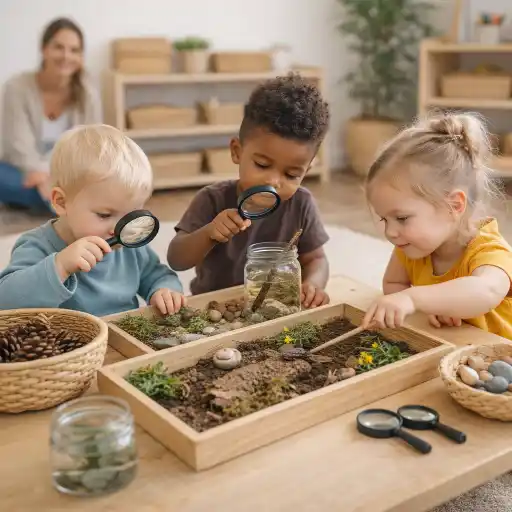
Design invitations that are short, repeatable, and tied to one learning target. Use a 2–3 station rotation and change materials weekly so children revisit ideas without cognitive overload. Below are scalable examples you can implement tomorrow:
- 🌱 Spring: seed cups for germination observations—measure sprout height weekly and graph results.
- 💧 Summer: shallow sink/float tubs and evaporation charts—ask children to predict which objects will float and why.
- 🍁 Fall: leaf-sorting and leaf‑count graphs—compare size, color, and symmetry.
- ❄️ Winter: frozen toy excavations and salt vs. warm water melt tests—talk about temperature and states of matter.
Materials list (keep it simple): clipboards, magnifiers, tubs, droppers, loose parts (stones, sticks, shells), and waterproof labels. For planning templates and sample invitations, see Creating the Natural Outdoor Classroom Buy Now $16.00 as part of practical staff training.
How do you adapt these invitations for different ages and abilities?
Adaptation is mostly about changing the adult prompts, tools, and independence expectations. Use the same invitation across mixed groups by varying complexity:
- Infants: prioritize adult narration and richly descriptive language—"This water is cold; listen to the drip"—and tactile play with safe materials.
- Toddlers: add choice cards and single‑step experiments (drop/float) with adult modeling and hand‑over‑hand support as needed.
- Preschoolers: introduce prediction language, tallying, simple charts, and repeated trials to build #science procedures.
Inclusion strategies:
- Provide alternative grips (thicker tools, tongs) and seating options for children with mobility or fine‑motor needs.
- Offer picture schedules or tactile cues to sequence a 3‑step investigation.
- Pair peer buddies intentionally so social language and leadership develop in natural contexts.
How can programs keep outdoor science work safe, compliant, and reliable?
Safety and consistency come from short systems: a daily hazard scan, a posted weather/AQI decision chart, and explicit zone supervision. Practical elements to implement now:
- Assign numbered zones and a named adult observer for each zone; rotate assignments so everyone practices active scanning.
- Adopt a traffic‑light weather/AQI policy and post it at exits; remember state requirements vary - check your state licensing agency.
- Use a grab‑and‑go outdoor kit (clipboards, wipes, spare layers, first‑aid) and run a 5‑minute pre‑outdoor huddle.
For courses that strengthen safety planning, consider Safe and Sound: Creating Healthy Environments for Every Child Buy Now $55.00 and the family‑care focused Family Child Care: Building, Premises, and Outdoor Safety Buy Now $16.00. Also consult federal and public health guidance such as the CDC’s outdoor play and safety resources when creating your policies.
How do we connect outdoor science to curriculum, document learning, and avoid common mistakes?
Make connections explicit: map one outdoor invitation to 1–2 learning targets (e.g., vocabulary + measurement). Keep documentation light but purposeful: a photo, a child quote, and a one‑line learning note per child or station is often sufficient for families and licensing reviews. Use an inquiry cycle for older preschoolers: Ask → Predict → Test → Record.
Common mistakes and fixes:
- ❌ Overloading outdoor space with too many choices — ✅ Offer 2–3 focused invitations and rotate weekly.
- ❌ Weak supervision zones — ✅ Post a supervision map and assign zone leads.
- ❌ No indoor backup for bad weather — ✅ Train staff using Engaging Indoor Activities for Inclement Weather Buy Now $24.00 so learning goals can shift inside.
FAQ (practical):
- Q: How long should outdoor science blocks be? A: Start with 15–30 minutes and repeat across the day.
- Q: How to adapt for allergies or food-based activities? A: Follow family health plans; use visuals to communicate menus and supervise food handling.
- Q: How to train staff quickly? A: Short online modules—Building Early Science Foundations Buy Now $16.00 pairs well with a site‑specific outdoor course.
- Q: How to show impact? A: Track 3 simple indicators weekly (new words used, time on task, calmer transitions) and collect one photo per child per week.
Conclusion
Nature‑based #science invitations are high‑value, low‑cost ways to strengthen vocabulary, regulation, motor skills, and early inquiry for #children. Start with one small change this week—add a 15‑minute outdoor investigation or set up one loose‑parts science station—train staff with targeted modules like Creating the Natural Outdoor Classroom Buy Now $16.00 or Building Early Science Foundations Buy Now $16.00, document learning concisely, and iterate. With simple systems and intentional prompts, your team can make #nature a reliable engine for joyful, standards‑connected learning.
- CDA Preschool Credential
- CDA Preschool Credential with Portfolio Review
- Building Early Science Foundations
- Tomorrow's Einsteins: Infant and Toddler Science
- Birth to Five CDA Credential with Portfolio Review
- 24 Hour Texas Pre-Service
- CDA Bridge Bundle: Infant/Toddler
- Texas Director Credential
- Montessori Cultural Activities: Exploring the World Through Play and Learning
- Enhancing STEM Education for Infants and Toddlers
- Today Is Earth Day!
- Get Ready for Summer!
- How Can Childcare Educators Thrive in the Big Apple?
- CDA Certification en Español: Recursos y Consejos para Educadores Bilingües
- Actividades de Motricidad Gruesa que Desarrollan el Equilibrio, la Coordinación y la Fuerza
- 10 Ejemplos de Cómo la Cultura Influye en el Desarrollo Infantil
- Proporciones de Cuidado Infantil y Tamaños de Grupo por Edad en Virginia (Guía Rápida para Centros y Hogares)
- What California children’s museums best support hands-on preschool learning?
- How can we use nature-based learning through Minnesota's outdoor seasons?
- How Do Art Activities Support Cognitive Growth in North Dakota Preschoolers?
- How can New York early childhood programs use garden-based learning?
- How can New York childcare programs help children in the concrete jungle fall in love with nature?
- How can New York providers bridge the summer gap with year-round learning?
- How can Minnesota child care programs keep kids learning and engaged over the summer?
- Can forest preschool activities be integrated into traditional programs?
- How can I bring a Forest Preschool (nature-based learning) to my program?
- How Can Child Care Programs Use Easy Nature‑Based Activities for Every Season?
- STEM for Preschoolers: Fun Activities That Encourage Curiosity
- Can You Build a Leaf Bridge? Fall STEM Challenges for Pre-K
- How Can STEM Activities Turn Everyday Preschool Play Into Powerful Learning?
