Fall puts a living science lab right outside your classroom: leaves change, seeds appear, and weather shifts in ways children can investigate firsthand. Try the ideas below to build observation, language, early math, and problem-solving through joyful play; for a deeper foundation in developmentally appropriate inquiry, explore ChildCareEd’s Basic Science in Early Childhood Buy Now $25.00 course. This training offers practical guidance for planning meaningful investigations and strengthening children’s scientific reasoning.
Why is fall a meaningful setting for preschool STEM?
Seasonal change gives young children something concrete to notice and wonder about. Leaves shift in color and texture, temperatures cool, seeds and nuts become visible, and some animals prepare for winter. Instead of relying only on explanations, educators can invite children to observe these changes in their own outdoor environment.
These experiences nurture more than science knowledge. Children practice describing evidence, comparing objects, listening to peers, moving through outdoor spaces, and revising an idea when new information appears. A leaf investigation can involve classification and counting; a shelter-building challenge can invite planning, collaboration, and early engineering.
The goal is not to turn every moment outside into a formal lesson. Rather, notice what children are already interested in and offer a thoughtful question or material that helps them explore further. Nature is variable, affordable, and full of opportunities for children to develop #curiosity, patience, and confidence as learners.
- Visual inquiry: compare colors, shapes, patterns, and signs of change.
- Sound inquiry: listen for rustling leaves, birds, wind, and footsteps.
- Touch inquiry: describe surfaces as smooth, rough, dry, damp, soft, or firm.
- Movement inquiry: explore balance, force, speed, and body awareness outdoors.
How can teachers turn a seasonal observation into an investigation?
Begin with what children notice. A simple inquiry sequence—notice, wonder, predict, test, and represent—gives children a reassuring structure while leaving room for their ideas. Offer a basket of fallen leaves, a pinecone, or a shallow water tub, then ask, “What do you notice?” Give children time to answer with words, gestures, drawings, or their home language.
Follow children’s responses rather than rushing to supply the explanation. If they wonder why one leaf is crisp and another flexible, invite them to compare the leaves and consider what might happen if one gets wet. Ask, “What do you think will happen?” and “How could we find out?” After the test, return to the original prediction: “What happened? Was anything surprising?”
Use open-ended prompts and wait long enough for children to think. One clear question is usually more useful than several questions in quick succession. A child’s unexpected result is not a failed activity; it is information that can lead to another question. This approach positions children as active investigators and educators as supportive guides.
- Offer a small number of flexible materials to support focus.
- Repeat investigations so children can notice what stays the same or changes.
- Welcome predictions that differ from the result; compare ideas with evidence.
- Invite children to draw or dictate what they observed.
Which fall STEM activities are easy to try outdoors?
Choose brief, repeatable activities that can continue later at a classroom discovery table. Natural materials make excellent starting points, and everyday tools such as trays, magnifiers, rulers, and picture charts can help make children’s thinking visible.
- Leaf detectives: Collect a few fallen leaves and compare size, color, shape, and texture. Use magnifiers to look closely at veins, then arrange the leaves into a class display.
- Sink-or-float collection: Ask children to predict whether large, safe objects—such as an apple, a leaf, or a small gourd—will sink or float. Test them in a shallow tub and record results with drawings or picture symbols.
- Pinecone observations: Place pinecones in dry and damp locations and revisit them over time. Encourage children to describe any changes without suggesting that pinecones reliably forecast weather.
- Seed sorting: Compare seeds from adult-prepared pumpkins or other approved materials. Sort by size or shape and count small groups together.
- Nature engineering: Challenge children to build a shelter for a toy animal with large sticks and leaves. Ask what might make the roof stable or keep the animal protected.
🍂 Keep the invitation open-ended: children may decide to sort, count, build, draw, or tell a story about the materials. That flexibility helps the activity remain engaging for different interests and abilities.
How can nature investigations connect science with other learning?
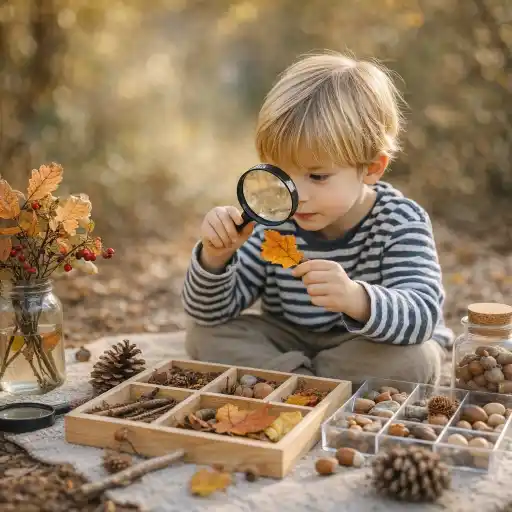
Fall explorations naturally combine science with language, mathematics, movement, and creative expression. Provide useful words in context—such as vein, stem, brittle, damp, heavier, lighter, float, sink, and shelter—and connect them to an object children can see or touch. Invite children to dictate observations, for example, “My leaf is dry and curled.” Pair vocabulary with gestures, photographs, and home-language words when possible.
Early math grows through sorting, counting, ordering, measuring, and comparing. Children can arrange leaves from smallest to largest, count seeds in groups, make a simple color graph, or compare the number of objects that floated. Adapt the level of challenge: some children may match two colors, while others can make a tally or explain which group has more.
Movement is part of the investigation too. Carrying a basket, walking over different surfaces, reaching to collect a leaf, or observing how wind moves leaves supports coordination and body awareness. Shared challenges also encourage turn-taking and cooperation. A nature-based learning environment can extend these experiences; ChildCareEd’s Creating the Natural Outdoor Classroom  Buy Now $16.00 course explores ways to make outdoor spaces inviting for discovery.
When children represent an idea through building, drawing, or storytelling, they revisit what they noticed and communicate it in a form that suits them. This makes seasonal STEM welcoming and richly interdisciplinary.
How can educators keep fall science safe and inclusive?
Before going outdoors, scan the area for sharp objects, standing water, unstable branches, poisonous plants, animal waste, and traffic hazards. Maintain active supervision: position adults to keep clear sight lines, scan continuously, and move when children or conditions change. Check weather and outdoor conditions, and provide appropriate clothing, water, and shade as needed.
Inspect collected materials and avoid unknown plants, mushrooms, berries, or objects that could present choking risks. Use larger materials with younger children, supervise water play closely, and wash hands after exploration. Check family information and program policies before using food materials such as apples or pumpkin. State requirements vary - check your state licensing agency.
Inclusion begins during planning. Provide seated and standing options, accessible tools, picture cues, and different ways to communicate. A child who prefers not to touch damp leaves can use tongs or observe with a magnifier; a child developing English can point, draw, gesture, or use a home-language word.
- Offer two or three focused activity choices to support supervision.
- Protect living things: observe animals and habitats without disturbing them.
- Prepare an indoor alternative for weather or accessibility needs.
- Use visual steps and adaptable tools so every child can participate meaningfully.
How can teams document discoveries and keep investigations going?
Documentation can be brief and useful. Capture a photograph, one child quote, and one concise observation about what the child noticed, predicted, tested, or changed. For example: “Jordan thought the wet leaf would be heavier, lifted both leaves, and revised the prediction.” This records reasoning without interrupting the experience or turning play into a worksheet task.
Use what you observe to plan a next step. If children are interested in leaf texture, offer a new comparison the next day. If they return to building shelters, add a different large natural material and ask what changes. A simple planning cycle can keep the work manageable:
- Observe what children repeatedly explore or ask about.
- Choose one question and a small set of safe materials.
- Invite children to predict, test, and represent their thinking.
- Revisit the experience and plan a reasonable extension.
- Share a photograph or prompt with families to invite conversation at home.
Strong fall STEM does not require elaborate supplies or perfect predictions. It grows from children’s questions, responsive adult support, and repeated opportunities to investigate. With thoughtful preparation, providers can make nature a welcoming setting for #science, #inquiry, #math, and collaboration. Start with one simple question outdoors, listen closely to children’s ideas, and let their discoveries guide what happens next.
For additional professional learning, explore these relevant English-language ChildCareEd courses:
- CDA Home Visitor Subject Area 3 Part 3 Birth to 5
- Professional Presence in Early Childhood
- The Best Promotion is Play
- Creating Environments that Nurture Growth and Community
- Texas Director Credential
- Building Early Science Foundations
- Wellness in Action: Teaching Healthy Habits to Children
- Montessori Cultural Activities: Exploring the World Through Play and Learning
- Enhancing STEM Education for Infants and Toddlers
- Supporting Families and Caregivers in Language and Literacy
- Pumpkins, Pinecones, and Leaves: Autumn-themed STEM Projects
- 🎉STEM-sational Fun: How Can You Spark Preschoolers’ Curiosity with Engaging STEM Activities? 🔬🧪🔢
- Actividades de Otoño Fáciles para Preescolares esta Temporada
- Easy Ways to Add STEM to Your Preschool Classroom
- How can I use STEM activities in my Preschool and Pre-K classroom?
- What are easy STEM activities I can do with preschoolers?
- How Do Art Activities Support Cognitive Growth in North Dakota Preschoolers?
- Calabazas, hojas y manzanas: actividades de otoño para preescolares
- How can pumpkin science create meaningful, hands-on fall learning for preschool classrooms?
- How can leaf-themed art and science activities deepen learning in my child care program?
- How can we encourage scientific thinking through hands-on exploration?
- How can I introduce STEM concepts in early childhood?
- STEM for Preschoolers: Fun Activities That Encourage Curiosity
- What’s Happening Outside? Fall Science Adventures for Preschoolers
- Can You Build a Leaf Bridge? Fall STEM Challenges for Pre-K
- Fall Detectives: 10 Questions Pre-K Kids Can Investigate This Season
- How Can STEM Activities Turn Everyday Preschool Play Into Powerful Learning?
- How Can Fall Nature STEM Activities Spark Preschoolers’ Scientific Thinking?
- How Can Simple Fall Activities Support Kindergarten Readiness Through Play?
