What looks like a simple tub of water can become a rich laboratory for young investigators. A thoughtfully planned sink-or-float experience strengthens prediction, observation, language, classification, and problem-solving; Basic Science in Early Childhood Buy Now $25.00 can help you extend those practices into intentional daily curriculum and professional learning.
For providers seeking additional support with play-based inquiry, Building Early Science Foundations  Buy Now $16.00 offers strategies for nurturing curiosity, experimentation, and discovery.
Why does sink-or-float play matter in early childhood?
Sink-or-float investigations are valuable because they connect children’s natural curiosity with authentic scientific practices. Children encounter a question, form an idea, test it, observe the result, and communicate what they discovered. This process positions #preschoolers as capable thinkers rather than passive recipients of information.
The experience also integrates several developmental domains. Children use vocabulary such as sink, float, predict, observe, sort, heavy, and light. They practice early mathematics by counting objects, comparing groups, tallying results, and using words such as more, fewer, same, and different. Scooping, carrying, and gently placing objects into water support fine-motor coordination.
Water play also creates opportunities for social learning. Children wait for turns, listen to peers’ explanations, negotiate categories, and discover that classmates may make different predictions. The National Association for the Education of Young Children describes water centers as meaningful settings for sensory exploration, mathematics, science, language, social development, and creativity (water and sand play).
How can providers introduce the investigation?
Begin with a clear, child-friendly question: “Which objects will float, and which will sink?” Introduce only a few safe, contrasting objects at first, such as a cork, wooden block, plastic spoon, stone, sponge, and large metal spoon. Too many choices can make it difficult for children to notice patterns.
Model the inquiry cycle without rushing to provide the answer:
- Prediction: “What do you think will happen?”
- Reasoning: “What makes you think that?”
- Test: “Let’s place it gently in the water.”
- Observation: “What did you notice?”
- Comparison: “Was the result the same as your prediction?”
Use a two-column chart labeled Sink and Float. Children can place picture cards, object cards, or the tested objects in the appropriate category. For children who are ready, add columns for prediction and result. A second trial helps children consider whether an observation is consistent.
Most importantly, treat predictions as thoughtful ideas, not answers that are simply right or wrong. Say, “Our result was different from our prediction,” or, “We found out something new.” This language protects risk-taking and encourages children to revise their thinking in response to evidence.
What scientific concepts can preschoolers explore?
Preschoolers do not need formal equations for density or buoyancy. They can begin by noticing that objects made from different materials behave differently in water and that size, shape, material, and enclosed air may affect the outcome. The American Chemical Society explains that objects that float are often light for their size, while objects that sink are heavy for their size (Float and Sink).
Avoid teaching the oversimplified rule that “heavy things sink.” A large wooden block may float, while a small metal paper clip may sink. A hollow, sealed object may float because it contains air. Changing the shape of aluminum foil or modeling clay can help children see that form matters too: a boat shape may float while the same material compressed into a ball sinks.
Use questions that invite comparison:
- “What do the floating objects have in common?”
- “Does a bigger object always sink?”
- “What happens if we change the shape?”
- “Can we make this sinking object float?”
- “What material is each object made from?”
Introduce scientific vocabulary naturally after children encounter the underlying idea. Children’s explanations and observations are more important than memorizing definitions.
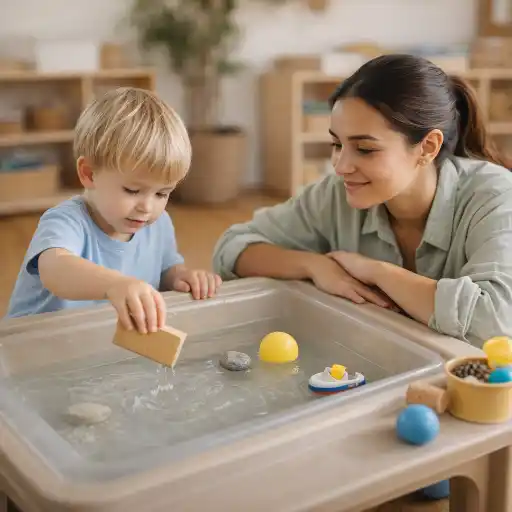
How can providers create a safe and inclusive setup?
Choose a shallow, stable container and place it on a tray or washable surface. Provide towels, smocks, and access to handwashing. Select objects that are waterproof, unbreakable, non-toxic, and too large to create a choking hazard. Avoid sharp materials, small loose parts, and objects that could release harmful substances.
- 🧺 Begin with four to six materials so children can compare meaningfully.
- Use picture labels for “sink” and “float” to support emerging readers and dual-language learners.
- Position the activity where adults can see and hear every child.
- Establish expectations for gentle placement, sharing, and cleanup.
- Offer larger objects, adaptive grips, visual choice cards, or nonverbal response options when needed.
Active supervision is essential during every water experience, even when the container is shallow. Providers should remain close, continuously monitor children, and empty containers immediately after use. State requirements vary - check your state licensing agency, particularly for water play, sanitation, supervision, and materials.
Inclusion does not require every child to participate in the same way. A child may point, gesture, draw, use a home language, or work with a peer. These alternatives preserve agency while allowing each child to engage in the investigation.
How can teachers extend and document the learning?
A strong investigation generates new questions. Invite children to compare plastic and metal spoons, test natural materials collected outdoors, or investigate whether a foil boat can carry blocks. Boat building introduces an early engineering cycle: children design, test, observe, and revise.
Connect the experience to mathematics by counting the sinkers and floaters, comparing which group has more, or creating a simple picture graph. Connect it to literacy by reading a book about boats or water and dictating children’s explanations. Connect it to art by inviting children to draw an object before and after testing.
Documentation should be practical rather than burdensome:
- Record the object, prediction, result, and child’s explanation.
- Photograph children’s hands at work.
- Write down exact child statements.
- Invite children to draw one discovery.
- Revisit the chart with unfamiliar objects several days later.
Look for evidence that a child makes a prediction, offers a reason, uses observation vocabulary, sorts according to results, compares outcomes, or revises an explanation. Assess the process of thinking rather than whether the child already knows which objects will float. As ChildCareEd’s guidance on float-versus-sink sorting emphasizes, the goal is transferable habits of inquiry.
What common mistakes should providers avoid?
One common mistake is explaining the science too soon. If adults announce the answer before children have explored, children may repeat terminology without understanding the evidence. Instead, offer one question, wait, and listen carefully.
Another mistake is treating predictions as tests of intelligence. Predictions are ideas based on prior experience. A surprising result is an opportunity for learning, not a failure. Use neutral, encouraging language and invite children to test again.
- Too many materials: begin with a focused collection.
- Several variables at once: change one feature at a time when possible.
- Unclear vocabulary: clarify whether “floating” means resting on the surface or remaining suspended.
- No repetition: repeat trials and compare observations.
- Weak cleanup routines: plan drying, sanitizing, and water disposal before the activity begins.
- Adult-dominated conversation: use open prompts and allow wait time.
When children disagree enthusiastically or revise their explanations, meaningful learning is often underway. The provider’s responsibility is to create a safe structure while preserving children’s curiosity and control.
Conclusion: What does sink-or-float play teach preschoolers?
Sink-or-float water play teaches far more than two categories. It gives children repeated practice with #prediction, observation, classification, evidence, communication, early mathematics, fine-motor coordination, collaboration, and persistence. The strongest investigations require neither expensive equipment nor complicated explanations. They require safe materials, thoughtful questions, repeated opportunities to test ideas, and an adult who listens.
For child care providers and directors, this activity is a practical way to make #science visible in everyday curriculum. Start with a small tub, a few accessible objects, and one question. Document children’s thinking, revisit the investigation, and let their new questions guide the next experience.
To deepen your classroom practice, explore ChildCareEd’s Basic Science in Early Childhood Buy Now $25.00, Building Early Science Foundations Buy Now $16.00, Lesson Planning for Preschoolers Buy Now $24.00, DAP for Preschool Buy Now $24.00, and Creating Safe & Healthy Child Care Environments Buy Now $55.00. Together, these learning opportunities can help you plan intentional investigations, strengthen classroom practice, and support safe, joyful discovery.
- 45 Hour Child Growth and Development
- Teacher-Child Interactions for Stronger CLASS® Outcomes
- CDA Bridge Bundle: Family Child Care without Portfolio Review
- CDA Bridge Bundle: Preschool without Portfolio Review
- Emergent Learning & Development
- Play, Learn, Grow
- Montessori Cultural Activities: Exploring the World Through Play and Learning
- CDA Certification en Español: Recursos y Consejos para Educadores Bilingües
- Requisitos Para Ser Maestra Principal En Un Daycare: Lo Que Necesitas Para Empezar
- 10 Ejemplos de Cómo la Cultura Influye en el Desarrollo Infantil
- Proporciones de Cuidado Infantil y Tamaños de Grupo por Edad en Virginia (Guía Rápida para Centros y Hogares)
- Por Qué la Supervisión Activa Es Clave para la Seguridad en el Cuidado Infantil
- Cómo Ser Maestra de Preescolar en Illinois
- Pumpkin, Leaves, and Apples: Fall Activities for Preschoolers
- Celebrando la amistad en el cuidado infantil durante el Día de los Mejores Amigos
- Canciones, juegos y preguntas de círculo para niños
- How Can Child Care Providers Encourage Preschoolers’ Growing Curiosity?
- How can pumpkin science create meaningful, hands-on fall learning for preschool classrooms?
- How can simple science experiments transform my preschool classroom?
- STEM for Preschoolers: Fun Activities That Encourage Curiosity
- What’s Happening Outside? Fall Science Adventures for Preschoolers
- Go on a Fall Hunt! Outdoor Learning Challenges for Preschoolers
- Fall Detectives: 10 Questions Pre-K Kids Can Investigate This Season
- What Can Float vs. Sink Sorting Teach Preschoolers About Science?
- How Can Sink-or-Float Water Play Become a Meaningful Science Investigation for Preschoolers?
- What Questions Keep a Preschool Science Conversation Going?
- How Can Toddler Sensory Play Become a Science Investigation?
