When children follow experiment directions without asking why, they may miss the most valuable part: learning how evidence can change an idea. Help school-age learners investigate, record what they observe, and reflect on results with practical strategies—and build your own toolkit through Basic Science in Early Childhood Buy Now $25.00, a focused training on planning investigations that strengthen scientific reasoning.
For more ideas about supporting this age group’s learning and development, explore Watch Me Grow: School Age Development ONLINE  Buy Now $24.00. Together, these resources can help you make everyday experiments more purposeful while honoring children’s questions and initiative.
Why does scientific thinking matter more than completing the steps?
A procedure can show children how to make something happen; scientific reasoning helps them understand what happened and how they know. When school-age children observe closely, compare outcomes with predictions, and explain results, they practice using evidence rather than treating an activity as a recipe with one correct answer. These habits support problem-solving, communication, persistence, and informed decision-making across subjects and daily life.
The Next Generation Science Standards emphasize planning and carrying out investigations, making observations or measurements, and using evidence. The National Science Teaching Association likewise describes science practices as a combination of skills and knowledge: asking questions, analyzing data, building explanations, and communicating findings. In other words, children learn science not only by hearing facts but by taking part in how explanations are developed.
This approach can also make an unexpected result productive. If the ramp car travels a shorter distance than predicted, the group has evidence to examine—not a failed activity to conceal. Educators can model that ideas are provisional and can be revised when observations suggest a better explanation. As NAEYC recommends, invite children’s questions, explore alongside them, and allow time for investigation and reflection.
How can you turn a familiar experiment into an investigation?
Begin with a question children can investigate using accessible, safe materials. A familiar activity such as testing which objects float can become richer when children decide what to compare, make predictions, and explain why they think an object will sink or float. The adult’s role is to establish a clear purpose and safety boundaries while leaving meaningful decisions to the group.
Try this simple sequence:
- Invite a question: “Which objects do you think will float, and what makes you think so?”
- Ask children to name one prediction and the reason behind it.
- Agree on what to observe—whether an object stays at the surface, sinks, or changes position.
- Test a few objects, then pause to describe what actually happened.
- Choose a follow-up question based on the results, such as whether material or shape offers a useful comparison.
Resist adding a complicated vocabulary lesson before children have had a chance to investigate. Introduce terms such as “evidence,” “pattern,” and “prediction” as they become useful. The point is not to make every activity open-ended in every respect; a concise demonstration may introduce unfamiliar tools or safety practices. Then return agency to children so they can test, adapt, and discuss their own ideas.
What should children record during an experiment?
Recording helps children hold onto what they noticed and compare it with what they expected. It need not look like a formal laboratory report. A drawing, a short written note, a measurement, a tally, or a photograph can capture useful information. NAEYC notes that writing, drawing, and photographs can all help children document observations and revisit what they discovered.
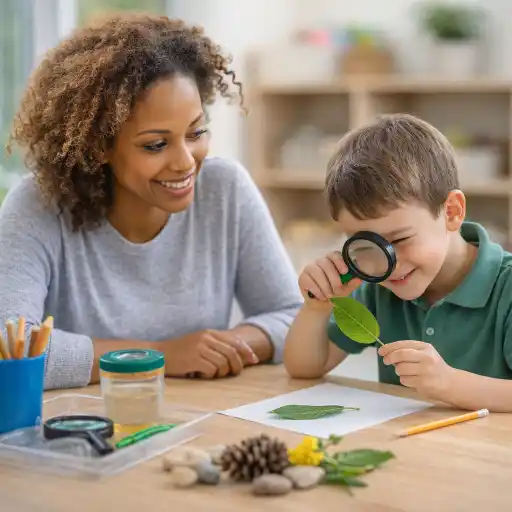
Introduce a simple recording sheet with a few repeatable prompts:
- Our question: What are we trying to find out?
- Our prediction: What do we think will happen, and why?
- What we did: What materials or steps did we use?
- What we noticed: What did we see, hear, measure, or count?
- Our next thought: What might we try or ask next?
Support children in separating an observation from an interpretation. “The car rolled 40 centimeters” reports a measurement; “the rough ramp slowed the car” offers an explanation that can be tested. Both matter, but distinguishing them helps children ground explanations in evidence. Offer different ways to record—dictation, diagrams, labels, or a partner scribe—so writing mechanics do not become a barrier to scientific participation.
How can educators guide reflection without giving away the answer?
After the test, make space for children to describe results before you explain them. Ask one focused question, listen, and allow wait time. Helpful prompts include “What did you notice?”, “Was that what you expected?”, “What evidence supports your idea?” and “What could we change if we tested it again?” These questions invite reasoning without turning the discussion into a quiz.
Compare the original prediction with the recorded observations. If a child expected the largest object to sink but it floated, acknowledge the difference and ask what the group can learn from it. Avoid declaring a prediction “wrong” as though the child has failed; instead, emphasize that a prediction helped the group decide what to test, while the outcome provides new information.
Reflection becomes especially meaningful when children consider how to improve an investigation. The NGSS guidance for grades 3–5 highlights fair tests, controlled variables, and using evidence to identify improvements. With school-age groups, introduce one manageable change at a time—for example, adjusting a ramp’s height while keeping the car and surface the same. Younger or less experienced learners can compare two trials verbally or visually before using formal terms such as variables.
How can you make scientific recording inclusive and manageable?
Children may show their reasoning in different ways and at different paces. Invite them to speak, draw, point to a picture, use a home language, dictate a sentence, or collaborate with a peer. A child who carefully watches before touching materials is still engaging in the investigation. Keep expectations focused on noticing and explaining rather than requiring every child to produce the same written product.
Make documentation brief enough to fit the activity. Choose one or two prompts rather than filling a page with questions, and use simple tables or icons when they help children compare trials. Photographing a changing setup or collecting one memorable child quote can preserve learning without interrupting exploration. Revisit those records in a later discussion or share them with families to show how children’s questions developed.
Common pitfalls are easy to adjust:
- 📷 Recording only the final outcome: Capture an observation or prediction from before the test as well.
- Correcting every unexpected result: Pause to ask what the evidence suggests before troubleshooting.
- Changing several factors at once: Adjust one feature when children are comparing outcomes.
- Making writing the whole task: Offer oral, visual, and collaborative recording options.
- Rushing the wrap-up: Reserve a few minutes for children to explain what surprised them and what they would investigate next.
Prepare age-appropriate materials, supervise actively, and adapt tools to children’s needs. State requirements vary - check your state licensing agency for applicable requirements.
How can a simple recording sheet support stronger inquiry?
A recording sheet is useful when it helps children notice, remember, compare, and communicate—not when it becomes a worksheet to complete for its own sake. Use it as a flexible scaffold: a question and prediction before testing, an observation during the investigation, and a short reflection afterward.
For example, after testing paper airplane designs, children might sketch each plane, record how far it traveled, and note which design they want to change. The sheet gives them a shared reference point for discussion and makes it easier to compare trials. It also helps educators notice children’s reasoning and plan a next step based on their interests.
Keep the tool adaptable. Some children may draw an outcome; others may add measurements or dictate a comparison. You can use the same basic prompts across different investigations, helping children become familiar with the cycle of asking, predicting, testing, recording, and reflecting. The goal is not a polished report but a visible record that supports thinking.
Conclusion: How do we help children think like scientists?
To help school-age children think like scientists, shift the focus from following directions to asking questions, observing carefully, recording evidence, and reflecting on results. Offer accessible investigations, make room for children’s predictions, and treat surprising outcomes as opportunities to revise ideas. A simple sheet or notebook can support the process when it captures what children expected, what happened, and what they wonder next.
As a provider, you do not need to supply every answer. Prepare safe materials, ask thoughtful questions, and give children the time and tools to explain what they notice. When children can show their evidence and revisit their thinking, even a small experiment becomes an opportunity to practice genuine scientific reasoning.
Explore five relevant ChildCareEd courses:
- Basic Science in Early Childhood Buy Now $25.00 — strategies for planning science investigations and supporting reasoning.
- Watch Me Grow: School Age Development ONLINE Buy Now $24.00 — development and learning for children ages 6–13.
- 45-Hour School Age Curriculum Buy Now
$399.00$275.00 — curriculum planning and age-appropriate learning experiences for school-age programs. - CDA: Essential Tools for Record Keeping Buy Now $16.00 — practical approaches to recording and communicating observations.
- Observations and Goal Setting in Childcare Buy Now $24.00 — using observations to inform planning and learning goals.
- 45 Hour Preschool Methods and Materials
- CDA Bridge Bundle: Preschool
- 45 Hour School Age Methods and Materials
- CDA Bridge Bundle: Family Child Care
- CDA Bridge Bundle: Family Child Care without Portfolio Review
- CDA Bridge Bundle: Infant/Toddler without Portfolio Review
- CDA Bridge Bundle: Preschool without Portfolio Review
- CDA Bridge Bundle: Infant/Toddler
- CDA Infants/Toddlers: Benefits to Observing
- Texas Director Credential
- Boo-tiful Science: Glow-in-the-Dark STEAM Experiments for Mini Mad Scientists
- CDA Certification en Español: Recursos y Consejos para Educadores Bilingües
- Menos Estrés a la Hora de Comer: Rutinas Simples Que Sí Funcionan
- ¡Obtén Tu Certificación de Cuidado Infantil de 90 Horas En Línea!
- ¿Cuáles son los pasos, los requisitos y las opciones en línea para la certificación de 90 horas para cuidado escolar en Maryland?
- Capacitación en Salud y Seguridad Preventiva en Línea para Proveedores de Cuidado Infantil
- Regulaciones de Licenciamiento de Cuidado Infantil en California para Centros y Hogares de Cuidado Infantil Familiar
- Proporciones de Cuidado Infantil y Tamaños de Grupo por Edad en Maryland (Guía Rápida para Centros y Hogares)
- Proporciones de Cuidado Infantil y Tamaños de Grupo por Edad en Nueva Jersey (Guía Rápida para Centros y Hogares)
- Proporciones de Cuidado Infantil y Tamaños de Grupo por Edad en Virginia (Guía Rápida para Centros y Hogares)
- Retraso del Habla en la Guardería: Cómo Pueden Ayudar los Proveedores
- Cómo Trabajar en el Cuidado Infantil en Carolina del Norte: Requisitos y Pasos
- Cómo Trabajar en el Cuidado Infantil en Wisconsin: Requisitos y Pasos
- Capacitación Previa al Servicio para Proveedores de Cuidado Infantil en Maryland
- How can I use STEM activities in my Preschool and Pre-K classroom?
- Celebrando la amistad en el cuidado infantil durante el Día de los Mejores Amigos
- Cómo simplificar la capacitación para sus empleados de daycare
- Field Trips for Elementary Students: 15 Adventures That Bring Learning to Life
- How Can Living vs. Non-Living Sorting Spark Early Science Thinking?
- How Can Child Care Providers Help School-Age Children Think Like Scientists?
