November’s changing leaves, harvest foods, and cooler days offer a ready-made invitation for children to investigate how the world works. With a few everyday materials and thoughtful questions, you can turn seasonal play into meaningful science, engineering, and math; Building Early Science Foundations  Buy Now $16.00 offers providers practical guidance on supporting young children’s inquiry and discovery.
Why is November a natural starting point for STEM discovery?
Children do not need a formal laboratory to think like scientists. They notice that leaves change color, wonder why a pumpkin floats, and compare the weight of objects they gather outdoors. November gives educators familiar, visible phenomena to explore together, making abstract ideas concrete and inviting children to connect classroom learning with daily life.
Hands-on activities also cultivate more than content knowledge. When children predict, test, describe, and try again, they practice reasoning, language, collaboration, and persistence. Early science experiences can also draw on children’s natural curiosity and strengthen their broader learning, including early math and communication, as discussed in Science in Early Childhood Classrooms: Content and Process.
Keep the emphasis on exploration rather than producing a perfect project. A boat that tips or a paper tower that falls gives children information to work with. A supportive adult can recognize the effort and invite another round of thinking: “What did you notice? What might you change?”
Which seasonal activities invite children to investigate?
Choose activities that connect to what children can see, touch, compare, and test. Use familiar seasonal materials, adapting the challenge to the children’s ages and abilities.
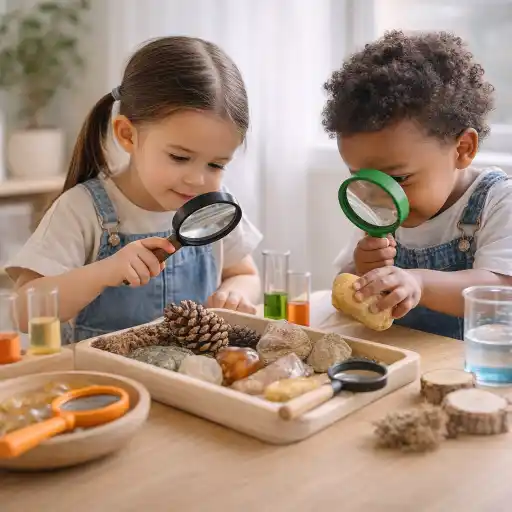
- 🍂 Leaf detectives: Gather a few fallen leaves, compare their colors, shapes, and textures, then sort and count them. Invite children to draw what they observe.
- Pumpkin or apple float test: Have children predict whether a small pumpkin, apple, leaf, or stone will sink or float. Test each object in a supervised water tub and talk about the results.
- Build a harvest boat: Offer foil, paper, or other safe materials and challenge children to make a boat that floats and carries a small load. Test, adjust the design, and try again.
- Paper-table engineering: Fold or roll paper to create a structure that can hold a light object. Compare which shapes feel stable and discuss how the children improved their designs.
- Kitchen science: With appropriate food-safety practices and attention to allergies, explore how cream changes when shaken in a sealed jar, or observe a simple adult-supervised fizzy reaction using baking soda and vinegar.
These experiences combine observation and play with early mathematics: sorting, counting, comparing, estimating, and noticing patterns. Seasonal STEM activity collections also include ideas such as cranberry chemistry, boats, and strength challenges; see November STEM activities and projects for more examples to adapt.
How can educators turn an activity into an inquiry?
A well-supported investigation begins with a question children can explore, not a lecture or a predetermined answer. Before setting out the materials, decide what concept you hope children might notice—such as floating, structure, color, or change—and offer a simple prompt: “Which object do you think will float?” or “How could we make the boat hold more?”
Then leave room for children to lead. Invite a prediction, let them handle the materials, and give them time to test ideas. When a result surprises them, resist the urge to explain immediately. Ask what they saw and what they would like to try next. In this way, children practice the basic rhythm of inquiry: question, predict, explore, observe, and reflect.
For preschoolers, activities work best when they are brief, safe, repeatable, and manageable with a small number of materials. A simple investigation can still be rigorous when children have a meaningful choice and a chance to compare outcomes. ChildCareEd’s guide to STEM for preschoolers: simple experiments describes accessible ways to support this learning through everyday explorations.
Use developmentally appropriate materials and close supervision, especially around water, food, small parts, tools, and reactions. State requirements vary - check your state licensing agency.
What teaching moves deepen curiosity without taking over?
Your most powerful contribution may be a well-timed question and the patience to wait for an answer. Observe first: notice what children choose, how they use the materials, and where they pause. Then use open-ended prompts that extend their thinking without directing them toward a single “right” result.
- “What do you notice about these leaves?”
- “What do you think might happen if we change the shape?”
- “How could we test your idea?”
- “What did you change after the first try?”
- “How could we show what happened?”
Make thinking visible with a quick drawing, a photo, a simple tally, or a short note capturing a child’s words. Documentation does not need to interrupt play; it helps you recall questions worth revisiting and share children’s discoveries with families and colleagues.
Celebrate process as well as outcomes. “You tested two designs” and “You noticed the wider base stayed steady” affirm careful thinking and persistence. Open-ended tinkering and building also help children explore materials, collaborate, and revise their ideas, as described in NAEYC’s Small Hands, Big Ideas: Exploring STEM Through Tinkering, Making, and Engineering.
How can you make seasonal STEM inclusive, safe, and practical?
A welcoming STEM invitation offers multiple ways to participate. One child may make a prediction aloud; another may point, draw, arrange materials, or explain an idea in a home language. Adjust the challenge and tools to each child’s developmental level, motor abilities, sensory preferences, and interests. The goal is shared exploration, not identical participation.
Keep setup manageable. A tray with a few materials, a clear work area, and a planned cleanup routine can make hands-on learning easier for staff and children. For outdoor observations, choose an accessible space and let children look closely at leaves, weather, and other seasonal changes. For indoor projects, use washable surfaces and place materials where adults can supervise closely.
- Check materials before use; remove hazards and avoid small items for children who may put them in their mouths.
- Supervise water, food, tools, and any experiment materials continuously; follow your program’s safety procedures.
- Ask about food allergies and dietary restrictions before food-based activities, and use non-food alternatives when needed.
- Offer choices, visual cues, adapted tools, and different ways to communicate observations.
- Plan for cleanup in advance so that a little mess does not become a reason to avoid exploration.
For a deeper look at setting up meaningful science invitations and nurturing children’s inquiry, explore ChildCareEd’s [Basic Science in Early Childhood](https://www.childcareed.com/courses-basic-science-in-early-childhood-3744.html). Providers working with infants and toddlers may also find [Enhancing STEM Education for Infants and Toddlers](https://www.childcareed.com/courses-enhancing-stem-education-for-infants-and-toddlers-3932.html) relevant to developmentally appropriate exploration.
How can you build on children’s discoveries through the month?
Children’s questions can become the thread connecting several November experiences. If they wonder why some objects float, revisit buoyancy with a boat-building challenge. If they become interested in leaf colors, compare leaves from different places or observe how a leaf changes as it dries. Revisiting an idea helps children recognize patterns and gives them opportunities to extend their thinking.
Keep a small record of what children ask and try. A shared chart might include a question, a prediction, a drawing or photo, and what the group noticed. For young children, a few dictated words or a picture can be enough. Invite families to share seasonal observations from home, while recognizing that traditions, foods, and November experiences differ across families and communities.
As a provider or director, you can support consistency by sharing simple prompts with staff and making a modest collection of reusable materials available. Begin with one investigation, reflect on what engaged the children, and adapt the next invitation based on their interests. If you want more ideas for outdoor observation, [Creating the Natural Outdoor Classroom](https://www.childcareed.com/courses-creating-the-natural-outdoor-classroom.html) explores ways to support children’s learning through nature.
Conclusion: How can November STEM activities support curiosity and discovery?
November STEM does not depend on elaborate supplies or a flawless finished product. Seasonal materials can help children observe, question, predict, build, compare, and try again. Educators make these experiences richer by preparing a safe, inclusive invitation, asking open questions, documenting children’s thinking, and treating unexpected results as useful information.
Start with one approachable activity: sort leaves, test what floats, or build a boat that can carry a small load. Follow the children’s questions, adapt the challenge to their needs, and return to promising ideas over time. When curiosity guides the experience, November becomes a meaningful opportunity for discovery—and children see themselves as capable thinkers and investigators.
- Moving About the Classroom: Effective Transitions for Everyday
- Building Early Science Foundations
- From Play to Planning: Building Culturally Competent, Child-Centered Curriculum
- Tomorrow's Einsteins: Infant and Toddler Science
- 45 Hour Infant and Toddler Methods and Materials
- 45-Hour Infant and Toddler Curriculum
- Creating Engaging and Meaningful Learning Experiences
- Texas Director Credential
- Montessori Cultural Activities: Exploring the World Through Play and Learning
- Enhancing STEM Education for Infants and Toddlers
- CDA Certification en Español: Recursos y Consejos para Educadores Bilingües
- 🎉STEM-sational Fun: How Can You Spark Preschoolers’ Curiosity with Engaging STEM Activities? 🔬🧪🔢
- 🚌🌄 Ideas de excursiones atractivas en Nevada
- 🚌❤️ Ideas de excursiones en Illinois
- Proporciones de Cuidado Infantil y Tamaños de Grupo por Edad en Nueva Jersey (Guía Rápida para Centros y Hogares)
- Proporciones de Cuidado Infantil y Tamaños de Grupo por Edad en Virginia (Guía Rápida para Centros y Hogares)
- Actividades de Otoño Fáciles para Preescolares esta Temporada
- Fun Preschool STEM Activities for Hands-On Learning
- Easy Ways to Add STEM to Your Preschool Classroom
- Calabazas, hojas y manzanas: actividades de otoño para preescolares
- How can child care providers use simple STEM activities with early learners?
- Diversión fresca de verano: actividades del Día Nacional del Helado para niños
- Canciones, juegos y preguntas de círculo para niños
- Cómo simplificar la capacitación para sus empleados de daycare
- How can we explore sand, space, and science with young children in preschool settings?
- How can I use simple STEM activities to spark curiosity in preschoolers?
- STEM for Preschoolers: Fun Activities That Encourage Curiosity
- How Can November STEM Activities Encourage Curiosity and Discovery?
- How Can November Outdoor Activities Help Children Explore and Appreciate Nature?
- How Can November Professional Development Improve Infant and Toddler Teaching Practices?
