What happens when a simple tub of water becomes a laboratory for young investigators? A float-versus-sink sorting activity helps preschoolers practice prediction, observation, classification, language, early mathematics, and problem-solving in one engaging experience. For deeper guidance on planning developmentally appropriate investigations, explore Basic Science in Early Childhood Buy Now $25.00, a two-hour training that can strengthen classroom practice and contribute to professional learning hours.
Providers who want to extend this work beyond one activity may also benefit from Building Early Science Foundations  Buy Now $16.00, which focuses on children’s curiosity, experimentation, and discovery. Or you can use our ready-made resource: Sorting Mat - Sink or Float Buy Now $1.49
Why does float-versus-sink sorting matter in early childhood?
A sink-or-float investigation may look like water play, but it is a purposeful inquiry into observable properties of matter. Children encounter a genuine question, form an idea, test it, and compare the result with their expectation. These experiences position #preschoolers as capable thinkers rather than passive recipients of scientific facts.
Hands-on inquiry also connects several developmental domains. Children strengthen vocabulary as they use words such as float, sink, predict, observe, sort, and material. They practice early mathematics by counting objects, tallying predictions, comparing groups, and using concepts such as more, fewer, same, and different. Handling objects, transferring water, and placing materials carefully in a tub support fine-motor coordination.
The investigation also supports social learning. Children take turns, listen to peers’ explanations, negotiate categories, and discover that classmates may have different predictions. A project-based study of water similarly demonstrates how inquiry can promote teamwork, documentation, communication, and connections across the curriculum (Dixon, Purposeful Learning: A Study of Water).
How does sorting develop scientific thinking?
Sorting gives children a way to organize evidence. Before testing, invite each child to predict whether an object will sink or float and to explain the reasoning: “I think the cork will float because it feels light.” The explanation is more valuable than whether the prediction matches the outcome. When children test the object, they can compare their initial idea with what they observed.
Use a simple two-column chart labeled Sink and Float. Children may place picture cards, object cards, or the actual items in the appropriate group after testing. For children who are ready, add columns for prediction and result. A repeated trial can help children notice whether an observation is consistent, an approach recommended in inquiry investigations of sinking and floating (Gardner, Sink or Float? Inquiry Investigation).
- Prediction: “What do you think will happen?”
- Observation: “What did you notice?”
- Comparison: “Was it the same as your prediction?”
- Classification: “Where should we place this object?”
- Communication: “What makes you think that?”
These steps reflect early scientific practices: asking questions, gathering evidence, interpreting results, and communicating ideas. A child who changes an opinion after testing is not failing; the child is using evidence.
What scientific concepts can preschoolers explore safely?
Preschoolers do not need a formal equation for density. They can begin with the accessible idea that objects behave differently in water and that size, shape, material, and enclosed air may influence what happens. The American Chemical Society describes floating and sinking as observable properties and explains that objects that float are often light for their size, while objects that sink are heavy for their size (Float and Sink).
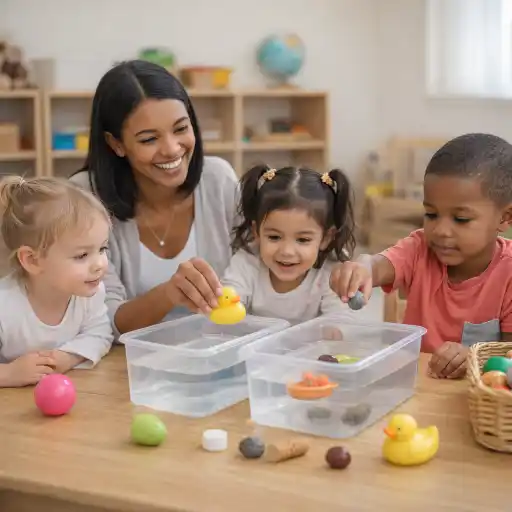 Be careful not to teach an oversimplified rule such as “heavy things sink.” A large wooden block may float, while a small metal paper clip may sink. A sealed, hollow object may float because it contains air. Changing the shape of aluminum foil can also demonstrate that form and displacement matter. These observations give children productive reasons to revise their thinking without requiring abstract terminology.
Useful questions include:
- “What do the floating objects have in common?”
- “Does a bigger object always sink?”
- “What happens if we make the foil into a ball? What if we make a boat?”
- “Can we make this sinker float?”
Use the scientific words naturally, but prioritize children’s explanations and evidence. Introducing a word after children encounter the idea often makes the vocabulary more meaningful.
How can providers design an effective classroom investigation?
Start with a clear question and a manageable collection of waterproof objects. Suitable materials may include a cork, leaf, wooden block, plastic spoon, rubber ball, sponge, stone, metal spoon, and large plastic container. Avoid objects that are sharp, breakable, toxic, or small enough to create a choking hazard. Early Science Matters emphasizes that small parts require particular caution with children age five and younger (Floating Rocks!).
Prepare the environment before inviting children to participate:
- Fill a clear tub only to a safe level and place it on a stable tray.
- Provide towels, smocks, and a nearby hand-washing routine.
- Use picture labels for “sink” and “float” to support emerging readers and dual-language learners.
- Limit the first investigation to four or six objects.
- Position the activity where adults can maintain active supervision.
Model the process with one object. Say, “I predict the sponge will float because it has air spaces. Let’s test it.” Then allow children to take turns. State requirements vary - check your state licensing agency, particularly for supervision, sanitation, water play, and materials.
For children who need additional access, offer larger objects, adaptive grips, visual choice cards, peer partnerships, or the option to point, gesture, draw, or respond in a home language.
How can teachers extend the learning and document progress?
One successful test should become the beginning of further questions. Invite children to search for another object made from a similar material, compare a plastic and metal spoon, or investigate whether a foil boat can carry blocks. A boat-building challenge introduces engineering: children design, test, observe failure or success, and revise their structure. This design-test-redesign cycle strengthens persistence and collaborative problem-solving.
Documentation can remain simple and useful. Create a class chart with the object, prediction, result, and child’s explanation. Photograph children’s hands at work, record exact statements, and invite children to draw one object before and after testing. The documentation can later support family communication, curriculum planning, and assessment.
Look for evidence that a child:
- makes a prediction and offers a reason;
- uses observation vocabulary;
- sorts objects according to test results;
- compares outcomes across objects or trials;
- revises an explanation when new evidence appears.
Rather than scoring correct answers, observe the child’s process. Revisit the activity several days later with unfamiliar objects. The goal is not memorizing which items float; it is developing transferable habits of inquiry. A free seasonal extension, Pumpkin Seed Exploration & Sink or Float Lab Buy Now $0.00, can connect sensory investigation with scientific thinking.
What common mistakes should providers avoid?
Several well-intentioned practices can narrow children’s learning. The first is announcing the answer too quickly. If adults explain density before children have explored, children may repeat a definition without understanding the evidence. Instead, pause, listen, and ask one open question.
A second mistake is treating predictions as right or wrong. A prediction is an idea based on available experience; the investigation provides new information. Use phrases such as “Our result was different from our prediction” or “We found out something new.” This language protects risk-taking and keeps curiosity alive.
Other pitfalls include:
- Too many materials: Begin with a focused set so children can compare meaningfully.
- Changing several variables: When exploring shape, change the shape while keeping the material similar.
- Ignoring children’s definitions: Clarify whether “floating” means resting on the surface, remaining suspended, or moving through water.
- Skipping repetition: Repeat trials and invite children to check whether the result is consistent.
- Forgetting cleanup and safety: Use stable containers, supervise continuously, and sanitize shared materials appropriately.
When children are deeply engaged, wet sleeves and enthusiastic disagreement are often signs of meaningful learning. The provider’s task is to make the environment safe enough for exploration while preserving children’s agency.
Conclusion: What can float-versus-sink sorting teach preschoolers about science?
Float-versus-sink sorting teaches far more than two categories. It gives children repeated practice with prediction, observation, classification, evidence, communication, early mathematics, fine-motor coordination, and collaborative problem-solving. The strongest investigations do not depend on a perfect answer or expensive equipment; they depend on thoughtful questions, accessible materials, careful supervision, and time to test ideas more than once.
For child care providers and directors, the activity is also a practical way to make science visible in everyday curriculum. Begin with a small tub, a few safe objects, and one question. Document a child’s words, revisit the investigation, and let children’s questions guide the next challenge. With consistent support, ordinary water play becomes a powerful foundation for lifelong #science learning.
Additional professional learning can be found through Enhancing STEM Education for Infants and Toddlers Buy Now $16.00, DAP for Preschool Buy Now $24.00, and Lesson Planning for Preschoolers Buy Now $24.00. These courses can help educators connect inquiry, developmentally appropriate practice, and intentional planning.
- 45 Hour Child Growth and Development
- 45 Hour Preschool Methods and Materials
- Power of Art: Bldg Self-Esteem & Positive Behavior for ALL Abilities
- CDA Bridge Bundle: Preschool
- CDA Bridge Bundle: Family Child Care without Portfolio Review
- CDA Bridge Bundle: Infant/Toddler without Portfolio Review
- CDA Bridge Bundle: Preschool without Portfolio Review
- Emergent Learning & Development
- Supporting Families and Caregivers in Language and Literacy
- 🎉STEM-sational Fun: How Can You Spark Preschoolers’ Curiosity with Engaging STEM Activities? 🔬🧪🔢
- Proporciones de Cuidado Infantil y Tamaños de Grupo por Edad en Maryland (Guía Rápida para Centros y Hogares)
- Proporciones de Cuidado Infantil y Tamaños de Grupo por Edad en Virginia (Guía Rápida para Centros y Hogares)
- Easy Ways to Add STEM to Your Preschool Classroom
- Autumn Activities for Toddlers and Preschoolers
- Pumpkin, Leaves, and Apples: Fall Activities for Preschoolers
- How can child care providers use simple STEM activities with early learners?
- Celebrando la amistad en el cuidado infantil durante el Día de los Mejores Amigos
- How can we encourage scientific thinking through hands-on exploration?
- How Can Child Care Programs Use Easy Nature‑Based Activities for Every Season?
- How can simple science experiments transform my preschool classroom?
- How Can Childcare Programs Use Nature-Based Science Activities to Strengthen Learning?
- STEM for Preschoolers: Fun Activities That Encourage Curiosity
- What’s Happening Outside? Fall Science Adventures for Preschoolers
- Go on a Fall Hunt! Outdoor Learning Challenges for Preschoolers
- What Can Float vs. Sink Sorting Teach Preschoolers About Science?
- What Can Hot vs. Cold Sorting Teach Preschoolers About Safety?
- How Can Sink-or-Float Water Play Become a Meaningful Science Investigation for Preschoolers?
- What Questions Keep a Preschool Science Conversation Going?
- How Can You Adapt a Sink-or-Float Investigation for a Mixed-Age Group?
