Introduction
You need quick, clear small group plans that work every day. This guide helps child care providers and directors plan fast, run smooth #smallgroups, and keep children learning. Here are the five words to remember in this article: #smallgroups #preschool #planning #activities #transitions. Why this matters: quick planning saves time, reduces stress, and gives children predictable, powerful learning moments. For simple lesson templates and ideas, see ChildCareEd's lesson plan resources and the short planning tips in How to Create Developmentally Appropriate Lesson Plans.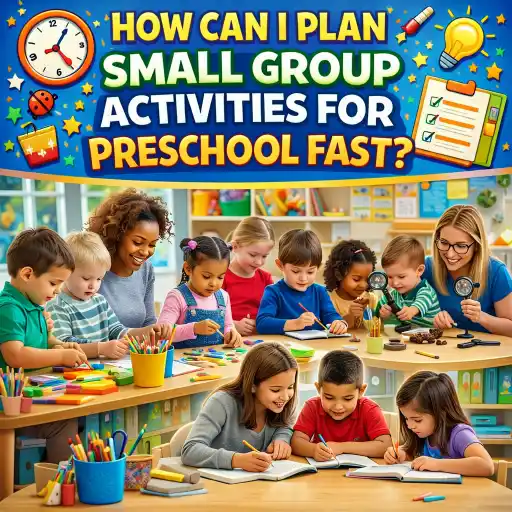
Keep this short checklist with you when you plan: 1) pick one clear goal, 2) choose 2–3 quick activities, 3) set a timer, 4) prep materials in a tub, 5) note one observation. State requirements vary - check your state licensing agency.
How can I plan small groups quickly each day?
Use a repeatable, fast system so planning becomes a 10–15 minute task. Follow these 6 steps:
- Decide the goal (1 skill only). Example: identify beginning sounds or practice taking turns. Keep goals tiny and measurable.
- Pick a format: 1 teacher + 4 children for 10–12 minutes, or 2 adults + 6 children for 15–20 minutes. Small groups should be no more than 4–6 kids for focused practice.
- Choose 2 quick activities: one warm-up (30–60 sec), one main activity (6–8 min), one short wrap-up (1–2 min). This keeps attention and gives practice.
- Prep in a tub. Put all materials, a visual script, and a timer in one container. Teacher timesavers like pre-made cards or activity tubs save setup time; see Teacher Timesavers.
- Use a rotation chart or names-in-frames. Rotate daily so each child visits each center across the week (see how to pull small groups).
- Reflect 1 line: after each group, jot one quick note—what worked, who needs more practice.
Tools that speed planning: simple weekly templates, activity cards, and a tiny resource binder. ChildCareEd has ready resources and templates you can adapt quickly (free lesson plans).
What activities work best for short small-group sessions?
Choose high-engagement, low-setup activities that match your single goal. Here are quick activity ideas you can use today. Each one fits a 10–12 minute group.
- 🎵 Freeze/Move Warm-up (Executive function): 30–60 seconds of move-then-freeze helps focus. Try ideas from executive function games.
- 🧩 Hands-on Main Activity — 6–8 minutes: use manipulatives for the skill (e.g., letter tiles, count & bead, sorting trays). Many teachers keep ready-to-go trays; see play center ideas at Research-and-Play.
- 📚 Mini-Story or Script — 2 minutes: a very short book or puppet script reinforces language goals. Circle time tips help make stories interactive (Circle Time Ideas).
- 🔁 Quick Game — 1–2 minutes: a timer-based turn-taking game or matching game to practice sharing and turns (see small-group games at No Time For Flashcards).
- ✅ Wrap-up with a visual check: thumbs up or a sticker for effort. Praise specifics: “You waited for your turn”—this builds social skills (see sharing & taking turns).
Make variations for mixed abilities: offer easier and harder versions of the main task, or provide a peer buddy. Keep materials open-ended so one tub fits several goals.
How do I organize space, materials, and transitions to save time?
Good organization makes small groups fast and calm. Use clear routines and simple layout choices so children know what to do. Try these practical steps:
- 📦 Prep tubs the night before. Label with picture + short script. Keep one tub per group slot (language, math, play).
- 📍Use fixed spots for groups. If each group has a consistent table or rug area, children move quickly and know where to sit. Rotate the group names on a chart each day or week.
- 🔔Use predictable signals and a timer. A bell, song, or sand timer tells children when to finish. The CSEFEL brief on transitions has many examples of cues and routines (Helping Children Make Transitions).
- 🧭Plan transitions as mini-lessons. Teach and practice the steps (clean-up, line-up, move quietly). ChildCareEd’s course on transitions gives more detail (Moving About the Classroom Buy Now $35.00).
- 🌿Keep centers simple and consistent. A few well-stocked centers beat many scattered ones. See how one teacher manages centers at Research-and-Play.
Quick layout tips: place noisy centers away from small-group tables, use caddies for shared supplies, and post a 3-step clean-up chart. Practice transitions weekly until children do them independently. Remember: state requirements vary - check your state licensing agency.
How do I adapt groups, manage behavior, and measure quick success?
Small groups are great for differentiation and behavior coaching. Use short, consistent strategies to support every child.
- 🎯 Adapt by level in three ways: 1) change materials (big vs. small pieces), 2) shorten turn length, 3) add visual cues (picture steps or timers).
- 🗣️Use scripts and practice them: teach short phrases children can copy (“My turn, your turn,” “Can I play next?”). Role-play during circle time (see guided play tips in Friendship & Sharing).
- 🧘Co-regulate when needed: get on their level, model calm breathing, offer a short reset break and then rejoin the group.
- 📋Measure fast: use one-photo + one-sentence notes after a group. Track 1 target skill per child weekly: ready, needs prompting, or needs more support.
- ⚠️Common mistakes and how to avoid them:
- Overplanning: keep plans tiny and flexible.
- Too many transitions: limit switches; use predictable signals.
- Forcing sharing: teach scripts and timers instead of taking toys away.
When a child repeats a challenge, add a short, repeated practice in a 2–3 minute spot each day. Partner with families: send a one-line home tip (“Try a two-minute turn timer at home”) to keep progress steady. For more strategies on play and development, explore ChildCareEd courses like The Best Promotion is Play Buy Now $35.00.
Conclusion
Fast small-group planning is a skill you build with simple systems: one clear goal, ready tubs, short activities, tidy transitions, and quick notes. Try this 10-minute plan tonight: choose a goal, make one tub, pick a 10-minute schedule, and test it tomorrow. Keep it small, keep it repeating, and celebrate tiny wins. You are building big learning in little chunks — and that matters.
Need templates or quick activity packs? Start with ChildCareEd’s free lesson plans and the small-group game ideas linked above. You’ve got this — your planning can be quick, calm, and powerful.
- 45 Hour Child Growth and Development
- Lesson Planning for Preschoolers
- 45 Hour Preschool Methods and Materials
- Birth to Five CDA Credential with Portfolio Review
- Children at the Wheel: Emergent Curriculum
- 45 Hour School Age Methods and Materials
- CDA Bridge Bundle: Preschool without Portfolio Review
- Texas Director Credential
- Moving About the Classroom: Effective Transitions for Everyday
- How can I plan small group activities for preschool fast?
- How can I make simple lesson plans for toddlers and preschoolers?
- Cómo Celebrar el Día Nacional del Kindergarten
- Lista para Guardería en Casa en Texas: Cómo Iniciar una Guardería en el Hogar
- How can we better engage children in group activities?
- A Simple Guide to Toddler and Preschool Lesson Plans
- How Can Early Childhood Classrooms Celebrate Diversity and Inclusion?
- Calabazas, hojas y manzanas: actividades de otoño para preescolares
- How can we help children reach new heights—from the Space Needle to the preschool classroom?
- Canciones, juegos y preguntas de círculo para niños
- Can a World Cup theme on the DC circle time rug teach teamwork, turn-taking, and big feelings?
- Cómo simplificar la capacitación para sus empleados de daycare
- Classroom Resources to Help Child Care Teachers Save Time
- What school-age group activities work best in daycare centers?
- How can preschool classrooms effectively support early math skills?
- School-Age Program Ideas: Games, Projects, and Group Activities
- Preschool Team-Building Activities for Better Communication and Friendship
- Get to Know You Activities for Preschool: 12 Easy First-Week Ideas
- Kindergarten Songs for Circle Time: 15 Sing-and-Move Ideas That Sneak in Learning
- How Can You Review an AI-Generated Preschool Lesson Plan?
