Young children already investigate the world by noticing, wondering, testing, and revising their ideas. You can make those natural habits more visible with simple language, playful investigations, and the Building Early Science Foundations  Buy Now $16.00 course, which helps providers strengthen developmentally appropriate exploration and experimentation while earning a certificate after completing the course requirements.
For an immediately usable recording tool, pair your investigation with the Think Like a Scientist: Observation & Experiment Recording Sheet Buy Now $0.99. It gives children a concrete way to express an “If…then…because” hypothesis, record observations, identify variables, and draw a conclusion.
Why do hypotheses, observations, and conclusions matter in early childhood?
Introducing these concepts does not mean asking preschoolers to memorize formal scientific vocabulary or reproduce a laboratory report. It means helping them develop a disciplined way to think: notice something carefully, make a tentative prediction, gather evidence, and explain what the evidence suggests. Head Start identifies observing phenomena, engaging in scientific talk, asking questions, making predictions, conducting investigations, analyzing results, and communicating conclusions as important early science goals.
This process also strengthens language, early mathematics, executive function, and collaboration. When children describe a texture, compare the distance a car travels, or explain why a tower fell, they are connecting experience with representation and reasoning. Karen Worth likewise describes early science as a meaningful context for curiosity, language, problem-solving, cooperation, and mathematical understanding.
The goal is not a “correct” answer at the beginning. A hypothesis is a reasonable idea based on what a child currently knows. A conclusion is an evidence-based explanation after testing. Children therefore learn that changing one’s thinking is not failure; it is a productive part of #inquiry.
How can teachers explain the three ideas in child-friendly language?
Use consistent words, gestures, and sentence stems. Introduce one term at a time and immediately connect it to something children can see or touch.
- Observation: “What do you notice?” Explain that an observation is information gathered with our senses or tools. “The rock feels rough” is an observation.
- Hypothesis: “What do you think will happen?” A hypothesis is a testable idea or prediction. “I think the rock will sink because it is heavy” is a hypothesis.
- Conclusion: “What did we find out?” A conclusion connects the result to the original idea. “The rock sank, so our prediction matched what happened” is a conclusion.
Model the difference between observation and interpretation. “The water is cloudy” is an observation; “Someone put sand in it” is an explanation that still needs evidence. This distinction builds precision without discouraging children’s thinking.
Offer multiple ways to participate. Children may speak, gesture, draw, point to a picture, dictate to an adult, use a home language, or photograph the investigation. Representation is especially valuable for children who are still developing expressive language or who communicate differently.
How can a simple experiment make the scientific process understandable?
Choose a familiar phenomenon with a clear question and safe, accessible materials. A sink-or-float investigation works well because children can handle objects, make predictions, test them, sort results, and revisit their reasoning.
- Ask a question: “Which objects will float in water?”
- Invite hypotheses: “What do you think will happen? Why?” Record children’s words without correcting them.
- Observe and test: Let children examine each object, place it in the water, and watch carefully.
- Record evidence: Use drawings, photographs, a two-column chart, tally marks, or the recording sheet.
- Develop a conclusion: Ask, “What happened? Which predictions matched? What surprised you?”
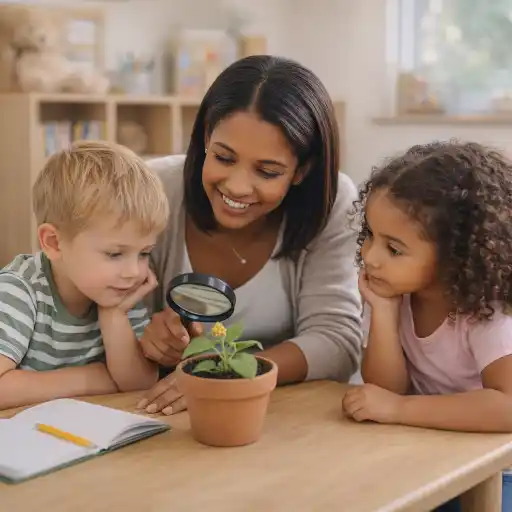
Keep the investigation focused by changing one variable at a time. For example, children might compare two objects, then later design a foil boat that carries counting bears. Resist explaining density immediately; first let children encounter the pattern through repeated testing and conversation.
Other effective investigations include ramp races, color mixing, seed growth, shadows, melting ice, and water flow. The materials can remain simple. A cardboard ramp, clear cups, leaves, blocks, magnifiers, and recycled containers can generate substantial scientific thinking when teachers provide time and thoughtful prompts.
What teacher language supports thinking without taking over?
The educator’s role is to make children’s thinking visible while preserving their agency. Observe before intervening, then use prompts that invite evidence rather than suggest an answer. A useful sequence is notice, predict, test, explain, extend.
- 🔎 Notice: “What do you see, hear, feel, or notice changing?”
- Predict: “What might happen next?”
- Test: “How could we find out?”
- Explain: “What makes you think that?”
- Extend: “What could we change and test again?”
Allow wait time. Children often need several seconds to organize an answer, especially when they are working in a second language or using a new concept. Repeat or rephrase a child’s idea, then add precise vocabulary: “You noticed the car moved farther on the smooth surface. Farther describes the distance.”
Avoid turning every exchange into a quiz. Too many rapid questions can make exploration feel like an evaluation. Sometimes a descriptive comment is more productive: “You placed the large block underneath the small block, and now the tower is standing.” This invites children to continue investigating.
When results contradict a hypothesis, respond with curiosity: “Our test gave us a different result. What should we try next?” That response communicates that evidence matters more than pleasing the adult.
How can documentation turn children’s experiences into learning?
Documentation should capture the process, not merely the final product. A quick photograph, child quote, drawing, or teacher note can show how a child reasoned. The Think Like a Scientist recording sheet is particularly useful when children are ready to organize an investigation into a hypothesis, observations, variables, and conclusion. For younger children, adapt it with icons, dictated language, stickers, or a shared class chart.
Use a brief documentation routine:
- Record the child’s original hypothesis in their own words.
- Capture one or two specific sensory or measurable observations.
- Note what variable changed and what stayed the same.
- Invite the child to draw, dictate, or explain the result.
- Revisit the documentation later and ask whether the child’s thinking has changed.
Documentation also supports responsive planning. NAEYC emphasizes that observation and assessment should be ongoing, purposeful, developmentally responsive, and used to guide curriculum. A child who repeatedly notices movement may benefit from ramps, tubes, wheels, and measurement tools. A child who prefers drawing may demonstrate understanding more fully through diagrams than through conversation.
Directors can support consistency by creating a shared inquiry template, scheduling short staff reflection meetings, and displaying children’s work at their eye level. Families can receive a photo and a prompt such as, “Ask your child what they thought would happen and what they discovered.”
How can providers avoid common mistakes and include every child?
Several well-intentioned practices can unintentionally limit inquiry. The most common is providing the answer too quickly. Instead, acknowledge uncertainty and help children identify a way to gather evidence. Another mistake is treating only accurate predictions as successful. Praise careful noticing, persistence, revision, and explanation.
- Too much adult direction: Prepare the environment, ask one focused question, and step back.
- Too many variables: Change one feature at a time so children can compare results.
- Only verbal recording: Accept drawings, gestures, photos, home-language responses, and dictation.
- One-time activities: Repeat the investigation with a small change and compare outcomes.
- Unclear safety routines: Use age-appropriate materials, active supervision, trays, handwashing, and clear rules about tasting. State requirements vary - check your state licensing agency.
Inclusion begins with access. Place tools where children can reach them, provide adapted grips or larger materials when needed, and offer partners without requiring one child to speak for another. Dual-language learners can use picture cards, gestures, translated vocabulary, and family contributions. Children with sensory differences may need choices about touching, smelling, noise, or proximity.
For professional development, providers may also explore Basic Science in Early Childhood Buy Now $25.00, which focuses on intentional planning, meaningful materials, experimentation, and scientific reasoning; Tomorrow’s Einsteins: Infant and Toddler Science Buy Now $16.00, which addresses scientific curiosity in the earliest years; and Enhancing STEM Education for Infants and Toddlers Buy Now $16.00, which connects cognitive development with STEM exploration.
Conclusion: How can you begin tomorrow?
Start with one familiar question, such as “Which object will move fastest?” Invite every child to share a hypothesis in a personally meaningful way. Give children time to observe and test, document a small amount of evidence, and close by asking what the results suggest. This predictable cycle teaches that science is not a collection of facts delivered by adults; it is a way of making sense of experience.
Remember the central sequence: a hypothesis is an idea to test, an observation is evidence gathered through attention and tools, and a conclusion is an explanation based on what happened. When providers consistently model this process, children become more confident questioners, careful listeners, persistent problem-solvers, and thoughtful communicators. With a simple recording tool and continued professional learning, your classroom can make scientific thinking visible every day.
- 45 Hour Child Growth and Development
- CDA Bridge Bundle: Preschool
- CDA Bridge Bundle: Family Child Care
- CDA Bridge Bundle: Family Child Care without Portfolio Review
- CDA Bridge Bundle: Infant/Toddler without Portfolio Review
- CDA Bridge Bundle: Preschool without Portfolio Review
- CDA Bridge Bundle: Infant/Toddler
- Sensitive Periods in Montessori: Guiding Natural Learning
- Texas Director Credential
- CDA Certification en Español: Recursos y Consejos para Educadores Bilingües
- Capacitación en Salud y Seguridad Preventiva en Línea para Proveedores de Cuidado Infantil
- Regulaciones de Cuidado Infantil en Maryland para Centros y Hogares de Cuidado Infantil Familiar
- Regulaciones de Licenciamiento de Cuidado Infantil en California para Centros y Hogares de Cuidado Infantil Familiar
- Proporciones de Cuidado Infantil y Tamaños de Grupo por Edad en Maryland (Guía Rápida para Centros y Hogares)
- Proporciones de Cuidado Infantil y Tamaños de Grupo por Edad en Nueva Jersey (Guía Rápida para Centros y Hogares)
- Proporciones de Cuidado Infantil y Tamaños de Grupo por Edad en Virginia (Guía Rápida para Centros y Hogares)
- Lista para Guardería en Casa en Texas: Cómo Iniciar una Guardería en el Hogar
- Apoyo en Preescolar para Retrasos del Habla: Estrategias Simples que Ayudan
- Cómo Trabajar en el Cuidado Infantil en Wisconsin: Requisitos y Pasos
- Capacitación Previa al Servicio para Proveedores de Cuidado Infantil en Georgia
- Canciones, juegos y preguntas de círculo para niños
- Cómo simplificar la capacitación para sus empleados de daycare
- How Can Child Care Providers Use Emergent Curriculum to Make Children’s Thinking Visible?
- How Can Educators Use Emergent Curriculum and Project-Based Learning Effectively?
- How Can Child Care Providers Introduce Hypotheses, Observations, and Conclusions to Children?
- What Happens Before Biting—and How Can Child Care Teams Find the Pattern?
- How Can Child Care Providers Question Their First Interpretation of a Child’s Behavior?
- How Can Child Care Providers Document Challenging Behavior Effectively?
- What Can Preschool Teachers Learn from a Child’s Play Preferences?
