What if your next engaging STEM experience is already in the recycling bin? With a few safe household items, intentional questions, and time for children to test ideas, you can create meaningful learning without purchasing expensive kits. For a deeper, classroom-ready approach, explore Beautiful Junk: Using Recycled Materials in the Classroom  Buy Now $16.00, an online training that helps providers transform everyday recyclables into learning tools while earning applicable professional development hours.
Why do everyday materials matter for early STEM learning?
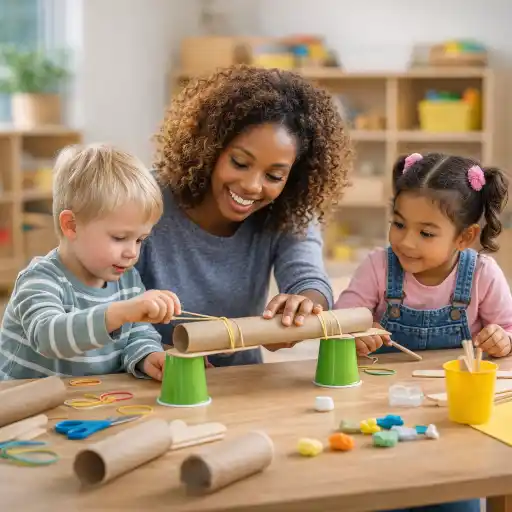
Low-cost STEM is not a lesser version of “real” STEM. Cardboard, containers, paper, caps, fabric, and natural loose parts offer something commercial kits often cannot: ambiguity. A cardboard tube can become a tunnel, wheel, telescope, or structural support. Because the material does not dictate one outcome, children must imagine possibilities, make decisions, test designs, and revise their thinking.
These experiences support the habits associated with scientific and engineering practice. Children observe properties, make predictions, compare results, communicate explanations, and persist through unexpected outcomes. The NAEYC resource Small Hands, Big Ideas: Exploring STEM Through Tinkering, Making, and Engineering emphasizes that young children develop scientific and engineering dispositions when they take things apart, combine materials, solve problems, and improve creations.
Recycled materials also promote equity. Programs can offer repeated opportunities to experiment without making families or teachers purchase specialized supplies. The process connects classroom learning to children’s daily lives and creates natural conversations about sustainability, reuse, and responsible resource choices.
- Children practice #problemSolving and flexible thinking.
- Teachers can repeat investigations and vary one condition at a time.
- Programs reduce material costs while expanding opportunities for #exploration.
- Children develop vocabulary through explaining plans, evidence, and results.
Which items should providers collect and how should they prepare them?
Begin with a manageable collection rather than saving everything. Choose materials that are clean, dry, versatile, and easy for children to manipulate. Invite families and local businesses to donate appropriate items, but give clear guidelines so staff do not spend excessive time sorting unsafe or unsuitable materials.
- Cardboard boxes, cereal boxes, paperboard, and paper towel tubes
- Scrap paper, magazines, envelopes, and paper bags
- Clean plastic containers, yogurt cups, lids, and large bottle caps
- String, yarn, fabric scraps, rubber bands, and craft sticks
- Natural loose parts such as smooth stones, leaves, pinecones, and sturdy sticks
- Tools such as rulers, measuring cups, child-safe scissors, tape, and non-toxic glue
Inspect every item before use. Remove sharp edges, staples, residue, mold, broken pieces, and anything that previously held chemicals. Small objects may create choking hazards, particularly for infants and toddlers. Clean non-porous materials according to your program’s procedures, launder washable fabrics, and discard items that cannot be sanitized appropriately. State requirements vary - check your state licensing agency.
Store materials in shallow, labeled bins or trays. Picture labels support independence and help children return items to their “homes.” A small rotating collection is usually more productive than an overflowing shelf. Keeping a “works in progress” area also allows children to revisit and improve designs across several days.
What low-cost STEM challenges can children begin this week?
The strongest challenges are simple, open-ended, and testable. Present a problem rather than a model to copy. Offer three to six materials, introduce one question, and allow children to decide how to proceed.
- 🏗️ Paper tower: Using scrap paper and tape, can children build the tallest tower that stands independently? Invite them to compare wide bases, rolled paper, folds, and supports.
- Recycled bridge: Can cardboard, tubes, or craft sticks create a bridge for a toy car? Children can vary the span, number of supports, or material arrangement.
- Ramp investigation: Use cardboard, books, toy cars, and different surface coverings. Ask how height, length, or texture changes movement.
- Container boat: Provide foil, plastic containers, corks, and tape. Ask children to design a vessel that floats and holds a small number of counters.
- Wind-powered object: Offer paper, cardboard, straws, and fabric. Children can design something that moves when they blow or when placed near a fan.
- Sound makers: Use containers, rubber bands, cardboard, and paper. Encourage children to compare vibrations, volume, and pitch without requiring a finished instrument.
Challenge cards can make these invitations easier to use during centers or small groups. A card might state the problem, list available materials, and provide reflection prompts such as “What did you notice?” and “What could you change?” The goal is not to complete a worksheet; it is to make children’s thinking visible through action and conversation.
How can teachers guide inquiry without taking over?
Providers often feel pressure to make an activity successful. Yet children learn most when they own the problem. Your role is to create conditions for productive exploration, observe carefully, and offer just enough support to extend thinking.
- Observe first. Notice what children try, how they select materials, and where they encounter difficulty.
- Ask one open question. Try “What do you notice?” “What are you testing?” or “How might you make it stronger?”
- Encourage prediction. Invite children to explain what they think will happen before testing.
- Support iteration. Use language such as, “That result gives us information. What could we change?”
- Document evidence. Take a photograph, record a child’s words, create a tally, or invite a quick drawing.
Avoid correcting designs too quickly or praising only a successful outcome. A collapsed tower may reveal an important discovery about balance. A boat that sinks gives children a reason to reconsider shape, weight, or material. Strengths-based language—“You kept testing,” “You noticed a pattern,” or “You found a new possibility”—builds confidence and #persistence.
Introduce vocabulary naturally: stable, flexible, rigid, heavier, lighter, balance, connect, measure, float, sink, faster, slower, and redesign. For dual language learners, use gestures, photographs, home-language labels, and opportunities to explain ideas in the language most comfortable for them.
How can activities be inclusive, safe, and developmentally appropriate?
One challenge can support many levels of participation when teachers plan multiple entry points. A younger child may select materials or test whether a structure stands. An older or more experienced child may compare measurements, record trials, or add a design constraint.
- Offer larger materials, adapted grips, nonslip mats, or pre-cut pieces when needed.
- Use visual sequences showing: problem, plan, build, test, and improve.
- Provide choices of roles, including builder, tester, materials manager, recorder, photographer, and narrator.
- Accept demonstrations, drawings, oral explanations, dictated language, and home-language responses as documentation.
- Create a quieter work area for children who are sensitive to noise, clutter, or messy textures.
- For infants and toddlers, use only large, washable objects and focus on supervised sensory exploration, posting, filling, dumping, and cause-and-effect experiences.
Active supervision is essential during open-ended work. Position adults so all children and materials remain visible, scan continuously, listen for changes, and interact rather than supervising from a fixed location. Keep tools age-appropriate and provide direct support for scissors, hole punches, or any construction materials that require additional care.
Directors can strengthen implementation by creating a shared safety checklist, scheduling a weekly materials inspection, and reserving brief staff-meeting time for reviewing documentation. The course Enhancing STEM Education for Infants and Toddlers Buy Now $16.00 is another relevant option for providers who want strategies tailored to the youngest learners.
How can providers avoid common mistakes and sustain the approach?
Low-cost STEM is most effective when it becomes a consistent routine rather than an occasional special event. Begin with one invitation each week, then repeat it with a small change. Repetition allows children to deepen concepts and gives teachers better evidence of growth.
- Too many materials: Start with a limited selection and add items in response to children’s questions.
- Over-directing: Demonstrate safety, then step back. Offer prompts instead of a prescribed product.
- Focusing on appearance: Evaluate children’s reasoning, testing, communication, and revision—not whether the creation looks polished.
- Avoiding mess: Use trays, smocks, washable surfaces, and predictable cleanup roles rather than eliminating valuable investigations.
- Skipping documentation: Use a quick photo-and-quote method to make learning visible and plan the next challenge.
Challenge cards can support consistency across classrooms. A useful card includes the question, safe materials, a simple constraint, vocabulary, and one reflection prompt. Directors may keep cards in a shared digital folder or binder, organized by age group and concept.
For curriculum alignment, connect each challenge to observable goals: sorting and comparing, measuring, describing properties, cooperating, using tools, predicting, or revising. This makes the learning defensible without reducing playful inquiry to a checklist. The course Curriculum Planning Buy Now $35.00 can help providers connect developmentally appropriate activities with intentional lesson planning.
Conclusion: How can everyday items become meaningful STEM learning?
Low-cost STEM activities succeed when providers combine accessible materials with thoughtful design. Collect and inspect a small range of recyclables, present one open-ended problem, supervise actively, and give children time to test and revise. A paper tower, cardboard ramp, recycled boat, or container sound maker can support science, engineering, math, language, creativity, collaboration, and confidence.
The central question is not whether your program owns expensive equipment. It is whether children have opportunities to wonder, make predictions, build, observe evidence, and try again. Use Beautiful Junk: Using Recycled Materials in the Classroom Buy Now $16.00 to deepen your understanding of recycled-material learning, and consider Basic Science in Early Childhood Buy Now $25.00 for additional strategies that strengthen scientific reasoning through intentional classroom experiences.
Start tomorrow with three materials and one question: “What can you make, and how will you know if it works?” Small invitations, repeated thoughtfully, can lead to remarkably big learning.
Recommended ChildCareEd courses
- Beautiful Junk: Using Recycled Materials in the Classroom Buy Now $16.00
- Basic Science in Early Childhood Buy Now $25.00
- Enhancing STEM Education for Infants and Toddlers Buy Now $16.00
- Curriculum Planning Buy Now $35.00
- CDA: Curriculum Alignment & Materials Buy Now $16.00
References
- 45 Hours Director-Administration ONLINE
- CDA Bridge Bundle: Preschool
- CDA Bridge Bundle: Family Child Care
- CDA Bridge Bundle: Family Child Care without Portfolio Review
- CDA Bridge Bundle: Infant/Toddler without Portfolio Review
- CDA Bridge Bundle: Preschool without Portfolio Review
- CDA Bridge Bundle: Infant/Toddler
- Texas Director Credential
- Enhancing STEM Education for Infants and Toddlers
- Strategies for Finding Budget-Friendly Deals, Discounts, and Promotions on Back to School Supplies
- Counting Candy Canes: The STEM of Holiday Fun for Early Learners
- CDA Certification en Español: Recursos y Consejos para Educadores Bilingües
- 🎉STEM-sational Fun: How Can You Spark Preschoolers’ Curiosity with Engaging STEM Activities? 🔬🧪🔢
- Cómo Empezar una Guardería en Casa: Requisitos y Pasos
- Proporciones de Cuidado Infantil y Tamaños de Grupo por Edad en Maryland (Guía Rápida para Centros y Hogares)
- Proporciones de Cuidado Infantil y Tamaños de Grupo por Edad en Virginia (Guía Rápida para Centros y Hogares)
- Lista para Guardería en Casa en Illinois: Cómo Iniciar una Guardería en el Hogar
- Fun Preschool STEM Activities for Hands-On Learning
- How can I use STEM activities in my Preschool and Pre-K classroom?
- Can Toddlers Do STEM in the Sandbox at Minnesota Daycares?
- What are easy STEM activities I can do with preschoolers?
- How can child care providers use simple STEM activities with early learners?
- Canciones, juegos y preguntas de círculo para niños
- How can preschool teachers use simple STEM activities to spark big learning?
- STEM for Preschoolers: Fun Activities That Encourage Curiosity
- How Can Recycled Materials Create Engaging Learning Centers?
- How Can Child Care Providers Create Low-Cost STEM Activities With Items They Already Have?
- How Can Child Care Leaders Decide Which Classroom Supply Requests Need an Answer First?
