Young children don’t need specialized labs to begin learning science, technology, engineering, and math. Everyday play materials—blocks, water, kitchen tools, and the outdoors—are rich learning environments. This article gives practical, research-informed strategies you can use tomorrow in your program to turn routine play into intentional #STEM learning while honoring children’s curiosity and agency. Expect numbered steps, quick teacher moves, safety reminders, and links to useful resources from ChildCareEd and trusted partners.
1) How do blocks teach engineering, spatial reasoning and math?
Blocks are classic open-ended materials that invite design thinking, testing, and iteration. Use them to scaffold engineering and early math through 1) building challenges, 2) measurement and counting, and 3) pattern and symmetry investigations.
- 🔧 Choose a clear challenge (e.g., build a bridge to hold a toy car for 10 seconds). Keep constraints small so children can plan and test quickly. See similar block STEM prompts at Fun Preschool STEM Activities and a roll-and-build idea at STEM Projects with Blocks.
- 📏 Add math: count blocks, measure heights with nonstandard units (paperclips, hands), compare results, and graph outcomes.
- 🧪 Encourage iteration: ask “What if we change the base?” and let children rebuild. Use documentation (photo + child quote) to make thinking visible (Easy Ways to Add STEM).
Why it matters: block play builds spatial language, persistence, and early engineering habits of mind—predict, test, adjust.
2) What learning lives in water play and simple experiments?
#Water play merges sensory joy with scientific inquiry. Use tubs, measured scoops, droppers, and objects for sink/float testing, volume comparisons, and color-mixing investigations.
- 🌊 Start with a focused question: “Which object will float?” Record predictions, test, sort, and discuss results. ChildCareEd’s sink-or-float and water-drop activities offer tested invitations (Fun and Easy STEM Activities, Water Drop STEM Activity).
- 🧪 Try 1–2-step experiments: color mixing with droppers, filling circles with drops to count capacity (fine motor + #measurement).
- ⚠️ Safety first: supervise at arm’s length, limit water depth, use trays, and post visual rules. For curriculum and safety guidance, see water play lists and water-safety resources like the Red Cross materials (Water Safety for Kids).
Practical tip: rotate one question each week and document children’s ideas—this builds a classroom culture of inquiry.
3) How does cooking become accessible science, math and technology?
Cooking is a natural STEM lab: measuring (math), observing chemical changes (science), sequencing (technology concept of algorithms), and engineering (adjusting a recipe). You don’t need full meals—short, supervised food-prep invitations work well.
- 🍽️ Plan 3 teacher moves: (1) safety and clear roles, (2) ask an open question (“What will happen if we add more liquid?”), (3) document with photos and child comments. See classroom cooking guidance at Cooking in the Classroom and curriculum ideas from The Creative Kitchen.
- 🔢 Use math moments: count spoons, compare volumes, halve/double simple recipes. Use pictorial recipes for non-readers (Cooking With Preschoolers).
- 🧪 Explore science: watch batter rise, note temperature effects, or test dissolving (sugar/salt). Emphasize process and language—predict, observe, explain.
Family connection: send a one-step extension families can try at home to strengthen partnerships. stat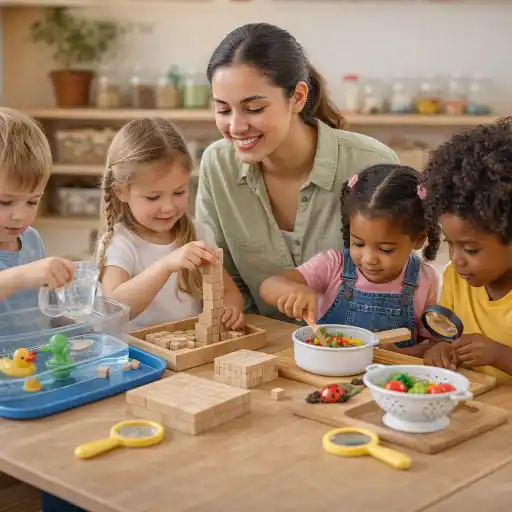 e requirements vary - check your state licensing agency.
4) What makes outdoor exploration a powerful STEM classroom?
Outdoor environments invite large-scale engineering, ecology study, measurement, and technology-as-tools (simple pulleys, shovels, magnifiers). Nature supplies open-ended “loose parts” for creative problem-solving and scientific observation. You can also adapt outdoor investigations into seasonal, theme-based invitations — for example, spooky, hands-on Halloween science activities that build inquiry and observation skills.
- 🌳 Outdoor prompts to try: (1) rock balancing challenges to test stability, (2) leaf chromatography to investigate pigments, (3) shadow/scaled mapping to explore light and measurement. See outdoor STEM ideas at No Time For Flashcards and forest science resources (Forest Science Activities). For easy-to-run, outdoor shadow invitations—shadow puppets, tracing and measuring shadows at different times of day, and simple light experiments—see Activities with Shadows.
- 🔁 Use loose-parts rotations: sticks, stones, pinecones, bottle caps—limit choices to 4–6 items to support deeper exploration (Easy STEM Ideas).
- 🧭 Integrate measurement and math: count seed pods, measure stick lengths with stones, and graph findings.
Why it matters: outdoor STEM supports gross-motor experimentation, sustained attention, and ecological literacy.
5) How do I implement safe, low‑prep STEM invitations and avoid common pitfalls?
Practical implementation matters for busy providers. Use simple setups, clear adult roles, and equitable access to materials.
- 🧺 Set up in 5 steps:
- Prepare 3–6 materials per table (keeps focus).
- Use trays and labeled bins for quick resets.
- Post short visual rules and model one teacher prompt.
- Document one photo and one child quote per invitation.
- Rotate weekly to renew interest.
- ❗ Common mistakes & quick fixes:
- Too much adult direction — Step back and ask one open question.
- Overwhelming materials — Limit choices to 3–6 items.
- No documentation — One photo + one sentence makes learning visible.
- 🔎 FAQ (quick):
- Q: How long should invitations last? A: 10–20 minutes for focused invites; extended projects can span days.
- Q: Need special kits? A: No—everyday materials are powerful (see Easy Ways to Add STEM).
- Q: How to include DLLs? A: Use gestures, visual labels, and accept responses in home languages.
Safety & policy reminder: always check materials for choking hazards, supervise water and cooking activities closely, and note that state requirements vary - check your state licensing agency.
Conclusion
Blocks, water play, cooking, and outdoor exploration are not extras — they are essential pathways to early #STEM learning. Use numbered invitations, short teacher moves, simple documentation, and rotating loose parts to create a classroom culture of inquiry. For ready-made activity ideas, teacher prompts, and printable invitations, explore ChildCareEd’s practical resources like What Are Fun and Easy STEM Activities, Fun Preschool STEM Activities, and the Cooking in the Classroom guide.
Quick next steps (doable tomorrow): 1) Pick one area (blocks, water, cooking or outside). 2) Prepare 3–5 materials in a tray. 3) Ask one open question, document one photo, and celebrate curiosity. You are building lifelong thinkers through everyday #play.
- CDA Home Visitor Subject Area 3 Part 3 Birth to 5
- CDA Home Visitor Subject Area 2 Part 3 Birth to 5
- 45 Hour Preschool Methods and Materials
- Birth to Five CDA Credential with Portfolio Review
- Emergent Learning & Development
- 45-Hour Infant and Toddler Curriculum
- Texas Director Credential
- Enhancing STEM Education for Infants and Toddlers
- CDA Infants/Toddlers: Smart Nutrition & Feeding
- Family Child Care: Building, Premises, and Outdoor Safety
- 🔍 ¿Qué ves cuando observas a un niño aprender?
- ❄️ ¿Qué actividades al aire libre funcionan bien para los niños de Illinois en cada estación? 🌷🍂
- ¿Cuáles son las mejores actividades del Día de la Tierra para niños en casa o en el aula?
- 10 Ejemplos de Cómo la Cultura Influye en el Desarrollo Infantil
- Proporciones de Cuidado Infantil y Tamaños de Grupo por Edad en Virginia (Guía Rápida para Centros y Hogares)
- Actividades de Otoño Fáciles para Preescolares esta Temporada
- Consejos de Supervisión Activa para Salones de Preescolar y el Juego al Aire Libre
- Easy Ways to Add STEM to Your Preschool Classroom
- How Can We Teach Preschoolers Through Play?
- Canciones, juegos y preguntas de círculo para niños
- Summer Preschool Activities for Art, Science, and Sensory Play
- How Can Child Care Providers Encourage Preschoolers’ Growing Curiosity?
- How can we explore sand, space, and science with young children in preschool settings?
- Why Does Old‑School Play (Blocks, Mud, Cardboard) Still Win?
- How can blocks, water play, cooking, and outdoor exploration introduce STEM to young children?
- STEM for Preschoolers: Fun Activities That Encourage Curiosity
- Crunch, Stomp, Scoop! Fall Activities Toddlers Can’t Resist
- Social Studies Activities for Toddlers: Start With Home, Helpers, and Their Little World
- How Can STEM Activities Turn Everyday Preschool Play Into Powerful Learning?
- How Do Light vs. Heavy Activities Build Early Measurement Skills?
