How can a simple hot-and-cold sorting activity build both scientific thinking and safer decision-making? With carefully chosen visuals, calm language, and intentional supervision, educators can help children develop temperature vocabulary without asking them to touch hazards. For deeper guidance on inquiry-based science experiences, explore Basic Science in Early Childhood Buy Now $25.00, a two-hour training that supports meaningful investigation and scientific reasoning in the classroom. Educators can also use the Sorting Mat - Hot or Cold Buy Now $1.49 to give children a hands-on way to classify familiar objects, strengthen descriptive language, and practice making safe, thoughtful observations.Why does temperature learning matter in preschool?
Temperature is part of children’s everyday experience: soup cools at lunch, ice melts at the sensory table, water runs from the faucet, and playground surfaces warm in the sun. Preschoolers are curious about these changes, but their developing judgment and impulse control mean that curiosity must be paired with clear boundaries. Sorting activities offer a concrete, developmentally appropriate way to connect observation, vocabulary, and safety routines.
The goal is not to teach children that everything warm is dangerous or that everything cold is harmless. Instead, children can learn that temperature provides information. Something may feel comfortable, uncomfortable, or unknown—and an unknown temperature is a reason to pause and ask an adult.
- Build #vocabulary such as hot, warm, cool, cold, melt, freeze, steam, and burn.
- Strengthen observation as children compare pictures, objects, and experiences.
- Practice #decisionmaking: stop, move away, and ask a trusted adult.
- Connect playful science to injury prevention and daily routines.
Children’s thinner skin can be injured quickly by hot liquids, steam, and heated surfaces. Therefore, instruction must never replace environmental prevention, active supervision, or adult responsibility. State requirements vary - check your state licensing agency.
How does sorting support scientific and safety reasoning?
Sorting is an early form of classification. When a child places a picture of cocoa under “warm” or an ice cube under “cold,” the child is using memory, language, visual information, and prior experience. The educator can extend the thinking with questions such as, “What makes you think it is hot?” or “How could we find out without touching it?”
Use familiar examples: soup, a fireplace, the sun, snow, a refrigerator, a popsicle, warm bathwater, and a sunny slide. Children should also learn that categories describe common conditions, not permanent facts. A refrigerator’s inside is cold, but its outside may not be. A playground slide may be comfortable in the morning and dangerously hot later in the day.
Open-ended prompts are more valuable than rapid correction:
- “What do you notice?”
- “What could happen if we touched it?”
- “Who can help us check?”
- “What should our bodies do when we hear ‘hot’?”
- “Is cold always safe to touch for a long time?”
These questions move children beyond memorizing two columns. They begin to consider evidence, context, uncertainty, and the safest next action. The teacher’s role is to scaffold reasoning while keeping the activity emotionally reassuring.
How can providers conduct the activity without creating risk?
Begin with photographs, laminated cards, and objects that are safe at room temperature. Never ask children to test an unknown material with their skin, and do not use steaming liquids, heated cookware, dry ice, or frozen objects as hands-on demonstrations. If sensory exploration is included, adults should prepare and check comfortably warm water or room-temperature materials before children participate.
Establish a short routine before sorting: “Eyes observe, words describe, hands stay safe, and adults handle hazards.” Repeat the routine across classrooms and transitions. A useful safety cue is: “Hot means stop; cold means check; unknown means ask.” This language is memorable without relying on frightening stories.
- 🧤 Use large cards, sturdy mats, and easy-grip tools for children with motor differences.
- Offer pointing, gestures, drawing, or dictation for children who are developing language.
- Provide picture symbols and home-language vocabulary when appropriate.
- Keep small pieces away from children who mouth materials.
- Offer observation-only roles for children with tactile sensitivities.
Adults remain responsible for checking food, water, equipment, surfaces, and materials. Sorting can build awareness, but preschoolers should not be expected to independently assess or manage a hazard.
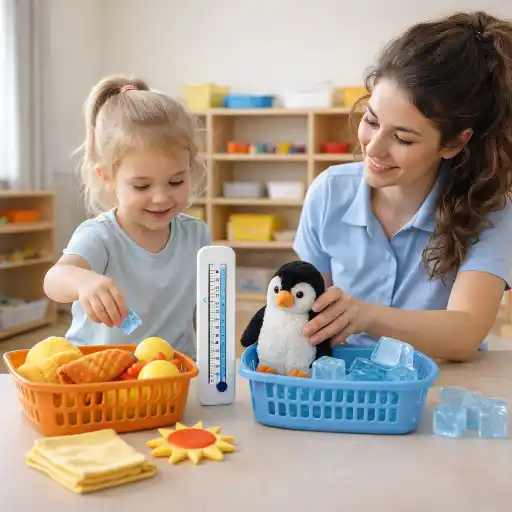
How can temperature sorting connect to classroom routines?
Children generalize learning when the same concepts appear during meaningful moments. At lunch, explain that adults check food before serving and that children wait when something is too warm. At the sink, model that water should be comfortably warm rather than hot. Outdoors, invite children to notice shade, sunlight, ice, wet clothing, and surfaces that may have changed temperature.
Role-play is especially effective because it allows children to rehearse responses without encountering real danger. Show a card depicting hot soup and invite children to practice saying, “Stop, don’t touch, ask an adult.” A teacher can model checking the item and explain that children do not need to prove temperature with their hands.
- At mealtime: “We wait for an adult to check hot food.”
- At the sink: “We ask for help if water feels uncomfortable.”
- On the playground: “We check surfaces before climbing.”
- During science: “We watch melting without touching unsafe materials.”
- During cleanup: “We tell an adult about steam, spills, or unusual smells.”
Environmental controls remain essential: keep hot foods and drinks out of children’s reach, turn pot handles inward, supervise water play closely, and inspect outdoor equipment. A consistent staff script supports safer, calmer responses across the program.
What mistakes should educators avoid, and how can learning be extended?
A common mistake is teaching “hot is bad and cold is good.” Cold water, ice, and winter temperatures can also cause discomfort or injury. A more accurate message is that temperature affects our bodies and that adults help determine what is safe. Another mistake is using real hot objects to make the lesson feel more authentic. Pictures, teacher modeling, and safe materials are sufficient.
- Mistake: Asking children to touch an unknown object. Better: Teach “look, pause, ask.”
- Mistake: Using fear-based burn stories. Better: Practice predictable, empowering responses.
- Mistake: Treating sorting as a one-time worksheet. Better: Revisit the concept during meals, water play, outdoor checks, and science centers.
- Mistake: Ignoring accessibility. Better: Adapt visuals, tools, language, and participation.
Assessment can remain informal. Observe whether children use temperature words, classify familiar examples, explain their thinking, and select an appropriate response. Record a brief quote such as, “I won’t touch the soup; I will ask you.” This documents vocabulary, reasoning, and safety understanding.
Extend the activity across learning domains:
For programs serving younger children as well, Full STEAM Ahead! explores engaging STEAM activities for infants and toddlers.
- Science: observe ice melting from a safe distance and discuss change.
- Math: count cards, compare categories, and create a simple graph.
- Language: dictate captions for a class safety book.
- Social-emotional learning: practice waiting, asking for help, and respecting boundaries.
- Family partnership: share the phrase “hot means stop and ask” for consistent home-school language.
For additional professional learning, Active Supervision: A Strategy That Works Buy Now $35.00 focuses on watching, listening, interacting, monitoring, and preventing problems before they escalate. Providers seeking practical inclusive adaptations may also explore Inclusive Lessons for Preschoolers  Buy Now $16.00, while Injury Prevention: Their Safety Is In Your Hands Buy Now $24.00 offers focused learning about preventing unintentional injuries.
Conclusion: How can sorting teach temperature safely?
Preschool temperature sorting is most effective when it combines concrete classification with vocabulary, open-ended questions, role-play, and environmental prevention. Children do not need to touch hot or frozen materials to understand temperature. They need repeated opportunities to observe, describe, pause, and seek adult help.
Start with safe visuals, use the consistent cue “Hot means stop; cold means check; unknown means ask,” and revisit the idea during meals, water routines, outdoor play, and science investigations. Document children’s language and decisions, adapt participation for diverse learners, and keep supervision at the center of every experience. In this way, a simple sorting mat becomes a meaningful foundation for science learning and safer everyday choices.
- Using AI Language Models for Trainers
- From Tantrums to Triumphs: Equipping Preschoolers with Self-Regulation Skills
- Teach with Respect!
- CDA Bridge Bundle: Family Child Care without Portfolio Review
- CDA Bridge Bundle: Infant/Toddler without Portfolio Review
- CDA Bridge Bundle: Preschool without Portfolio Review
- Staff Supervision, Observation & Feedback
- Texas Director Credential
- Building Vocabulary
- Mathematical Skill Development
- Requisitos Para Ser Maestra Principal En Un Daycare: Lo Que Necesitas Para Empezar
- Proporciones de Cuidado Infantil y Tamaños de Grupo por Edad en Nueva Jersey (Guía Rápida para Centros y Hogares)
- Cómo Celebrar el Día Nacional del Kindergarten
- Cómo Trabajar en el Cuidado Infantil en Carolina del Norte: Requisitos y Pasos
- Cómo Ser Maestra de Preescolar en Illinois
- Cómo Ser Maestra de Preescolar en Wisconsin
- Cómo Ser Maestra de Preescolar en California
- Cómo Ser Maestra de Preescolar en Maryland
- Calabazas, hojas y manzanas: actividades de otoño para preescolares
- Celebrando la amistad en el cuidado infantil durante el Día de los Mejores Amigos
- Canciones, juegos y preguntas de círculo para niños
- How can superhero-themed winter science activities energize your classroom?
- STEM for Preschoolers: Fun Activities That Encourage Curiosity
- How Can Cut, Sort, and Glue Activities Strengthen Early Learners’ Development?
- How Can Preschool Math Become Meaningful, Playful, and Part of Every Day?
- How Can Day vs. Night Sorting Help Children Understand Time and Routine?
- What Can Hot vs. Cold Sorting Teach Preschoolers About Safety?
- How Can Preschool Sorting Activities Teach Temperature Concepts Safely?
- How Can Child Care Providers Help Children Explore Weather Indoors and Outdoors?
