Every morning, the sky offers a fresh science question: What has changed, and what might happen next? A simple routine of noticing, comparing, and recording helps preschoolers build scientific language and reasoning from experiences they already know. To strengthen outdoor learning design, explore ChildCareEd’s CDA: Creating the Outdoor Classroom  Buy Now $16.00; it offers practical guidance for planning natural spaces where children can discover and learn.
Why can everyday weather become meaningful science?
Weather is immediate, observable, and relevant to children’s decisions. Preschoolers feel a breeze, see a puddle, notice a bright sky, and connect conditions with clothing or play. These familiar experiences provide a sturdy starting point for scientific inquiry—not because children need formal meteorology lessons, but because they can learn to attend to evidence and share what they think.
With a supportive adult, a child’s comment—“The wind is moving the leaves”—can lead to a richer investigation. What else moves? Does a ribbon move the same way? Is the wind stronger now than earlier? The teacher’s role is to listen, invite closer observation, and help children revisit their ideas rather than supply every answer.
This approach aligns with preschool science goals such as observing and describing phenomena, comparing what is noticed, asking questions, making predictions, and communicating findings. Weather inquiry also naturally supports vocabulary, early mathematics, drawing, conversation, and collaboration. In other words, one short daily routine can touch several areas of learning while honoring children’s curiosity.
Most importantly, children see that their observations matter. A classroom chart is not simply a decoration or a daily chore; it is a record of ideas that the group can inspect, compare, and discuss. Those small moments are how a shared #investigation begins.
How can teachers establish a daily weather-observation routine?
Keep the routine short, consistent, and genuinely observational. Choose a regular time—such as morning meeting—and invite children to look outside from a safe, supervised place. When conditions are suitable, step outdoors briefly so children can notice how the air feels, listen for weather-related sounds, and look at the sky and nearby surroundings.
Begin with open prompts: “What do you notice?” “What do you hear?” “How does the air feel?” Accept different answers and give children time to look again. Add precise but accessible words—breezy, cloudy, drizzle, warm, chilly—while building on the children’s own descriptions. A picture chart can make the routine accessible to children who are still developing spoken language or are learning more than one language.
- Invite children to describe the sky, wind, and how the air feels, rather than asking only, “What is the weather?”
- Rotate classroom roles such as weather reporter, picture-card chooser, or chart helper.
- Use symbols, drawings, gestures, or dictated words so children can record ideas in different ways.
- Revisit the chart later in the day when a visible change gives the group a reason to compare.
Useful prompts include “What seems different from yesterday?” and “What do you think we might see after snack?” Avoid treating one weather type as the “right” or preferred answer: sunshine, rain, wind, and cloud cover all offer learning opportunities. A predictable routine supports language and #observation while keeping the experience playful rather than test-like.
How can children compare observations and notice patterns?
Comparison turns separate weather reports into an investigation across time. Start with two observations children can remember: this morning and yesterday, or before lunch and after lunch. Ask what stayed the same and what changed. Young children may d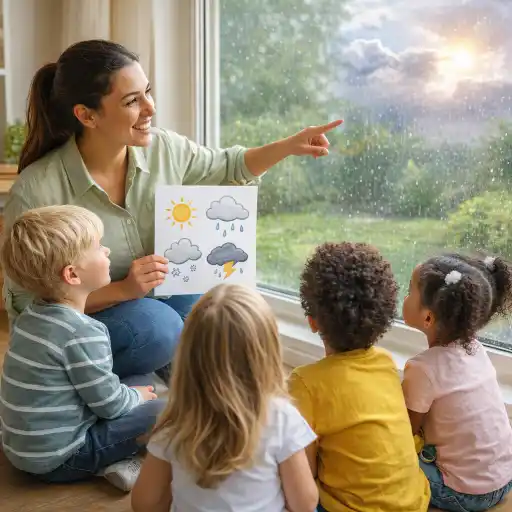 escribe differences qualitatively—“today feels colder,” “the clouds moved,” or “there were more puddles”—and those descriptions are meaningful evidence.
After several days, look together at the class chart. Count sunny or rainy days, notice repeated conditions, and use simple comparisons such as more, fewer, warmer, or cooler. The goal is not to teach complex forecasting; it is to help children use a record to support a thought. If the chart shows clouds on several days, ask, “What do you notice?” rather than telling them what the pattern means.
Keep the comparison manageable and connected to what children can directly see. A short weekly chart is often enough to prompt discussion. If interest continues, extend the record over additional weeks or compare two times of day. Educators can also pair weather observations with classroom experiences: Did the shaded area feel different from the sunny area? Did the wind move the ribbon more today than yesterday?
Introduce words like pattern, compare, and predict in context. For example: “We saw rain on two days. Let’s count the marks. What might we look for tomorrow?” The Next Generation Science Standards describe using local weather observations to describe patterns over time, while preschool guidance emphasizes comparison, questions, and communication. These experiences lay groundwork for early #STEM reasoning without demanding abstract explanations beyond children’s developmental stage.
What age-appropriate recording activities make children’s thinking visible?
Recording should help children remember and communicate—not become a handwriting assignment. Provide accessible formats and let the child’s idea lead the mark-making. A child might select a weather symbol, draw a sky, dictate a sentence, point to a picture, or help an adult add a tally. Teachers can write down children’s exact words beside their drawings to preserve their thinking.
Try a shared class chart with a row for each day and a small set of picture symbols. As children become familiar with it, add a simple tally or picture graph and count the categories together. A personal weather journal can offer more room for drawing and child-led detail. For younger preschoolers, compare two days at a time and use photos or symbols; children who are ready may maintain individual charts or make predictions for the next day.
ChildCareEd’s Think Like a Scientist: Observation & Experiment Recording Sheet is a resource teachers can use to support children in representing what they notice and what happens during an investigation. Adapt how children use a recording page to their abilities: drawing, marks, picture choices, or adult dictation can all document meaningful ideas.
- 📝 Model a quick record yourself: “I see gray clouds, so I’m drawing gray above our chart.”
- Use a small word bank with familiar terms such as sunny, cloudy, windy, and rainy.
- Invite children to revisit yesterday’s entry and describe whether today is similar or different.
- Display photos and children’s comments together so families can see the learning process.
Keep records brief and descriptive. Documentation is most useful when it captures children’s thinking, not just the weather category. A drawing and a few dictated words can show how a child’s ideas develop over time.
How can teachers extend weather curiosity while keeping children safe and included?
Let the observations guide the next experience. If children notice wind, compare how a ribbon, leaf, or pinwheel moves. If they see rainwater collecting, observe a rain gauge placed and secured by an adult. If they are curious about sunshine and shade, compare how two surfaces feel, using safe, simple language such as warmer and cooler. Tools should help children explore a question—not replace looking and wondering.
Weather investigations can happen indoors as well. Children might compare photos of the sky, move scarves to represent wind, sort weather symbols, or draw what they remember seeing. These alternatives preserve continuity when outdoor conditions are unsuitable and create varied ways to participate.
Plan for individual needs. Some children may prefer to observe from a sheltered spot; others may communicate through pointing, movement, drawing, a home language, or a partner. Offer appropriate clothing and equipment, provide choices within clear boundaries, and supervise actively. Follow your program’s weather and outdoor-play procedures, including relevant temperature, lightning, and air-quality guidance. State requirements vary - check your state licensing agency.
Common pitfalls are easy to avoid with intentional planning:
- Do not turn the chart into a quiz; welcome children’s descriptions and revisit them with evidence.
- Do not over-explain; ask one open question, listen, and allow thinking time.
- Do not require every child to write; drawing, gestures, symbols, and dictation count as recording.
- Do not let a chart substitute for current safety checks or active supervision.
For educators who want to develop outdoor learning environments more intentionally, ChildCareEd’s CDA: Creating the Outdoor Classroom Buy Now $16.00 explores planning and implementing natural outdoor spaces that invite children to explore and learn. It can be a useful next step as you connect daily weather routines with a thoughtfully designed #classroom environment.
Conclusion: How do daily weather observations become a preschool investigation?
Daily weather becomes an investigation when teachers help children notice, describe, compare, record, and revisit what they see. A brief observation routine gives children repeated practice with language and evidence; a simple chart or drawing makes their thinking visible; and open questions invite predictions and new questions. There is no need for elaborate equipment—the sky, a few symbols, and attentive conversation can provide a meaningful beginning.
Keep the experience flexible and developmentally appropriate. Let children record through drawings, symbols, marks, talk, or adult dictation, and adapt participation to each child’s interests and needs. Use outdoor and indoor options thoughtfully, with safety and supervision guiding decisions. When educators treat children’s ideas as worthy of further attention, ordinary weather becomes a shared opportunity for discovery and early #curiosity-driven learning.
For a ready-to-use way to capture children’s thinking, explore Think Like a Scientist: Observation & Experiment Recording Sheet. To deepen your planning for natural outdoor learning, consider the relevant ChildCareEd course, CDA: Creating the Outdoor Classroom Buy Now $16.00.
Helpful ChildCareEd courses
- Moving About the Classroom: Effective Transitions for Everyday
- Lesson Planning for Preschoolers
- Building Equity: Inclusionary Practices in Preschool
- CDA Bridge Bundle: Preschool
- CDA Bridge Bundle: Family Child Care without Portfolio Review
- Art from the Heart for Preschoolers: Open Ended Art Projects that Build Self-Esteem
- CDA Bridge Bundle: Infant/Toddler without Portfolio Review
- CDA Bridge Bundle: Preschool without Portfolio Review
- Texas Director Credential
- Anxiety: Signs & Strategies
- 🎉STEM-sational Fun: How Can You Spark Preschoolers’ Curiosity with Engaging STEM Activities? 🔬🧪🔢
- Celebrando la amistad en el cuidado infantil durante el Día de los Mejores Amigos
- Canciones, juegos y preguntas de círculo para niños
- How can I bring a Forest Preschool (nature-based learning) to my program?
- Preschool Schedule That Works: When to Plan Centers, Circle Time, and Outdoor Play
- What’s Happening Outside? Fall Science Adventures for Preschoolers
- Fall Detectives: 10 Questions Pre-K Kids Can Investigate This Season
- How Can Bingo Games Make Learning Feel Like Play?
- What Should a 2-Year-Old Be Learning at Daycare?
- How Much Outdoor Play Do Preschoolers Need Each Day?
- How Can Child Care Programs Balance Indoor and Outdoor Learning Across the Week?
- How Can Child Care Providers Help Children Explore Weather Indoors and Outdoors?
- Where Did the Puddle Go? How Can Children Follow One Puddle Over Time?
- What Can Children Investigate in a Garden Bed That Has Not Been Planted?
- How Can One Plant Help Children Notice Gradual Change Outdoors?
- Why Does the Wind Feel Different on Opposite Sides of the Playground?
- What Made This Track? How Can Providers Separate Outdoor Observations from Guesses?
- When Rain Erases the Chalk, How Can Disappearing Art Become a Science Investigation?
- How Can Teachers Turn Daily Weather Observations into a Preschool Investigation?
- How Can Daily Weather Observations Become a Preschool Investigation?
