Two-year-olds learn through relationships, routines, movement, language, and hands-on exploration—not worksheets or formal lessons. To strengthen your understanding of age-appropriate goals, explore Baby Steps to Milestones ONLINE  Buy Now $24.00, which can help you connect developmental knowledge to daily classroom planning and earn professional training hours. For a broader infant-toddler curriculum foundation, consider 45-Hour Infant and Toddler Curriculum Buy Now
 $399.00$275.00, while confirming whether the course fits your state and program requirements.
When families ask what their two-year-old is learning at daycare, they are often asking whether care is purposeful, nurturing, and developmentally appropriate. The answer is yes—but learning at this age looks like experimenting with a cup, naming a picture, comforting a friend, climbing safely, or practicing “my turn.” The goal is not to make every child perform on command. It is to create responsive experiences that invite participation, repetition, communication, and growing independence.
What developmental areas should daycare support at age two?
A strong toddler program supports the whole child across interconnected domains. The CDC describes milestones as skills that most children—about 75% or more—can do by a certain age, not as rigid deadlines. By age two, many children notice when someone is hurt, look to adults for cues, combine at least two words, point to requested pictures or body parts, manipulate switches and containers, play with multiple toys, run, kick a ball, climb stairs with help, and eat with a spoon. These examples provide a useful planning framework, while individual variation remains expected.
In practice, directors and teachers can organize goals into five broad areas:
- Language and communication: understanding directions, using gestures, learning vocabulary, and combining words.
- Cognitive development: exploring cause and effect, solving simple problems, matching, sorting, and beginning pretend play.
- Physical development: running, climbing, kicking, carrying, scooping, scribbling, and using utensils.
- Social-emotional development: expressing feelings, seeking comfort, noticing others, and practicing turn-taking.
- Self-help and independence: washing hands with support, helping clean up, making simple choices, and participating in routines.
ChildCareEd’s milestones guide for two-year-olds similarly emphasizes social-emotional, language, cognitive, movement, and self-help observations. These domains should be woven into play and caregiving rather than taught as isolated subjects.
How do everyday routines become meaningful learning experiences?
For toddlers, routines are curriculum. Arrival, meals, diapering or toileting, handwashing, transitions, outdoor play, and rest offer repeated opportunities to build trust and competence. A teacher might narrate, “You found your shoe. The blue shoe goes on your foot,” then pause for the child to attempt the next step. This brief interaction supports vocabulary, sequencing, memory, and independence without turning the routine into a test.
Predictable routines also reduce cognitive load. When children know what happens next, they have more capacity to communicate, explore, and regulate emotions. Use a picture schedule, give transition warnings, and keep directions short. Offer two meaningful choices—“Do you want the red cup or blue cup?”—rather than overwhelming children with many options.
Intentional routine-based learning may include:
- Counting napkins or naming foods during meals.
- Matching shoes, cups, or clothing items during care routines.
- Using songs to practice body-part vocabulary and transition expectations.
- Inviting children to carry safe materials, put toys in baskets, or wipe a small surface.
- Reading one or two books before rest and pausing for pointing, gestures, or words.
These experiences honor the child as an active participant. They also help teachers notice emerging skills in authentic contexts, which is more informative than asking every child to demonstrate a skill on demand.
Which play experiences best support language, thinking, and motor development?
Play should be active, repetitive, open-ended, and connected to children’s interests. A two-year-old does not need an elaborate lesson to learn. A basket of large blocks can invite building, knocking down, counting, requesting help, and negotiating space. A pretend kitchen can support vocabulary, imitation, sequencing, empathy, and early symbolic thinking.
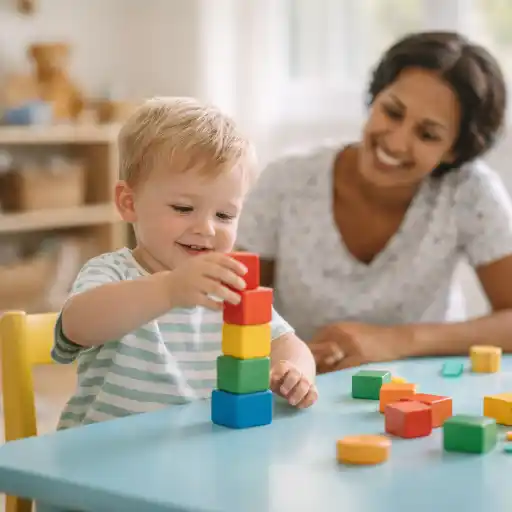
Offer a balanced selection of experiences throughout the day:
- 📚 Shared reading: Name pictures, repeat key phrases, connect the story to children’s experiences, and wait for responses.
- Movement play: Provide balls to roll, throw, and kick; tunnels to crawl through; and safe opportunities to run, climb, and balance.
- Fine-motor exploration: Use chunky crayons, play dough, large puzzles, stacking cups, scoops, and containers with lids.
- Sensory investigation: Offer supervised water, taste-safe materials when appropriate, fabric textures, or large tools for scooping and pouring.
- Pretend play: Add dolls, dishes, hats, phones, and household props so children can imitate familiar experiences.
- Music and art: Sing action songs, explore rhythm, and provide process-focused art rather than a model every child must copy.
ChildCareEd’s toddler activity guide recommends short, repeated invitations and simple classroom materials. Keep activities brief enough to match toddler attention spans, but make them available often. The adult’s role is to observe, model language, add a manageable challenge, and step back so children can try.
How can teachers build social-emotional learning and independence?
Two-year-olds are developing strong preferences and a growing sense of agency while still needing substantial co-regulation. A child who cries, grabs, or refuses may be communicating an unmet need, limited language, fatigue, or difficulty with waiting. These moments are opportunities to teach—not evidence that a child is intentionally misbehaving.
Responsive teachers connect before they coach: “You are upset. You wanted the truck.” Then they set a clear limit and offer a next step: “I won’t let you hit. You can stomp here or ask, ‘Turn please.’” Keep the language concrete and repeat it consistently. Practice emotional vocabulary during calm moments with books, puppets, songs, mirrors, and simple feeling faces.
Independence grows when adults provide enough support without taking over. Try:
- Allowing children time to attempt zippers, spoons, shoes, and cleanup.
- Breaking tasks into one or two steps and modeling the first step.
- Using positive, specific feedback: “You carried the napkins carefully.”
- Teaching turn-taking with duplicate materials when possible, then coaching short waits.
- Creating a cozy regulation space that is available for support, never punishment.
Social learning at two is often parallel play rather than cooperative play. Children may play beside one another, imitate peers, and gradually exchange materials. Teachers can protect play, narrate social actions, and support simple conflict resolution without expecting mature sharing.
How should daycare providers observe progress and respond to concerns?
Observation is not diagnosis. It is a professional practice for understanding strengths, planning responsive experiences, and communicating clearly with families. Record what happened, when, where, and under what conditions. “Said ‘more milk’ during snack after the teacher modeled the phrase” is more useful than “has good language.” Observe across several days and settings because tiredness, unfamiliar adults, home language, temperament, and classroom demands can influence performance.
A practical documentation cycle is:
- Choose one domain or skill to notice.
- Write a dated, objective example.
- Offer repeated opportunities and appropriate scaffolding.
- Review observations for patterns.
- Share strengths and questions privately with the family.
Talk with families promptly if a child loses a skill, is not meeting several expected milestones, or if your concerns persist. The CDC encourages families to share concerns with a child’s doctor and ask about developmental screening; providers can support that process without labeling or diagnosing. If screening indicates a need, families may explore early intervention services. State requirements vary - check your state licensing agency.
ChildCareEd’s Developmental Screening in Early Childhood Buy Now $16.00 course can help providers distinguish screening from assessment, document observations, and collaborate with specialists. Its practical focus is especially useful for directors building consistent observation procedures across a team.
Conclusion: What should a two-year-old be learning at daycare?
A two-year-old should be learning how to communicate, move, explore, connect, regulate with adult support, and participate in everyday routines. These goals are best achieved through warm relationships, predictable care, rich play, language-rich interactions, safe movement, and opportunities for growing independence—not academic pressure.
Use developmental milestones as a flexible reference, observe children in authentic contexts, document strengths and concerns objectively, and partner respectfully with families. When a concern persists or skills are lost, encourage timely screening and professional follow-up. For additional professional development, providers may also explore Milestones: By Leaps & Bounds Buy Now $35.00, Playful Spaces for Infants & Toddlers Buy Now $24.00, and Positive Attention: Interactions & Supervision of Infants & Toddlers Buy Now $35.00. Together, these resources can help teams turn ordinary daycare moments into purposeful, joyful learning.
- 45 Hour Child Growth and Development
- CDA Home Visitor Subject Area 3 Part 3 Birth to 5
- CDA Home Visitor Subject Area 2 Part 3 Birth to 5
- 45 Hour Preschool Methods and Materials
- Texas Director Credential
- CDA Infants/Toddlers: Brain Development and Gene Expression
- CDA Infants/Toddlers: Stages of Development
- 45 hour Growth and Development Birth-age 12 ONLINE
- CDA Home Visitor Subject Area 8 Part 1 Birth to 5
- CDA Certification en Español: Recursos y Consejos para Educadores Bilingües
- How Old Do You Have to Be to Work at a Daycare?
- 😫🧸 ¿Qué hacer cuando un bebé no quiere dormir la siesta en el aula?
- ¿Cuál es la diferencia entre un certificado CDA y la credencial CDA?
- Lista para Guardería en Casa en California: Cómo Iniciar una Guardería en el Hogar
- Daycare Jobs in Illinois: How Old Do You Have to Be?
- Daycare Jobs in Nevada: How Old Do You Have to Be?
- Daycare Jobs in Georgia: How Old Do You Have to Be?
- Daycare Jobs in California: How Old Do You Have to Be?
- Daycare Jobs in Wisconsin: How Old Do You Have to Be?
- Daycare Jobs in Virginia: How Old Do You Have to Be?
- Daycare Jobs in Maryland: How Old Do You Have to Be?
- Daycare Jobs in North Carolina: How Old Do You Have to Be?
- Celebrando la amistad en el cuidado infantil durante el Día de los Mejores Amigos
- How Many Kids Can You Watch in Maryland Without a License?
- Nevada Child Care Ratios and Group Sizes by Age: Home Daycare Guide
- Washington Child Care Ratios and Group Sizes by Age: Home Daycare Guide
- How Old Do You Have to Be to Start Working in Daycare?
- Do Texas Child Care Applicants Need Both Form 2985 and Form 2912?
- How Can Daycare Providers Find Grants That Are Still Open in 2026?
