An empty garden bed is not an empty learning space—it is a ready-made field site for curious children. With a few simple tools and thoughtful questions, providers can support observation, early science, and meaningful outdoor learning before planting begins. For a deeper foundation in guiding young children’s investigations, explore ChildCareEd’s Building Early Science Foundations  Buy Now $16.00; it offers practical insight into developmentally appropriate inquiry, exploration, and discovery.
Why is an unplanted garden bed worth investigating?
A bare or resting bed offers children a chance to notice what is already present before adults introduce seeds and plants. Soil, stones, roots, fallen leaves, moisture, and small organisms all provide evidence to observe and discuss. When children investigate these features, they practice slowing down, attending to detail, and sharing interpretations—habits that form an important foundation for science learning.
The inquiry is valuable even when children do not arrive at a definitive answer. A child may wonder why one patch is darker, whether a tunnel belongs to a worm, or where water goes after rain. Those questions can lead to comparisons, predictions, and revisiting observations on another day. In this way, the garden becomes a place for learning processes, not simply a place to grow food.
Garden investigations also connect naturally with other areas of development. Children can count stones, compare sizes, describe textures, sketch what they see, negotiate tool sharing, and listen to peers’ ideas. Gardening experiences can support science, math, language, art, and cooperation, as described in Penn State Better Kid Care’s guidance on gardening with young children.
What can children discover by observing the soil?
Invite children to study the soil’s visible and tactile qualities without assuming that all soil is the same. Begin with a small area and ask open prompts: “What do you notice?” “How does this soil look different from that soil?” and “What might be mixed in?” Children can use child-safe hand lenses to inspect grains, tiny stones, fine roots, and bits of decomposing leaves.
Offer words that help children describe evidence: gritty, crumbly, damp, dry, sticky, loose, dark, or pale. If appropriate for the children and program’s hygiene practices, they can compare a small amount of soil from different parts of the bed using tools or gloved hands. Avoid inviting children to taste soil, and remind everyone to wash hands after outdoor investigation.
- Compare soil color in a sunny patch and a shaded patch.
- Look for visible roots, leaf fragments, pebbles, or other natural materials.
- Notice whether the soil is compacted, loose, dry, or moist.
- Draw or photograph one detail to revisit later.
Children’s observations can be recorded in a shared chart or journal. Their drawings and exact words provide useful documentation of what they noticed and how their ideas develop over time.
How can children investigate water, drainage, and weather?
A garden bed can help children explore what happens when water meets soil. After rain, observe where puddles form, where the surface looks damp, and whether water appears to have moved downhill. If the weather is dry, an adult can supervise a small, consistent water test: add the same modest amount of water to two comparable spots and watch what happens. Ask children to predict before testing, then describe what they see.
Keep the investigation simple and change only one feature at a time when making comparisons. For example, children might compare a compacted patch with a looser patch, or a sunny area with one that is shaded. They may notice that some water remains on top while some disappears into the soil. Introduce terms such as absorb, soak, puddle, and drain in relation to their direct observations.
Children can also look for evidence of weather and seasonal change: a dry crust after warm days, softened soil after rain, or leaves carried into the bed by wind. These observations help connect a familiar outdoor place to changing conditions. Soil activities that compare texture and water absorption are also described in Little Bins for Little Hands’ soil investigation guide.
What signs of living things might be hidden in the bed?
Even before planting, the bed may contain evidence of life. Children can look for small insects, earthworms, webs, burrows, seed husks, roots, or decaying plant material. Encourage careful looking rather than digging widely or removing organisms. A hand lens, a tray for temporarily viewing a small sample, and an adult’s close supervision can help children observe without causing unnecessary disturbance.
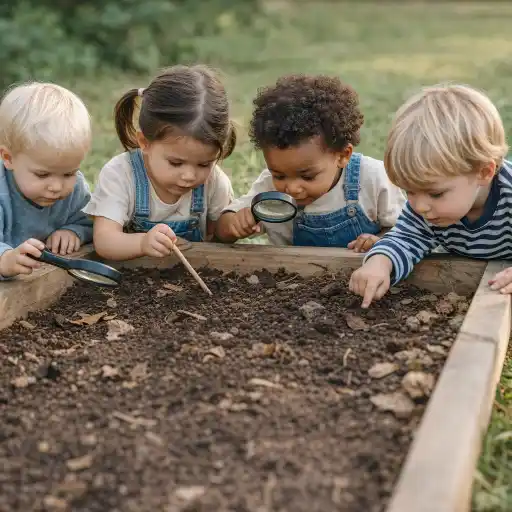
Ask questions that support curiosity and care: “Where did you find it?” “What is it doing?” “What might it need?” and “How can we return it safely?” If a child finds a living creature, observe it briefly in its habitat and leave it where it was found whenever possible. Do not promise that every organism can be identified on the spot; wondering together is part of the process.
- Look beneath loose leaves or near the edge of the bed, with an adult guiding the search.
- Notice signs such as holes, tracks, or chewed leaves without disturbing the area.
- Compare a living organism’s location with its surroundings, then leave it undisturbed.
- Use drawings, photos, or dictated notes to record what children observed.
Discuss how roots and decomposing leaves are part of the garden’s living system. Children can begin to understand that a garden bed is a habitat as well as a future planting space.
How can providers turn observations into child-led investigations?
Start with children’s own questions and help them choose one feature that they can observe safely. A broad question such as “What is in the garden?” can become “Where do we find more small stones?” or “What happens to water in this part of the bed?” Keep the invitation open-ended: the goal is not to steer children toward a predetermined answer, but to help them notice and explain evidence.
A practical sequence is to notice, wonder, predict, investigate, and reflect. Ask children to share an initial idea, offer time to explore, and then return to the question together. They may communicate through speech, home languages, gestures, drawings, or demonstrations. Small groups can make it easier for each child to handle tools and contribute.
- 🔎 Set out a hand lens, a small trowel for adult-supervised use, and a simple observation sheet.
- Record children’s predictions in their own words or with pictures.
- Take a photo or make a drawing, then revisit it after rain or a few days.
- Offer accessible choices for children with different sensory, mobility, communication, or attention needs.
Educators can strengthen their practice with ChildCareEd’s Basic Science in Early Childhood Buy Now $25.00, which focuses on intentional, meaningful science experiences, and Creating the Natural Outdoor Classroom Buy Now $16.00, which explores nature-rich outdoor learning environments.
How can providers keep exploration safe and inclusive?
Before children enter the garden, check the bed and surrounding area for sharp objects, animal waste, standing water, unknown plants, or other hazards. Use age-appropriate tools, maintain active supervision, and establish clear expectations such as “tools stay low” and “we look gently and leave living things in place.” Children should not handle unknown plants, soil amendments, fertilizers, or chemicals. Follow the program’s handwashing and outdoor safety procedures.
Consider children’s allergies, sensory preferences, and access needs. Some children may prefer a tool rather than touching soil; others may benefit from a raised viewing position, picture supports, a quieter small group, or a chance to document from nearby. Participation can take many forms, and no child needs to touch a material to be an investigator.
Choose activities that fit the children’s ages and your setting’s policies. Do not use soil samples that may be contaminated, and avoid unnecessary handling of organisms. State requirements vary - check your state licensing agency. Staff can also review ChildCareEd’s 1,2,3, Eyes on Me: Classroom Safety Buy Now $32.00$24.00 for additional strategies related to safe supervision.
Conclusion: What can children investigate before planting?
Before a single seed goes into the ground, children can investigate soil color and texture, moisture and drainage, natural materials, signs of weather, and evidence of living things. These topics offer rich opportunities to observe, compare, predict, ask questions, document, and care for the environment.
Start with one child-generated question, a small area, and a few safe tools. Listen to children’s ideas, make their observations visible through drawings or photos, and return to the bed over time. An unplanted garden bed is not a blank space; it is an invitation to explore the world beneath children’s feet.
For additional professional learning, explore ChildCareEd’s Building Early Science Foundations Buy Now $16.00, Basic Science in Early Childhood Buy Now $25.00, Creating the Natural Outdoor Classroom Buy Now $16.00, and 1,2,3, Eyes on Me: Classroom Safety Buy Now $32.00$24.00. For a focused activity resource, the Building Early Science Foundations resources may also support planning.
- CDA Home Visitor Subject Area 3 Part 3 Birth to 5
- 45 Hour Preschool Methods and Materials
- 45 Hour Infant and Toddler Methods and Materials
- 45 Hour School Age Methods and Materials
- CDA Bridge Bundle: Family Child Care without Portfolio Review
- CDA Bridge Bundle: Infant/Toddler without Portfolio Review
- Potty Training Made Simple
- Creating Environments that Nurture Growth and Community
- Texas Director Credential
- How to Build a Classroom Garden
- CDA Certification en Español: Recursos y Consejos para Educadores Bilingües
- 🤔 ¿Cómo hablo con los padres cuando un niño no está avanzando en el entrenamiento para ir al baño?
- Apoyo en Español para Capacitaciones Grupales Presenciales y por Zoom en Cursos Selectos
- ¿Cuáles son las mejores actividades del Día de la Tierra para niños en casa o en el aula?
- 10 Ejemplos de Cómo la Cultura Influye en el Desarrollo Infantil
- Regulaciones de Licenciamiento de Cuidado Infantil en California para Centros y Hogares de Cuidado Infantil Familiar
- Proporciones de Cuidado Infantil y Tamaños de Grupo por Edad en Maryland (Guía Rápida para Centros y Hogares)
- Proporciones de Cuidado Infantil y Tamaños de Grupo por Edad en Virginia (Guía Rápida para Centros y Hogares)
- Lista para Guardería en Casa en Illinois: Cómo Iniciar una Guardería en el Hogar
- Lista para Guardería en Casa en California: Cómo Iniciar una Guardería en el Hogar
- Por Qué la Supervisión Activa Es Clave para la Seguridad en el Cuidado Infantil
- Consejos de Supervisión Activa para Salones de Preescolar y el Juego al Aire Libre
- 7 Estrategias de Supervisión Activa para un Cuidado Infantil Más Seguro
- Capacitación Previa al Servicio para Proveedores de Cuidado Infantil en Dakota del Norte
- Las Mejores Ideas de Excursiones para Guarderías en Texas
- Celebrando la amistad en el cuidado infantil durante el Día de los Mejores Amigos
- Canciones, juegos y preguntas de círculo para niños
- How Can Educators Turn Indoor Insect Interest into Outdoor Investigation?
- What Can Children Investigate in a Garden Bed That Has Not Been Planted?
